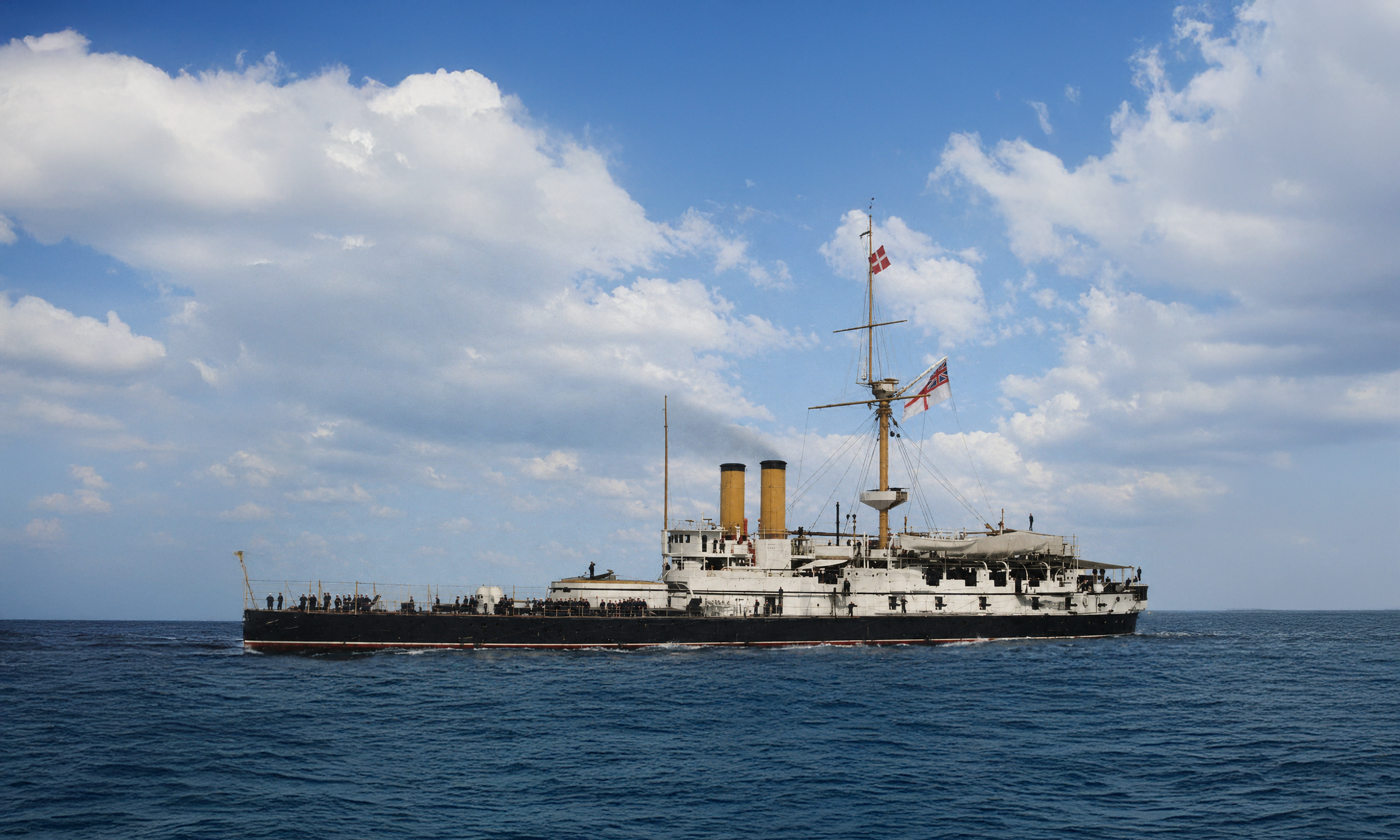
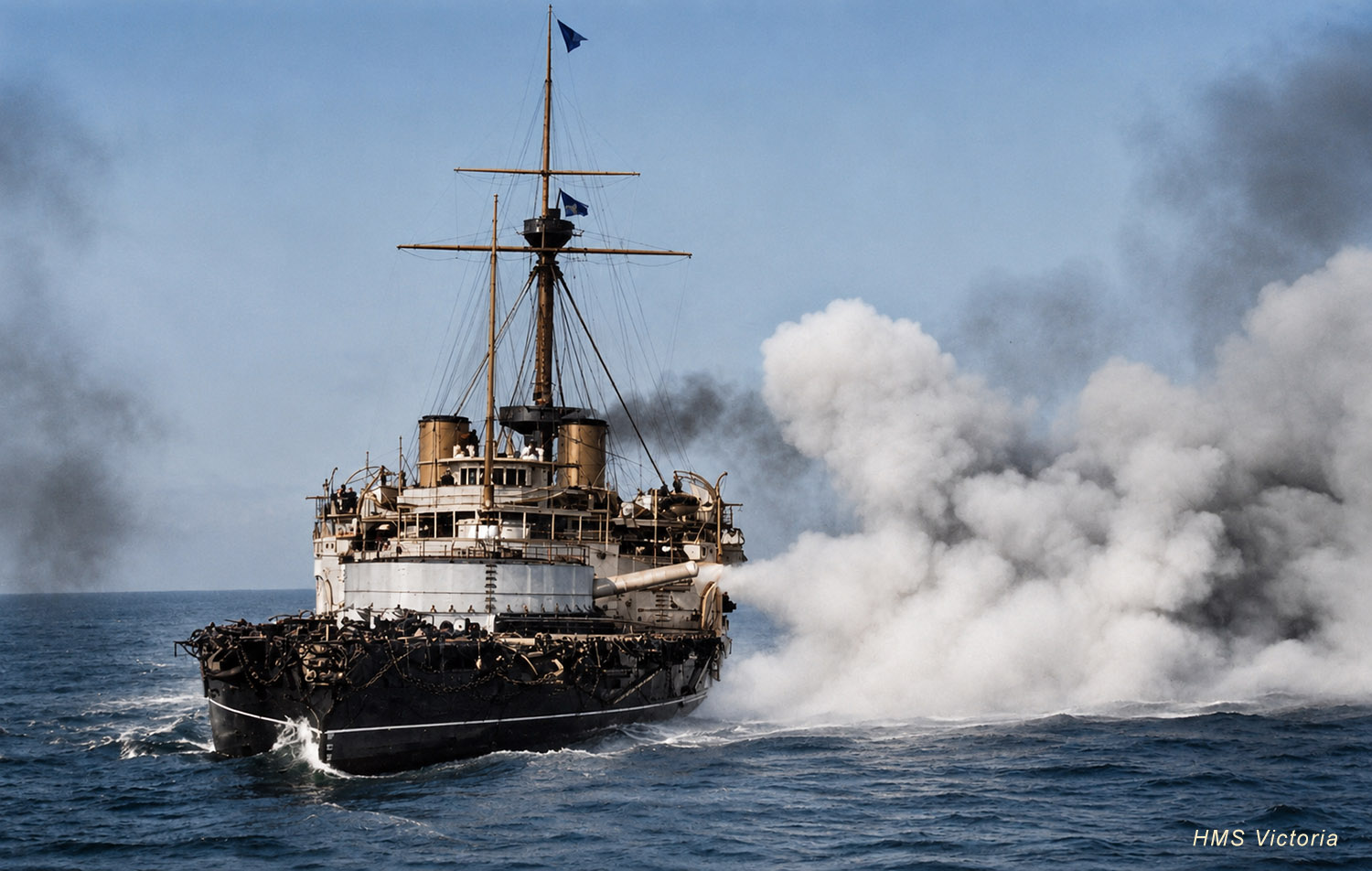
When Admiral Tryon gave the order that placed the mighty warships Victoria and Camperdown on a collision course, he made a tragic mistake—one that cost the lives of more than 350 crew members. Today, HMS Victoria is the only known shipwreck in the world resting vertically on the seabed.
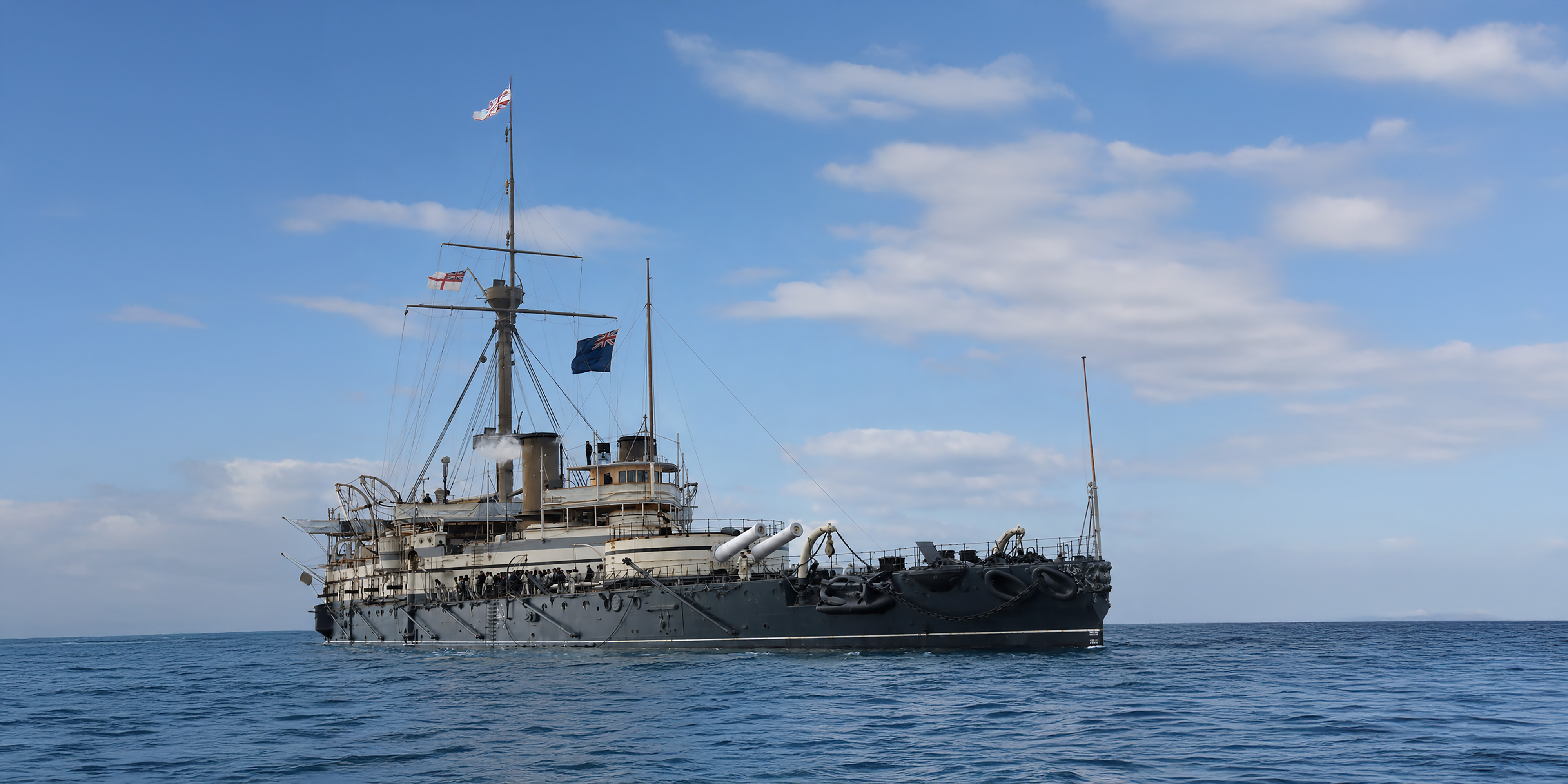
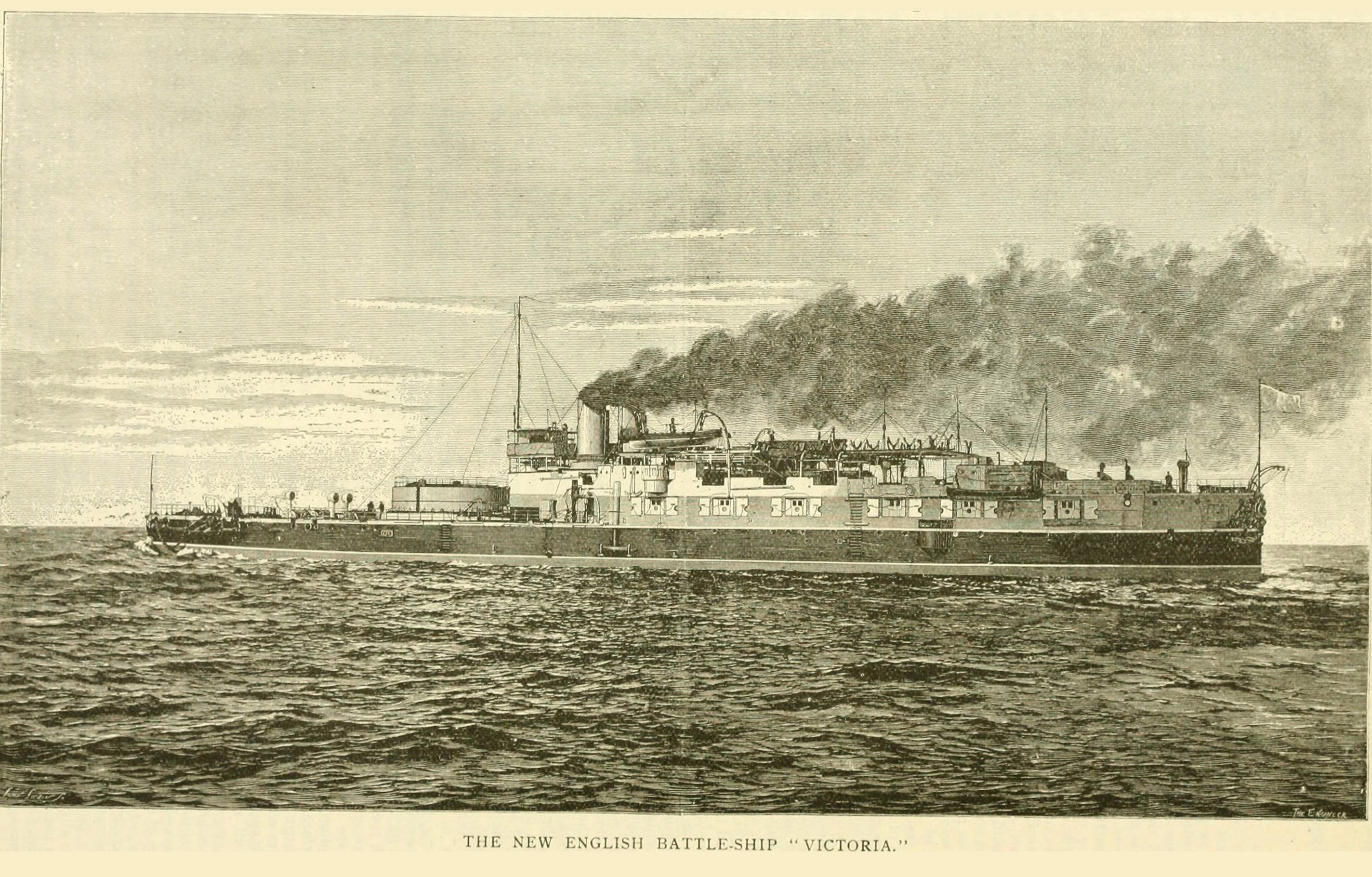
On 22 June 1893, Admiral Tryon stood on the bridge of his flagship, HMS Victoria, commanding what was then the most powerful navy in the world. With the coastline of Tripoli, Lebanon, already in view, the admiral ordered his fleet to turn around. At the time, HMS Camperdown was steaming alongside HMS Victoria at a distance of approximately 1,100 meters (3,610 feet). According to the admiral's orders, both vessels were to make an inward turn before reversing course. The commanding officer advised Admiral Tryon that the distance between the two ships was insufficient to perform the maneuver safely. The turning circle of each battleship was more than 2 kilometers (1.24 miles), making a collision almost inevitable.
In the Royal Navy, questioning the order of a superior officer was virtually unheard of. Admiral Markham, commanding Camperdown, doubted the signal that had been communicated by flags and initially hesitated to obey it. Only after Admiral Tryon impatiently signaled, "What are we waiting for?" did Markham have no choice but to comply with his superior's command. The order was given to put the helm hard over.
At a speed of 9 knots (10.4 mph / 16.7 km/h), the two battleships, each displacing approximately 10,000 tons, slowly turned toward one another. Several officers on both bridges quickly realized that a collision was unavoidable. Captain Bourke again warned Admiral Tryon that Victoria was far too close to Camperdown for the maneuver to be completed safely. The admiral, however, refused to alter his plan.
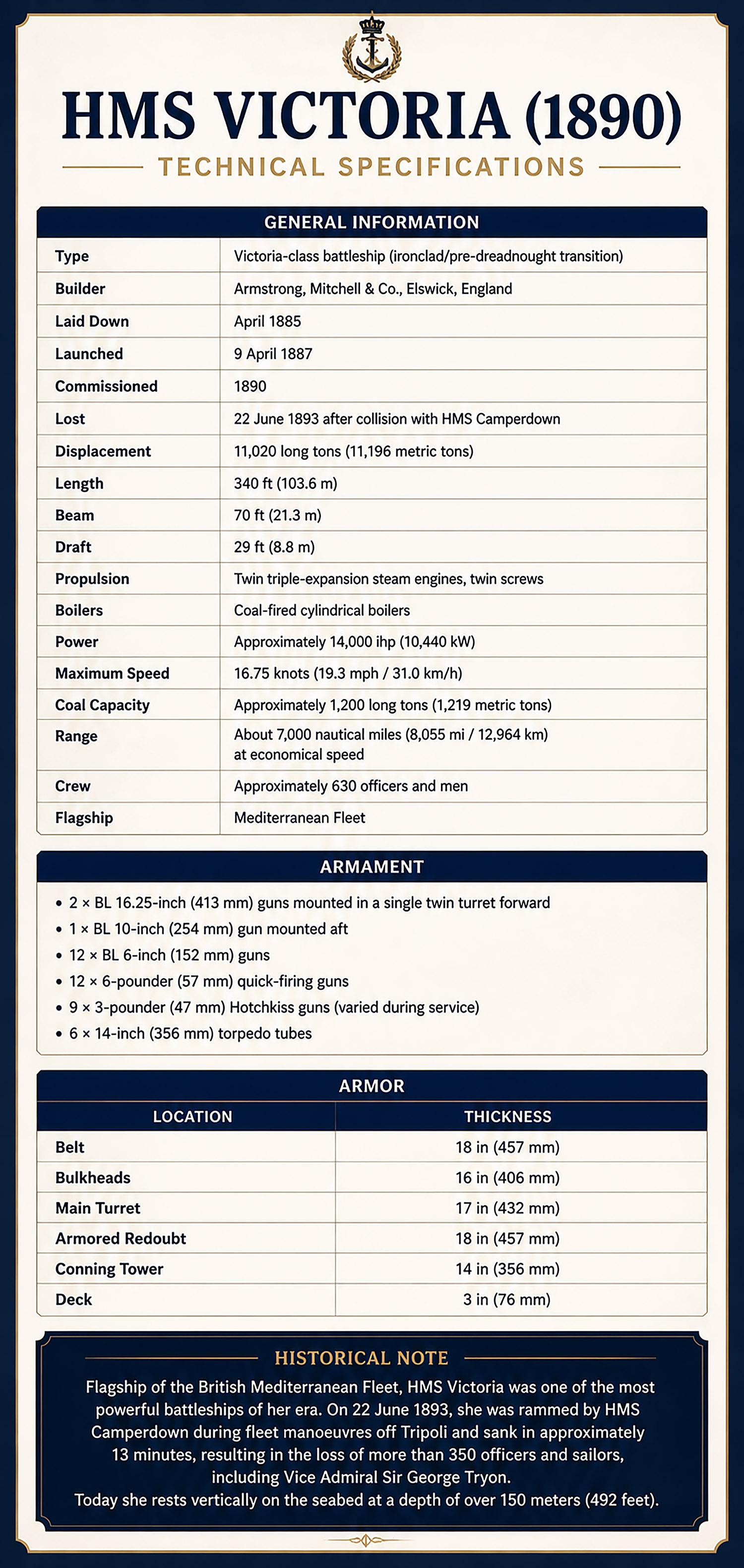
The combined closing speed of the two ships was now 18 knots (20.7 mph / 33.3 km/h), and the distance between them decreased rapidly. Bourke warned Tryon twice more that the ships were about to collide. When the admiral finally realized the danger, it was already too late. He frantically ordered both engines reversed in a last desperate attempt to avoid disaster. The helmsman immediately moved the engine-room telegraph to full astern while the engineers began reversing the propellers, powered by approximately 14,000 horsepower. Although the reversing engines slightly reduced the ships' speed, they could not prevent the inevitable.
Moments later, Camperdown came so close that the officers standing on her bridge were clearly visible. Then her reinforced steel ram struck the starboard side of Victoria near the forward coal bunkers. The ram tore deep into the hull, crushing the officers' wardroom almost instantly. The impact was devastating and reverberated throughout the ship with the force of an earthquake.
Aboard Camperdown, the order was immediately given to reverse the engines. Slowly, the battleship pulled herself free from Victoria, leaving a massive hole in the flagship's hull. Seawater poured through the opening with tremendous force, and Victoria began taking on water at an alarming rate. Open portholes, left unsecured because of the warm Mediterranean weather, allowed even more water to flood the ship as she developed an increasing bow-down list.
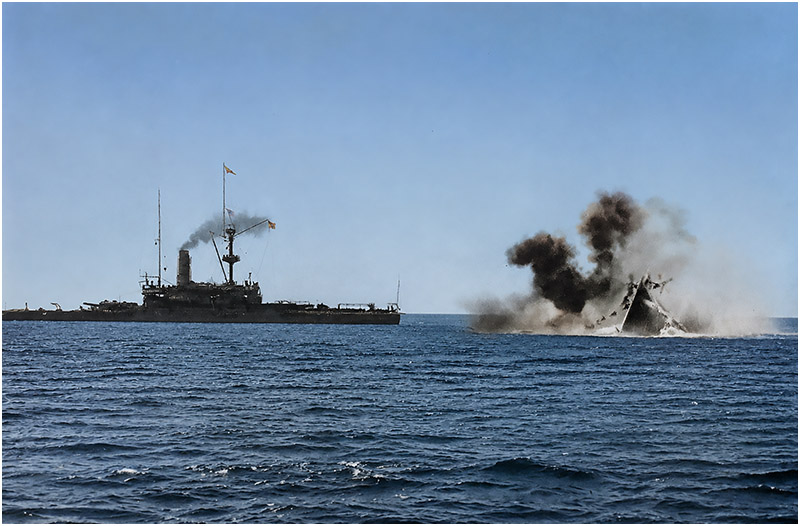
Within minutes, the bow disappeared beneath the surface while the still-turning propellers rose clear of the water. Everyone able to do so jumped overboard in an attempt to save themselves. Hundreds of crew members remained trapped inside the hull as the ship descended almost vertically into the deep blue, her propellers still turning. Those who escaped into the sea also faced the danger of being drawn beneath the sinking vessel or struck by the rotating propellers.
The crews aboard the surrounding battleships watched the tragedy unfold in stunned disbelief as they launched boats to rescue survivors. "It's all my fault," Admiral Tryon quietly told the officers around him. Those were the last words anyone heard him speak. Following the naval tradition of the day, he went down with his ship.
More than 350 officers and sailors lost their lives.
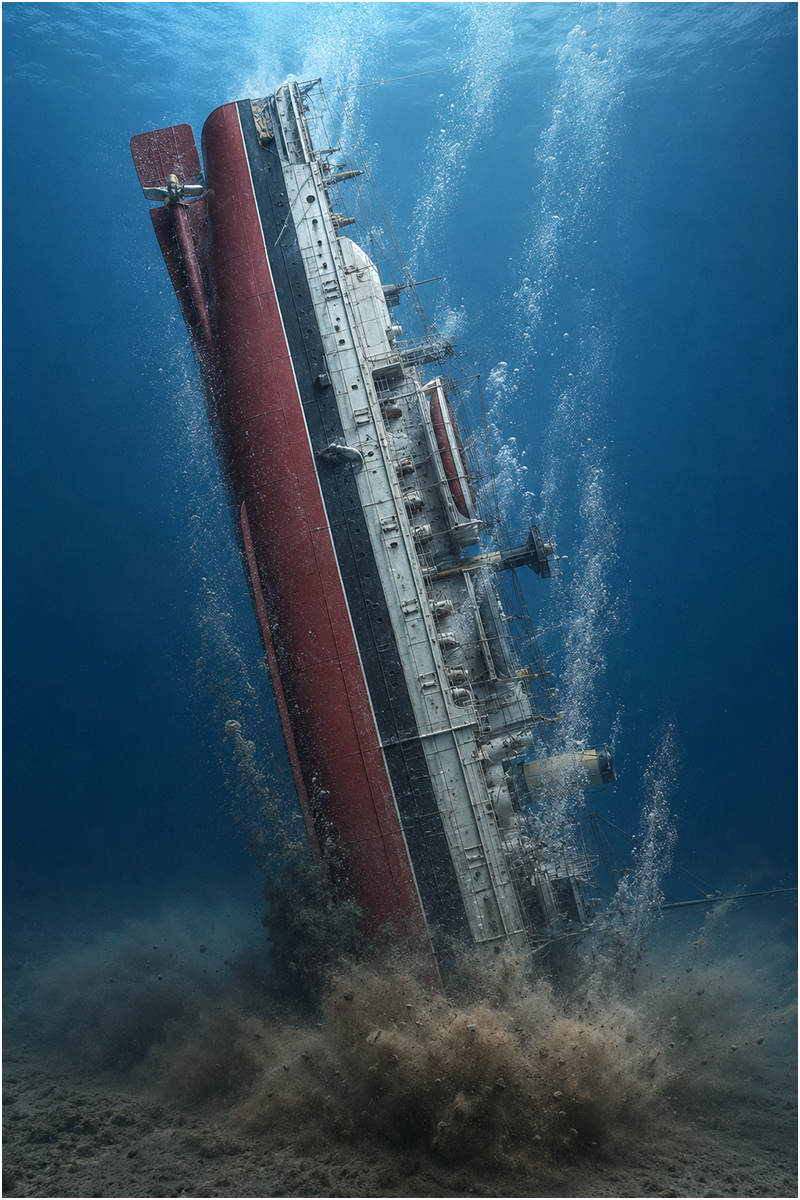
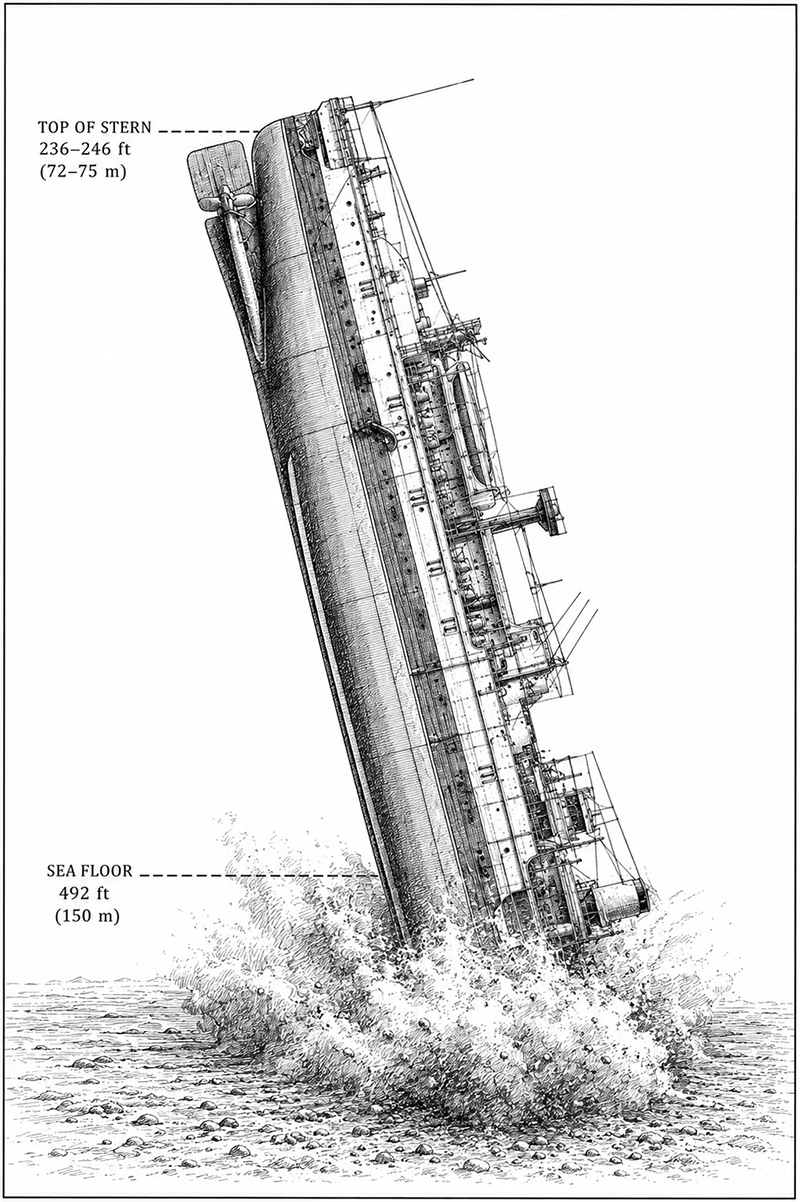
The wreck of HMS Victoria was discovered in 2004 by Christian Francis and Mark Ellyatt at a depth of more than 150 meters (492 feet). Much to their amazement, the battleship was standing almost perfectly vertical on the seabed. The tremendous weight of her massive guns, combined with the momentum of the sinking and the thrust of the still-turning propellers, had driven the bow deep into the seabed, where the wreck remains today.
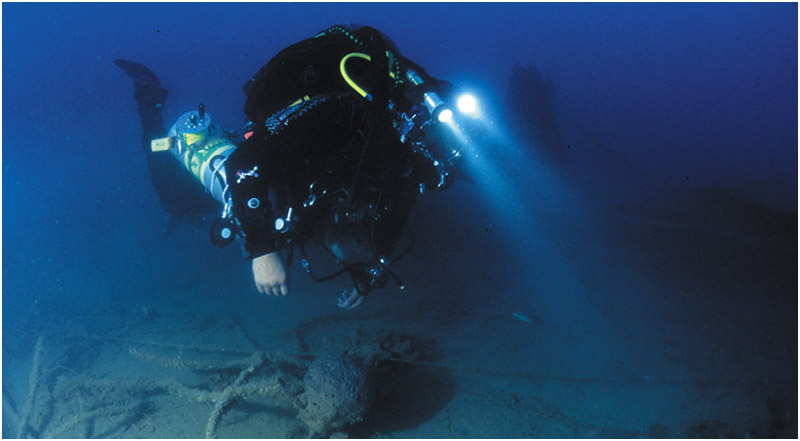
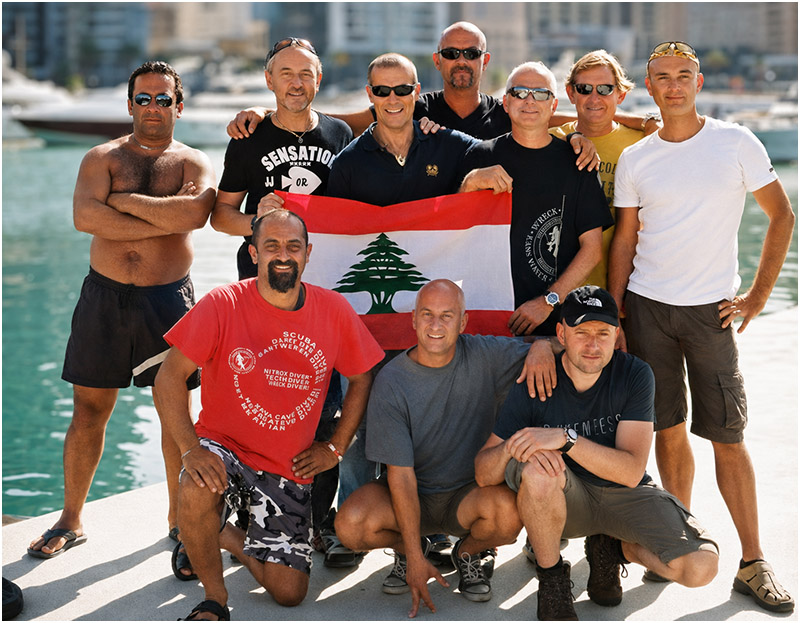
Our dive team consisted of eight closed-circuit rebreather divers. Our objective was to photograph and film the wreck at a maximum depth of 120 meters (394 feet). We operated from the well-equipped dive center of Walid Nohra in Beirut, which provided complete technical support for the expedition. Upon arrival, our first task was to reassemble our rebreathers after they had been transported in separate components. Later that same day, we completed a checkout dive to verify that all of our equipment was functioning properly.
The following day, our schedule included a dive on the wreck of the Lesbian, lying at a depth of approximately 65 meters (213 feet). Named after the Greek island of Lesbos, the ship is a magnificent Second World War wreck that has remained largely untouched since she sank. Poor weather conditions forced us to repeat the dive the following day. After our first deep wreck dive, we decided to install a decompression station to further improve diver safety. During the second dive, the station was thoroughly tested to verify its performance. Everything worked exactly as planned, and we knew we were ready for our dives on HMS Victoria.
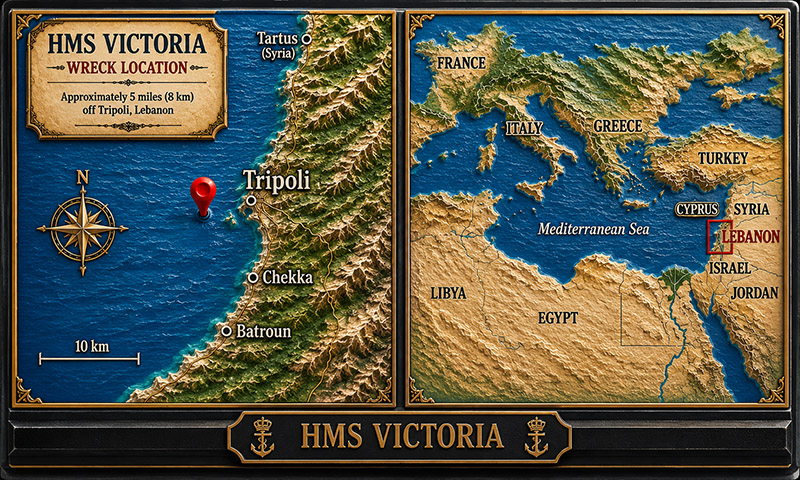
Before diving HMS Victoria, we first had to travel approximately 80 kilometers (50 miles) from Beirut to Tripoli. We made the journey by rental bus, allowing us to transport all of our dive equipment safely. Once in Tripoli, we boarded a boat for the final trip to the wreck, located approximately 5 kilometers (3.1 miles) offshore. It was still early morning when we arrived and tied into the buoy marking the wreck's exact location. Final equipment checks were completed before I entered the water with Pim de Roodes and Danny Moens as part of the second dive team.
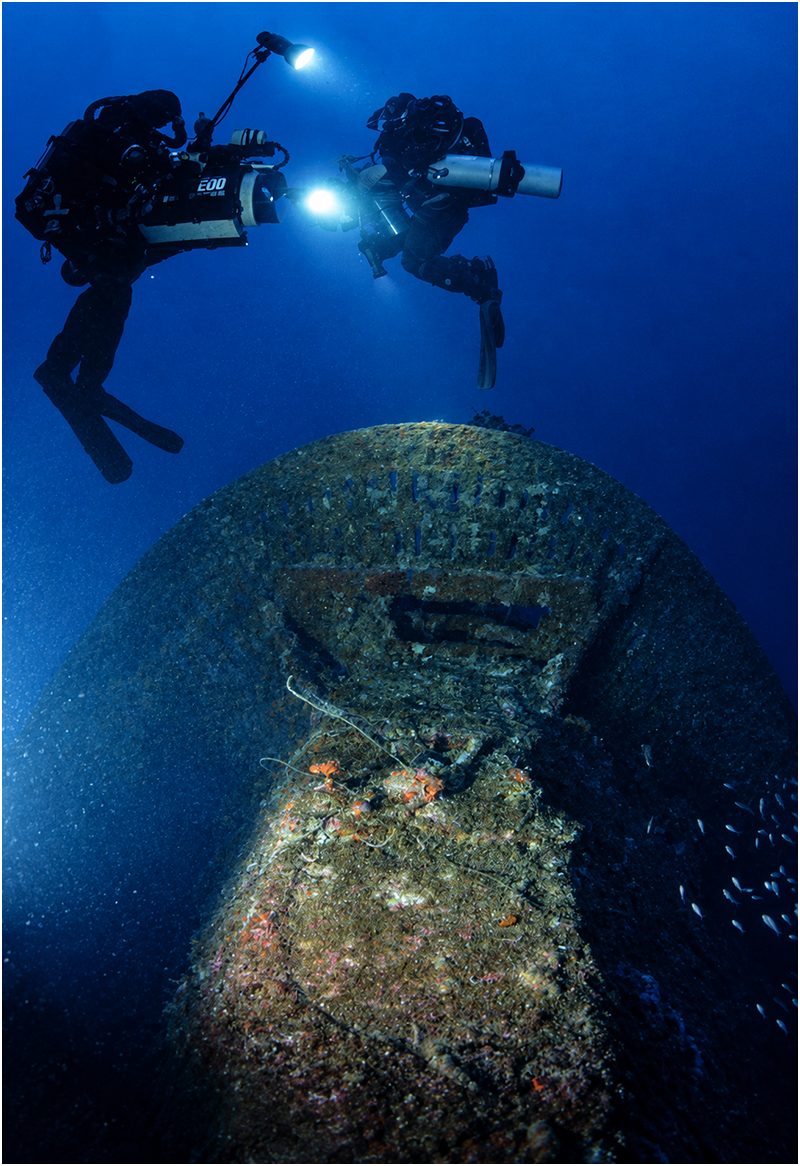
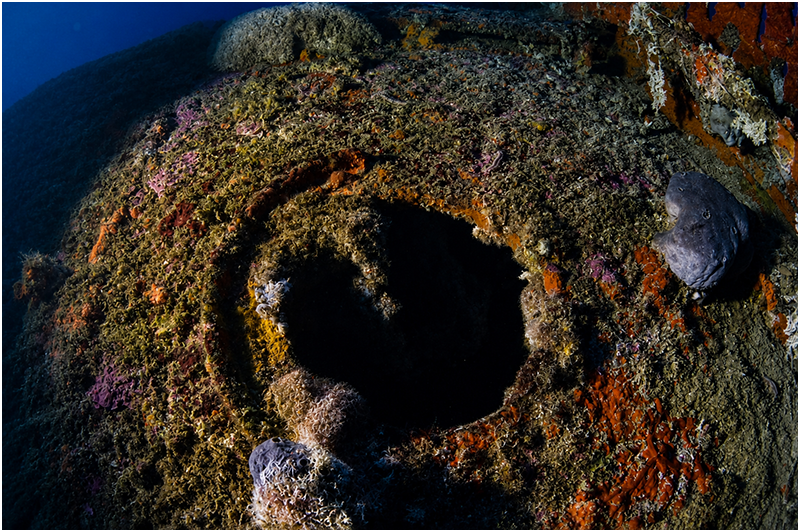
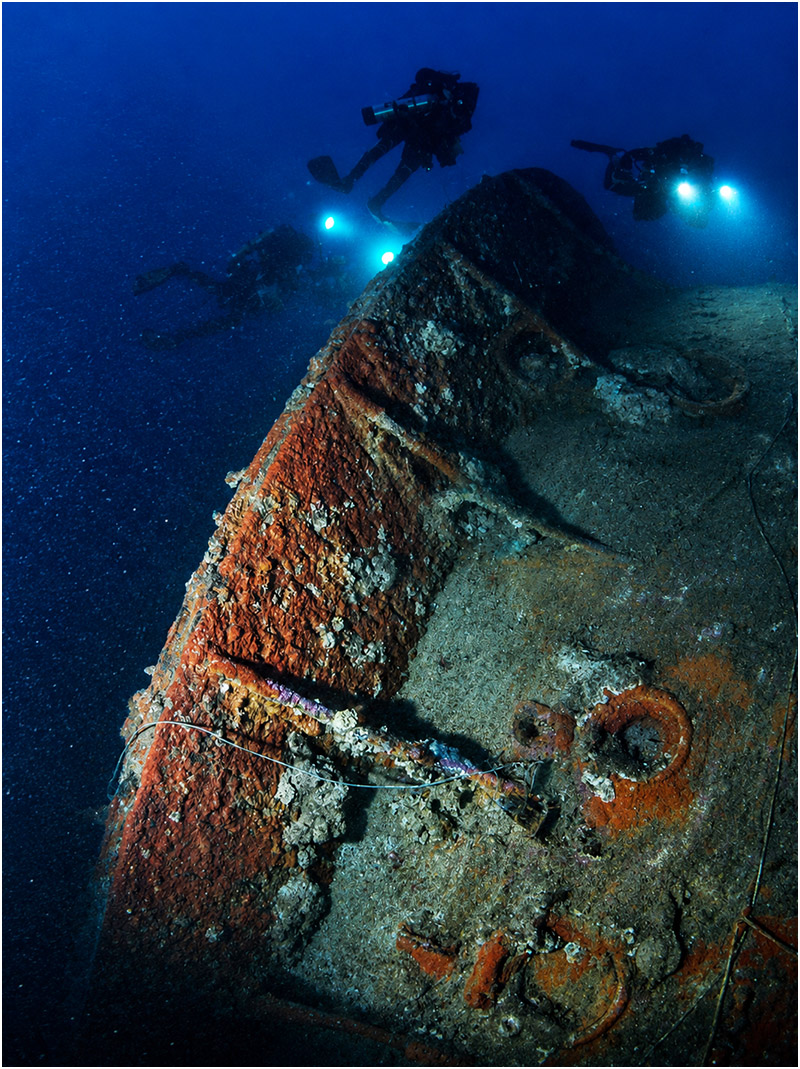
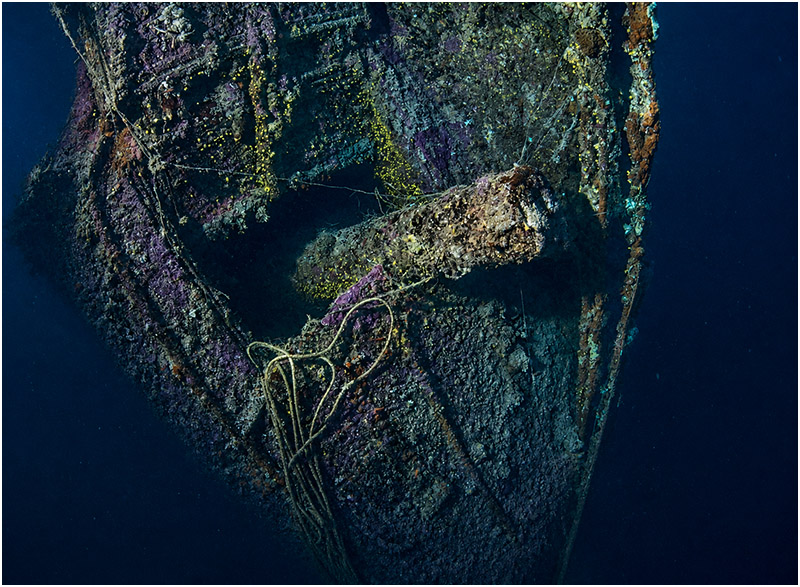
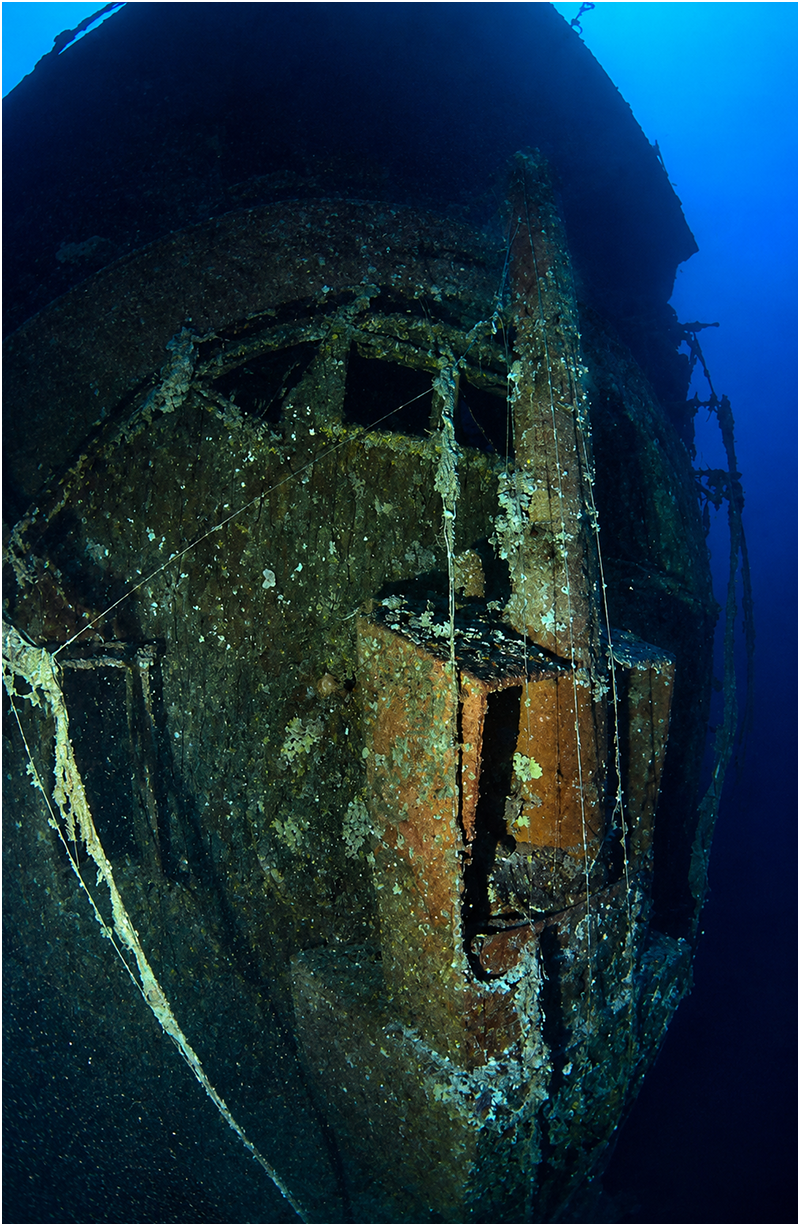
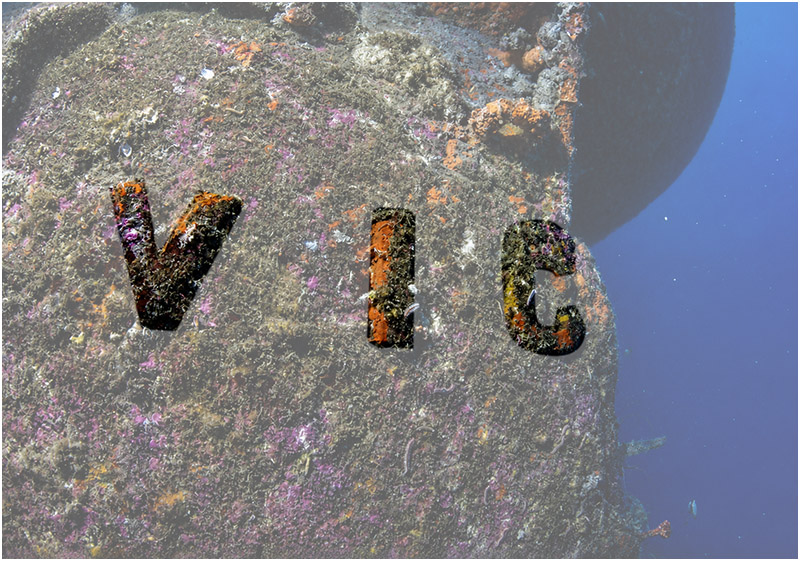
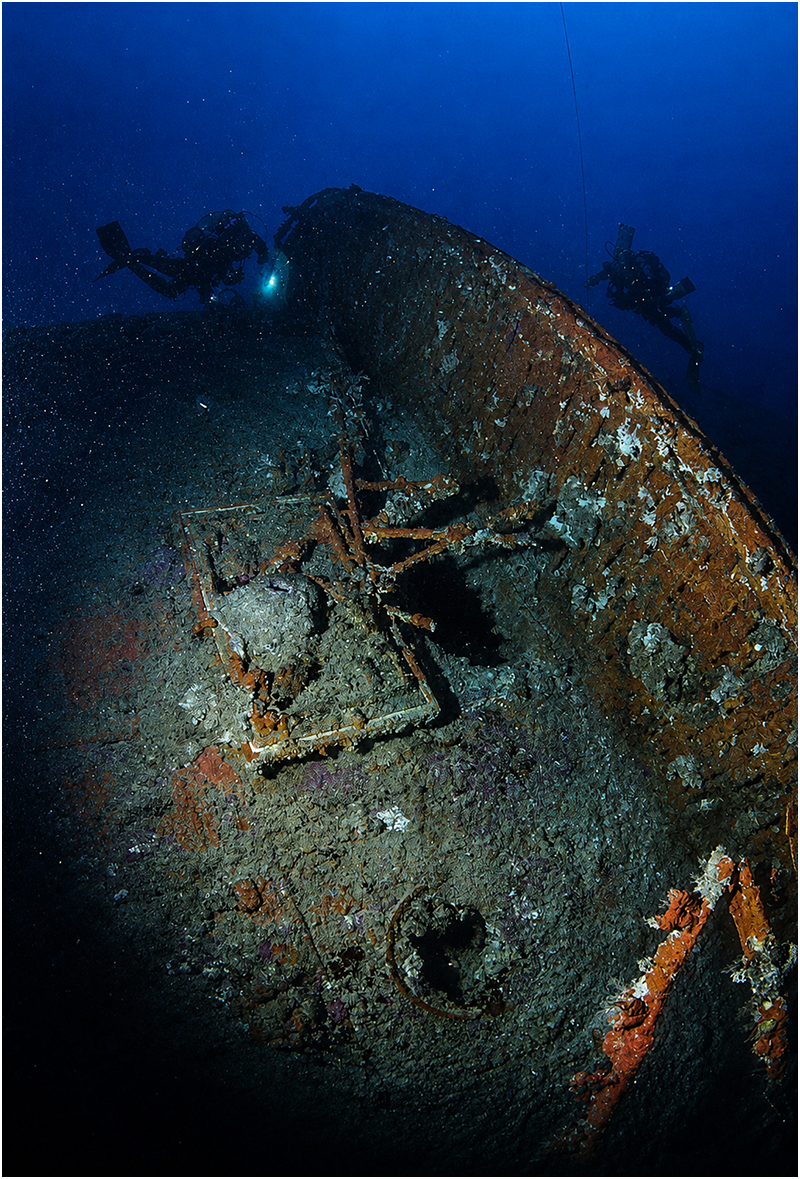
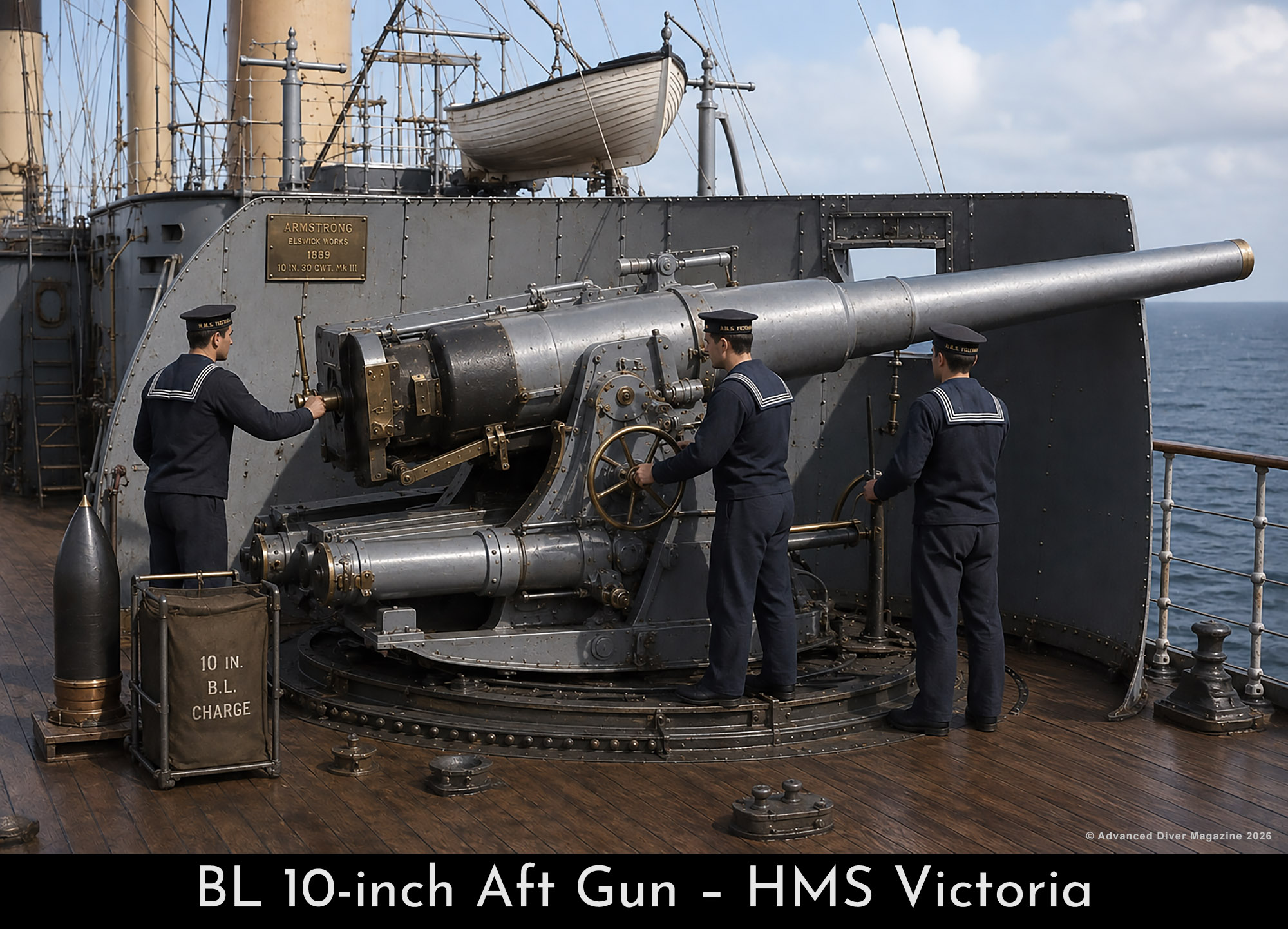
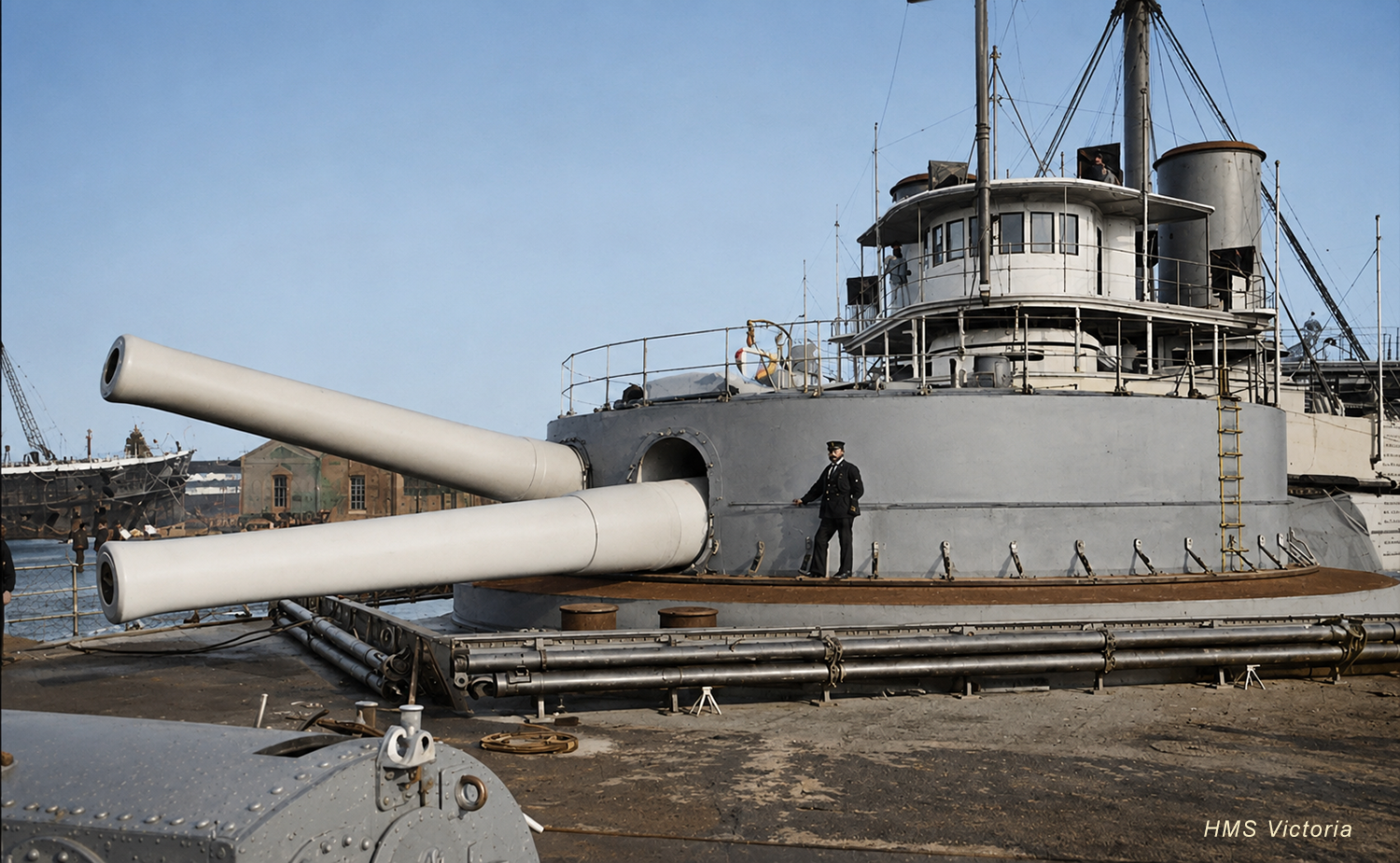
After waiting briefly at the buoy for our dive buddies, we began our descent. Emerging from the deep blue at approximately 65 meters (213 feet), the wreck slowly came into view, and we landed on the stern at 76 meters (249 feet). The two enormous propellers and massive rudder immediately captured our attention. Before descending farther, I prepared my camera because I wanted to photograph the ship's name still visible across the stern. After taking several frames, we continued downward, passing the balcony and entrance to Admiral Tryon's quarters. Reaching the quarterdeck, we came face to face with one of the ship's massive main guns, weighing approximately 9 tons (8.2 metric tonnes), its barrel pointing almost straight toward the surface. It was an incredible sensation and a true privilege to swim beside such an enormous warship standing upright on the seabed, resembling a giant underwater apartment building.
My dive computer now indicated a depth of 91 meters (299 feet). Because my camera housing was rated to only 75 meters (246 feet), I decided not to risk taking it any deeper. Instead, I concentrated on photographing the massive gun while my dive buddies continued their descent to approximately 110 meters (361 feet). Along the side of the wreck, I also noticed one of the smaller naval guns protruding through a gun port and took several additional photographs. Unfortunately, time passed quickly, and after approximately 20 minutes of bottom time we began our ascent, facing nearly three hours of staged decompression.
Back aboard the boat, the crew informed us that a car bomb had exploded only about 500 meters (1,640 feet) from where we had departed earlier that morning. Five soldiers had reportedly been killed and thirty people injured. As we traveled back to Beirut by bus later that day, we could still see the column of smoke rising in the distance—a sobering reminder that history is not confined to the wrecks resting beneath the sea.
The following day had been scheduled as a full day of rest, but two days later we were once again anchored above the wreck. Pim de Roodes and I had agreed that our first objective would be to photograph the entrance to Admiral Tryon's quarters while he recorded video with the mini-camera mounted on his Kirby Morgan full-face mask. As soon as we reached the wreck, it became obvious that the visibility was even better than it had been during our first dives. I immediately began taking photographs before we swam back toward the stern to capture a few more images of the massive propellers.
We then returned to the bow where, at a depth of 85 meters (279 feet), I carefully placed my camera on the deck so I could continue deeper without risking the housing. Descending to 111 meters (364 feet), we found ourselves directly beneath one of the ship's enormous main guns. Portions of the original wooden deck planking were still intact, and the massive capstan remained firmly in place. Looking upward, it was an incredible sight to see the huge battleship towering vertically above us. Beneath the gun turret, we also discovered a large opening that appeared big enough to swim through. Although the temptation was strong, our planned bottom time had expired, and we reluctantly began our ascent and the long series of decompression stops that awaited us.
On the way back up, I retrieved my camera and took several more photographs of Admiral Tryon's private terrace before leaving the wreck. After more than four hours in the water, my head finally broke the surface. As impressive as our first dive had been, this second exploration left an even greater impression on me.
For my final dive on HMS Victoria, I decided to leave my camera behind and simply enjoy the experience of exploring one of the world's most extraordinary shipwrecks. At a depth of 120 meters (394 feet), we discovered even more openings leading into the ship's interior. Looking inside, I could clearly see plates, tools, and other equipment still resting exactly where they had been left more than a century earlier. We left everything untouched, as HMS Victoria is a protected war grave and the final resting place of more than 350 officers and sailors.
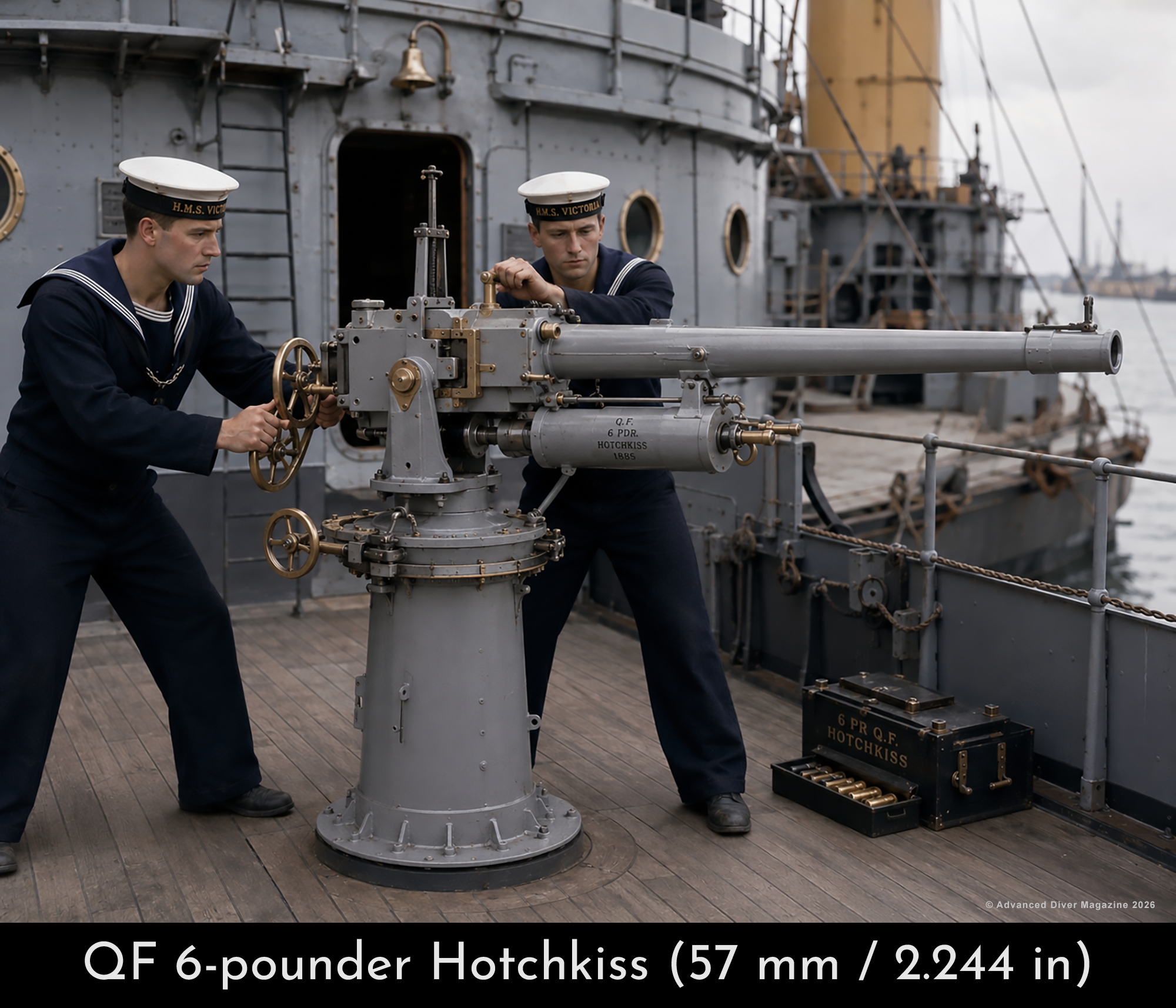
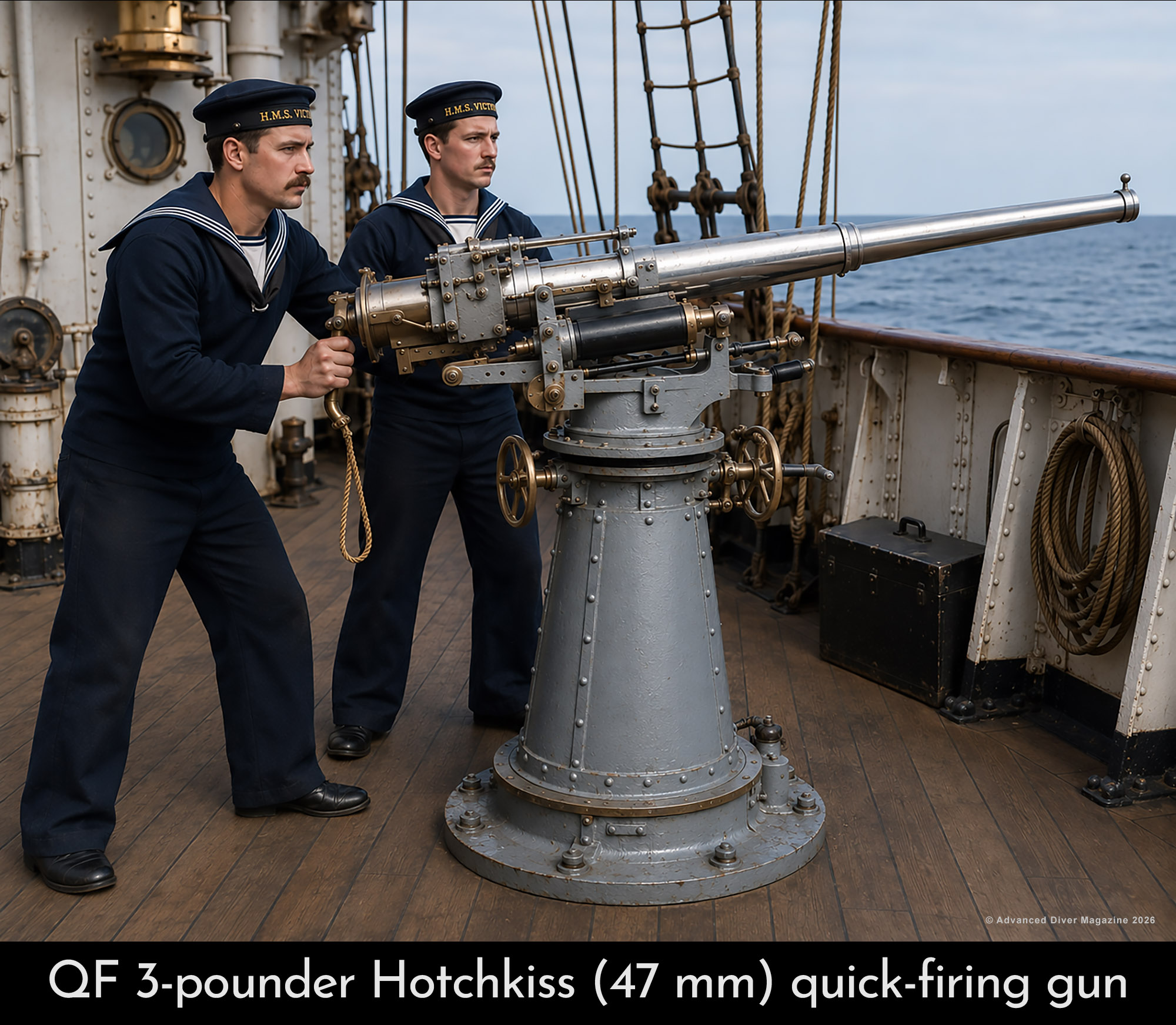
Along the sides of the wreck, several quick-firing guns still remained mounted on their original gun mounts. Returning to the massive capstan, I studied the heavy drive mechanism before once again looking upward at the great main gun towering above me. I couldn't help wondering how much longer the wreck's bow would continue supporting the enormous weight of the battleship. Additional smaller guns still protruded from several gun ports, and as I continued toward the stern, the two massive propellers gradually came back into view, each weighing several tons.
Finally, I arrived once more at the rudder and our ascent line. Passing Admiral Tryon's private terrace for the last time, I reflected on the admiral who had once stood there taking in the Mediterranean air, never imagining that a single order would seal both his fate and that of his ship. HMS Victoria became his final resting place, preserving forever one of the most remarkable chapters in naval history.
During my final decompression stop, I realized I had just completed one of the most memorable wreck dives of my life. Of all the shipwrecks I have explored around the world, none has left a stronger impression than HMS Victoria. No one knows how much longer this remarkable battleship will remain standing vertically on the seabed before gravity finally causes her to collapse. Until that day comes, she will remain one of the most extraordinary technical dives—and one of the most unique underwater war graves—anywhere in the world.
Artistic Reconstruction: This image is a historically informed artistic rendering of HMS Victoria moments after impacting the Mediterranean seabed on 22 June 1893. It is based on archaeological evidence and historical records but remains an interpretive visualization of the ship's final moments.
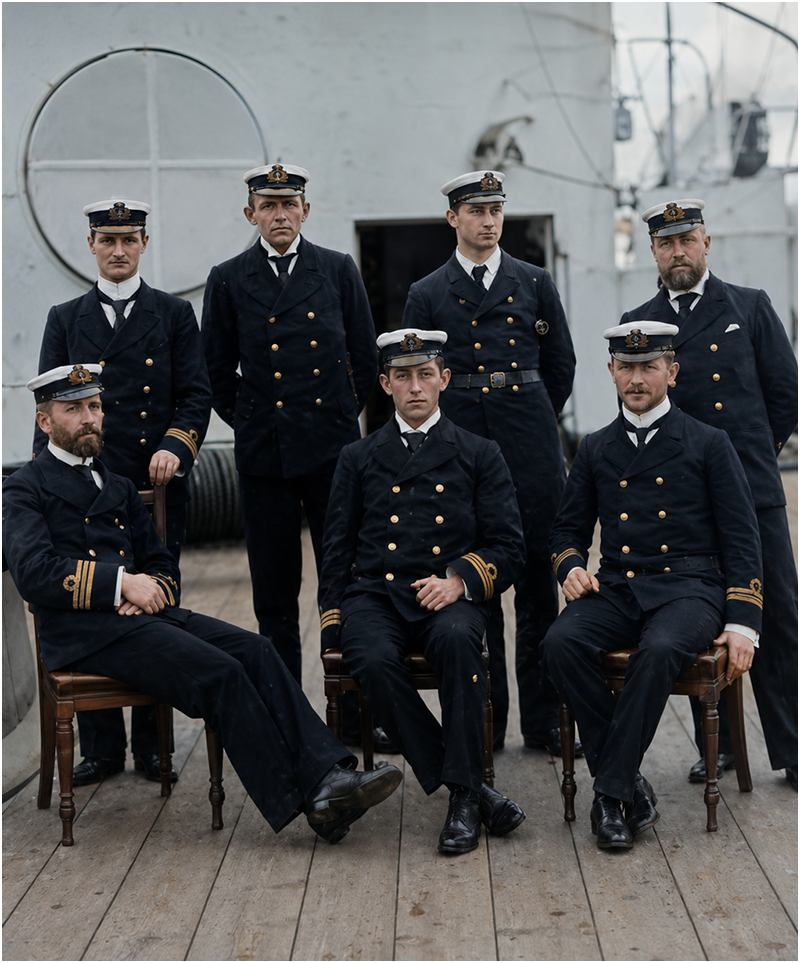
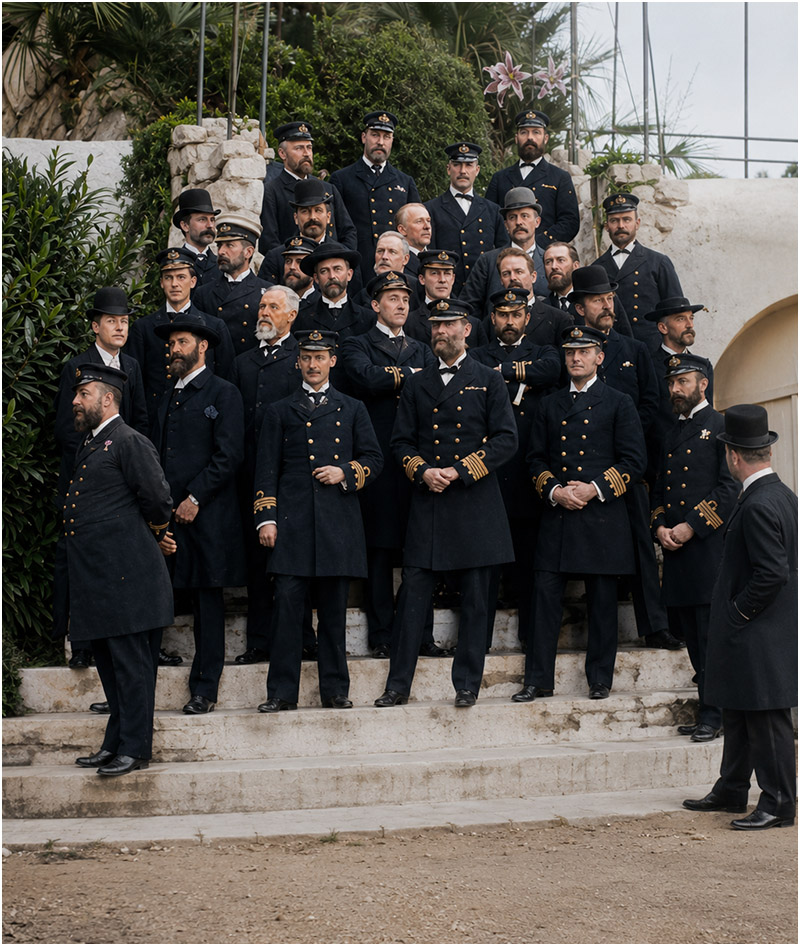
Back Row left to right: Crew, Danny Moens, Edoardo Pavio, Pim Deroodes, Paul Lijnen, Vic Verlinden, Johan Carlens
Bottom Row Left to Right: Crew, Erik Wouters, Danny Huyghe
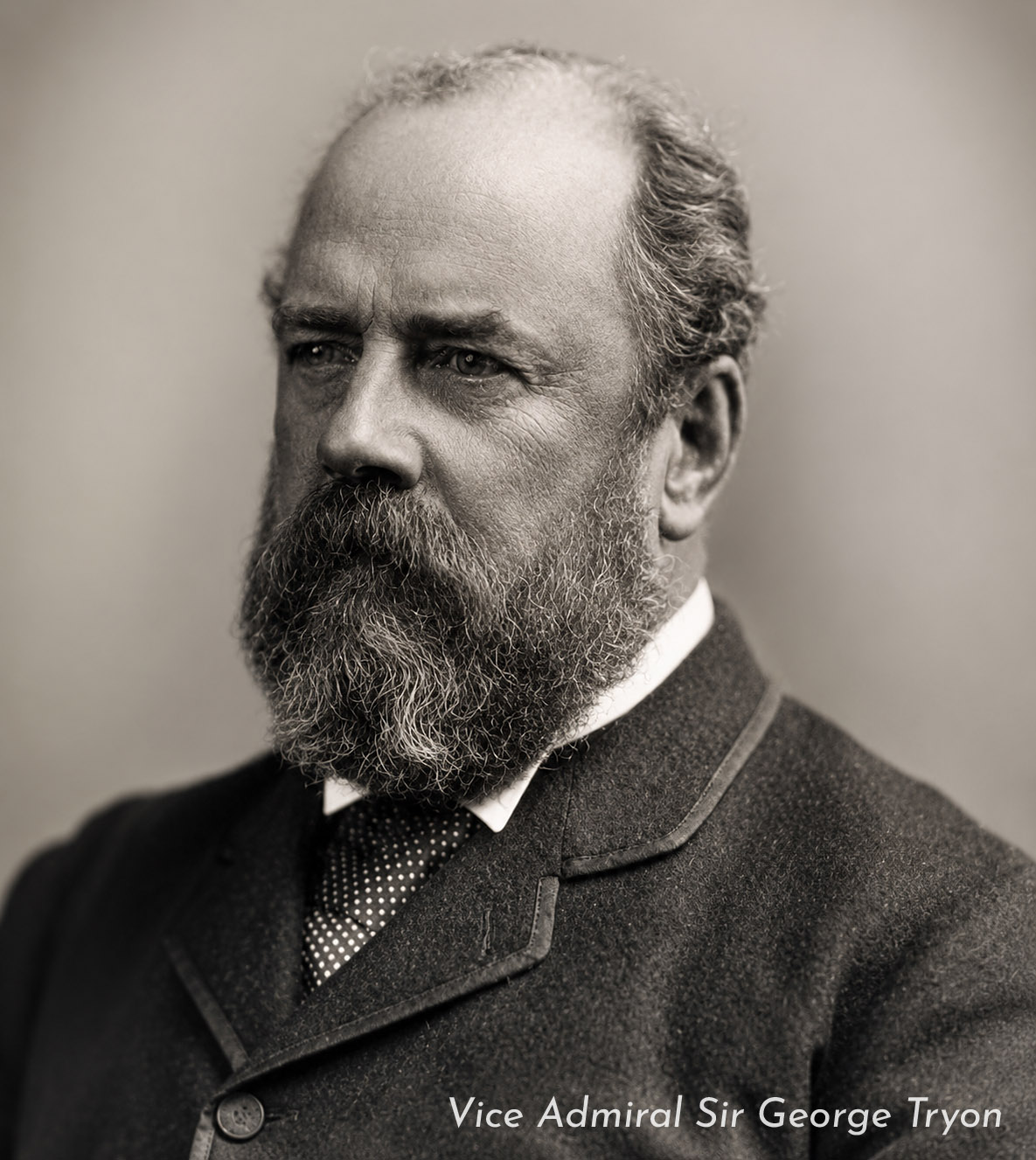
Vice Admiral Sir George Tryon (4 March 1832 – 22 June 1893) was one of the Royal Navy's most respected and innovative officers during the Victorian era. Entering the Royal Navy at the age of twelve, he quickly established a reputation for intelligence, discipline, and exceptional leadership. Throughout a distinguished career spanning nearly fifty years, Tryon served in the Crimean War, held numerous important commands around the world, and became recognized as a brilliant naval tactician. His greatest contribution to the Royal Navy was his emphasis on fleet maneuvering and tactical efficiency, encouraging captains to operate large formations with greater speed and precision. In 1891, he was appointed Commander-in-Chief of the Mediterranean Fleet, Britain's premier naval command and the most powerful concentration of warships in the world.
Despite his remarkable career, Sir George Tryon is remembered today for the tragic events of 22 June 1893. During routine fleet maneuvers off the coast of Tripoli, Lebanon, he ordered two columns of battleships to turn inward simultaneously, believing there was sufficient room for the maneuver. The order placed HMS Victoria and HMS Camperdown on a collision course, resulting in one of the Royal Navy's greatest peacetime disasters. More than 350 officers and sailors lost their lives when Victoria sank in less than fifteen minutes. Realizing the consequences of his mistake, Tryon reportedly told those around him, "It is all my fault," before remaining on the bridge of his flagship. Refusing to abandon his command, he went down with HMS Victoria as she disappeared beneath the Mediterranean, in keeping with the naval tradition of the era. Although the disaster forever overshadowed his distinguished career, historians continue to recognize Sir George Tryon as an innovative strategist whose influence on modern fleet tactics extended far beyond the tragic accident that claimed his life.
(Click image to enlarge)
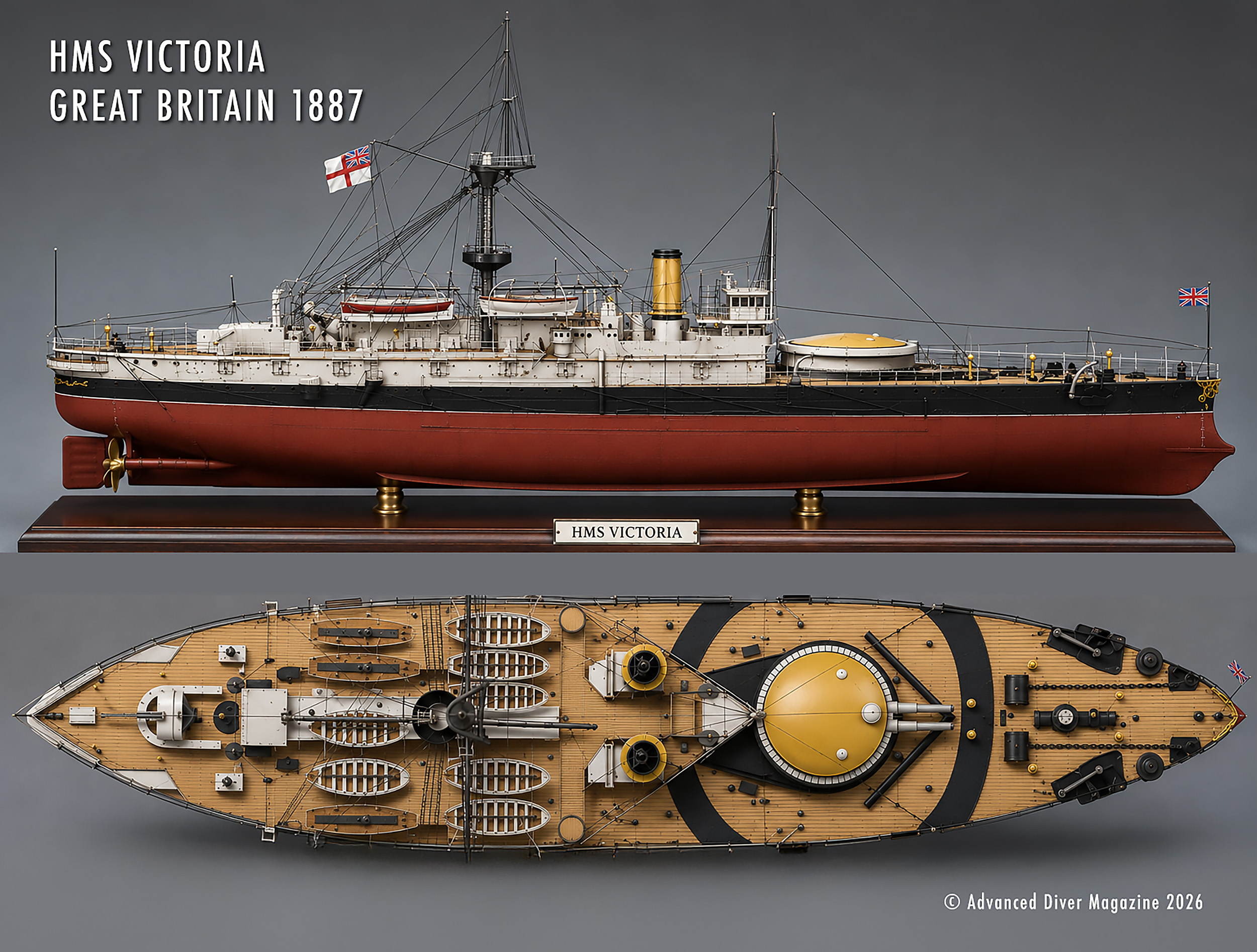
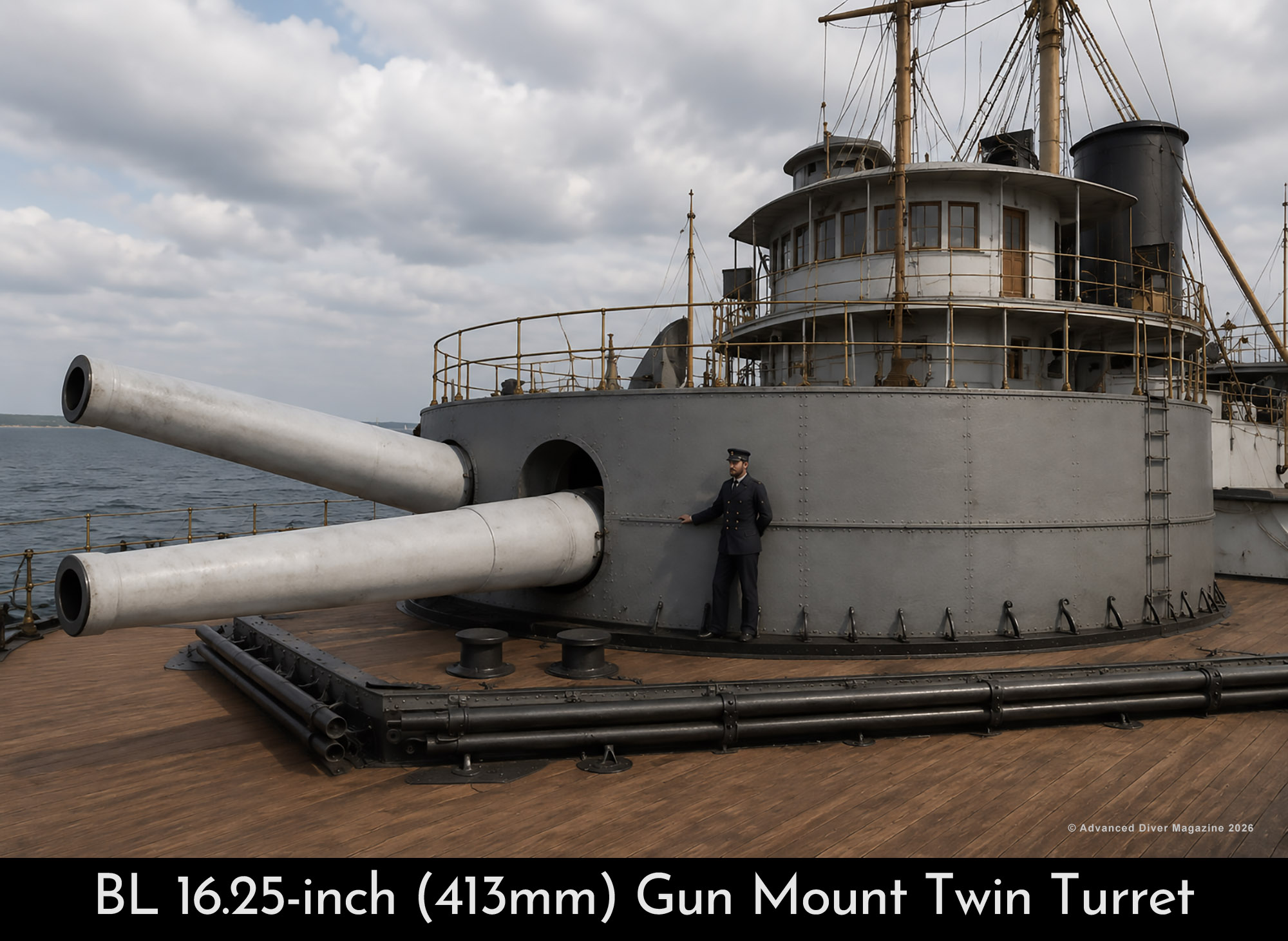
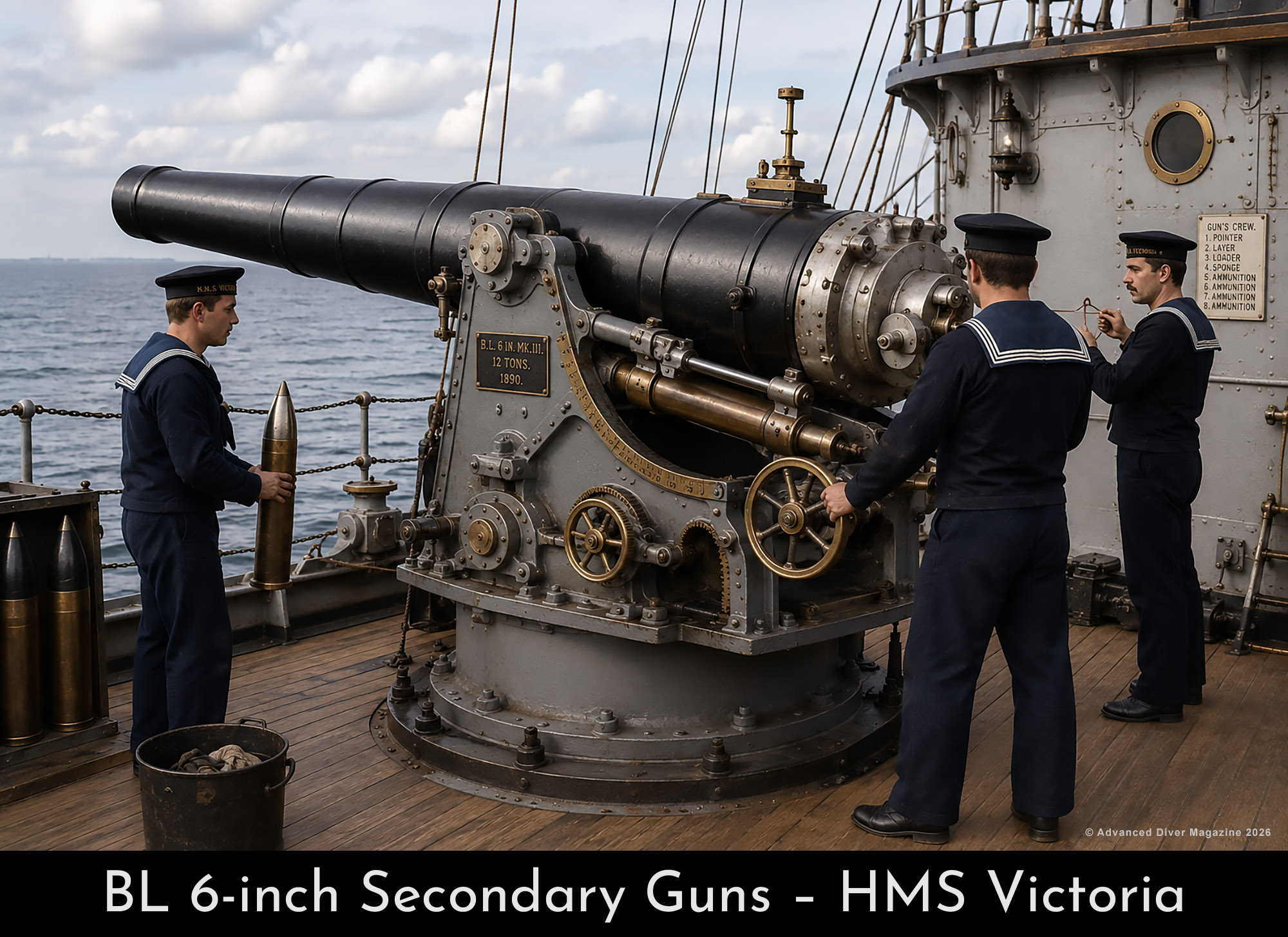
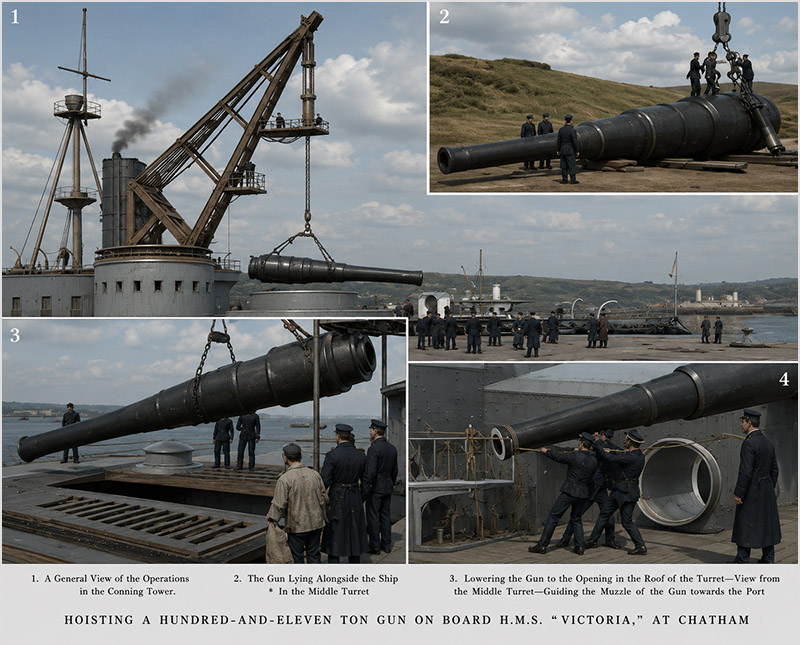
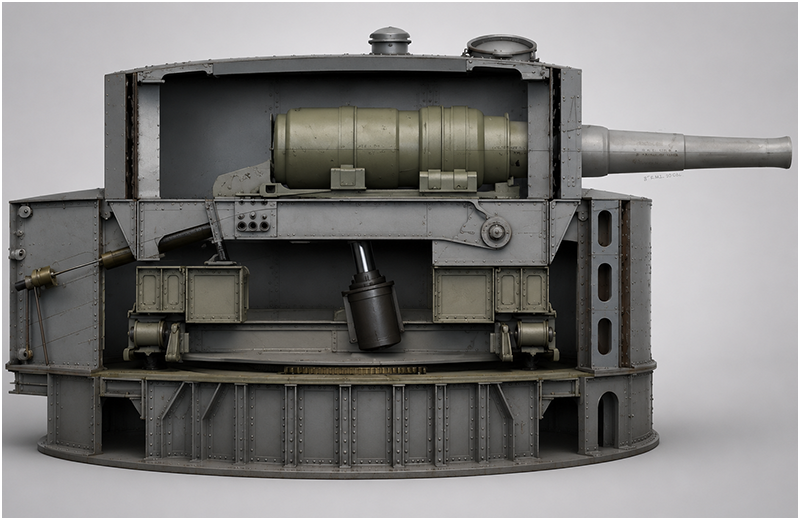
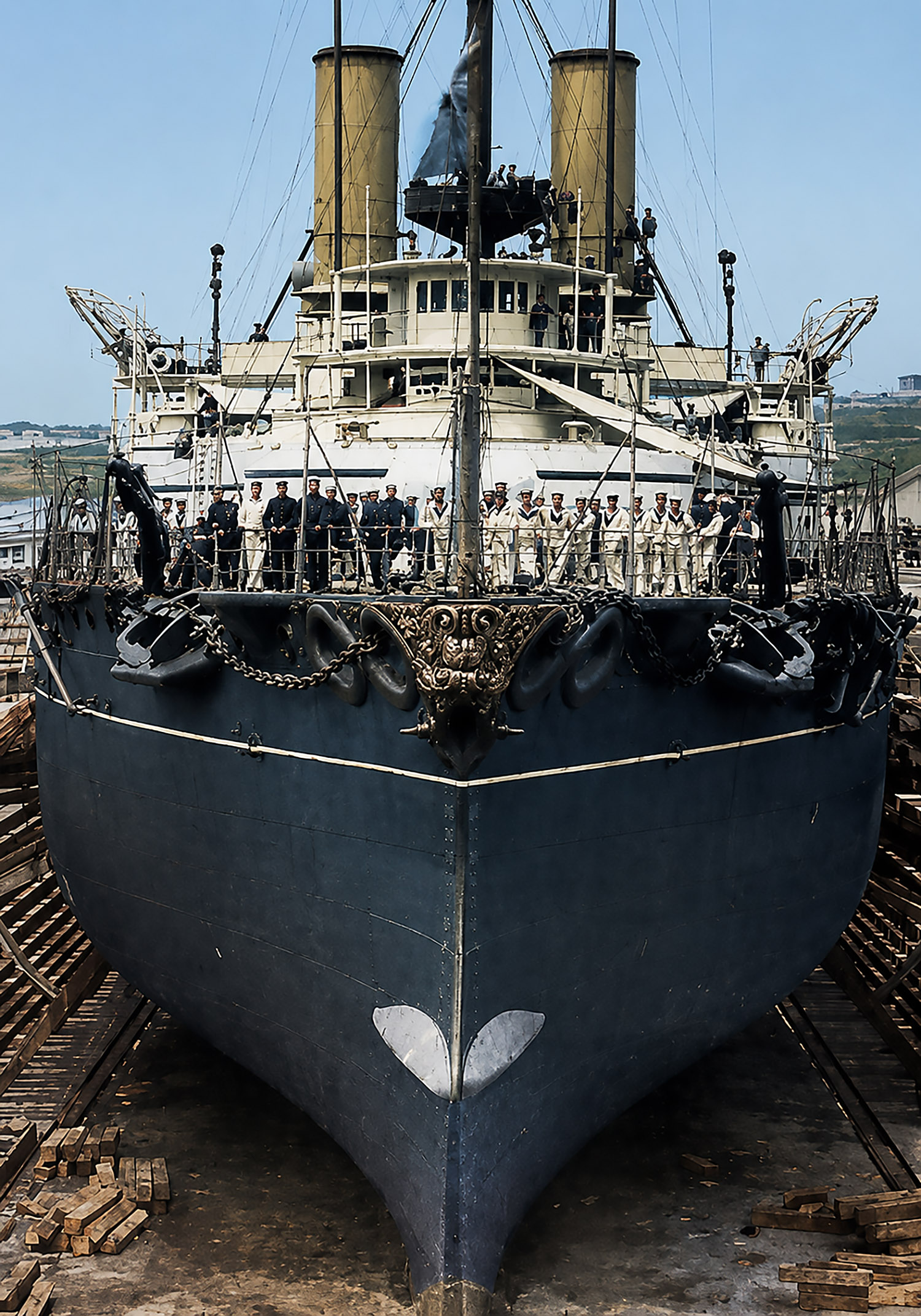
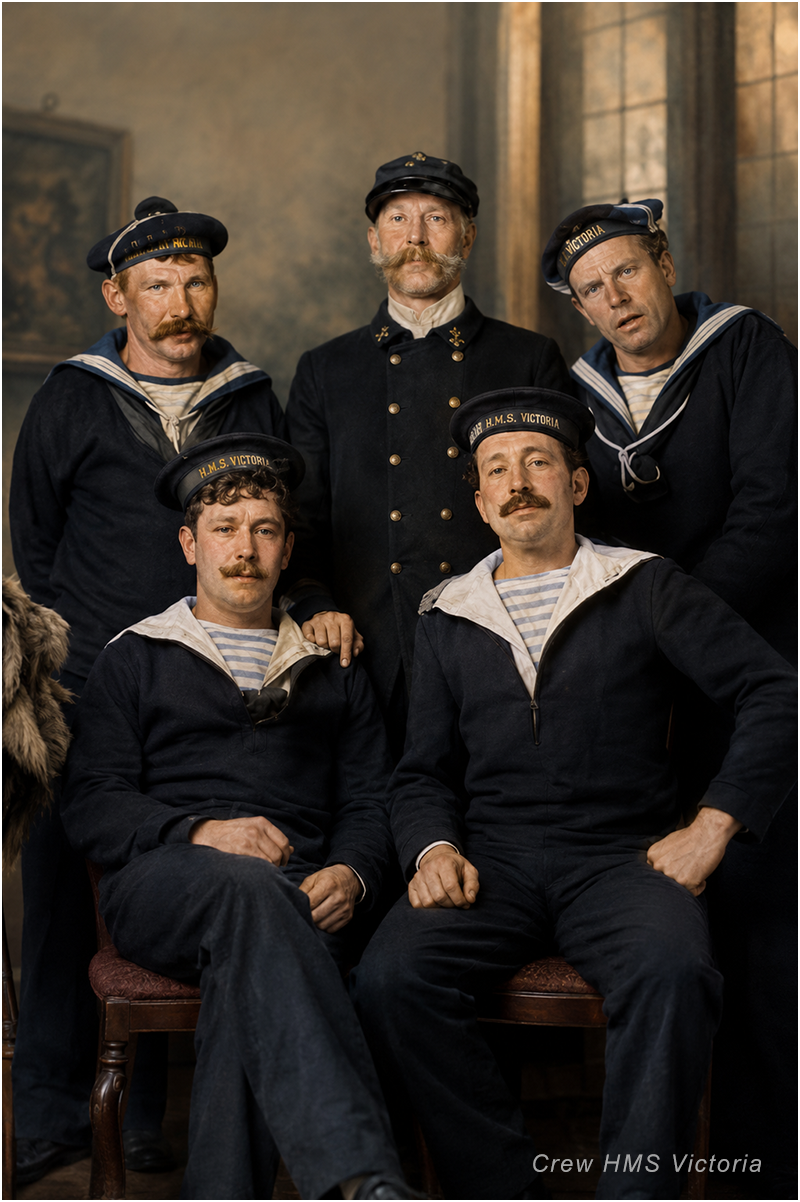
These historically informed artistic reconstructions are based on original artillery dimensions, period photographs, and surviving examples of the guns. The sailors are depicted in period-correct Royal Navy uniforms representative of those worn aboard HMS Victoria in 1893.


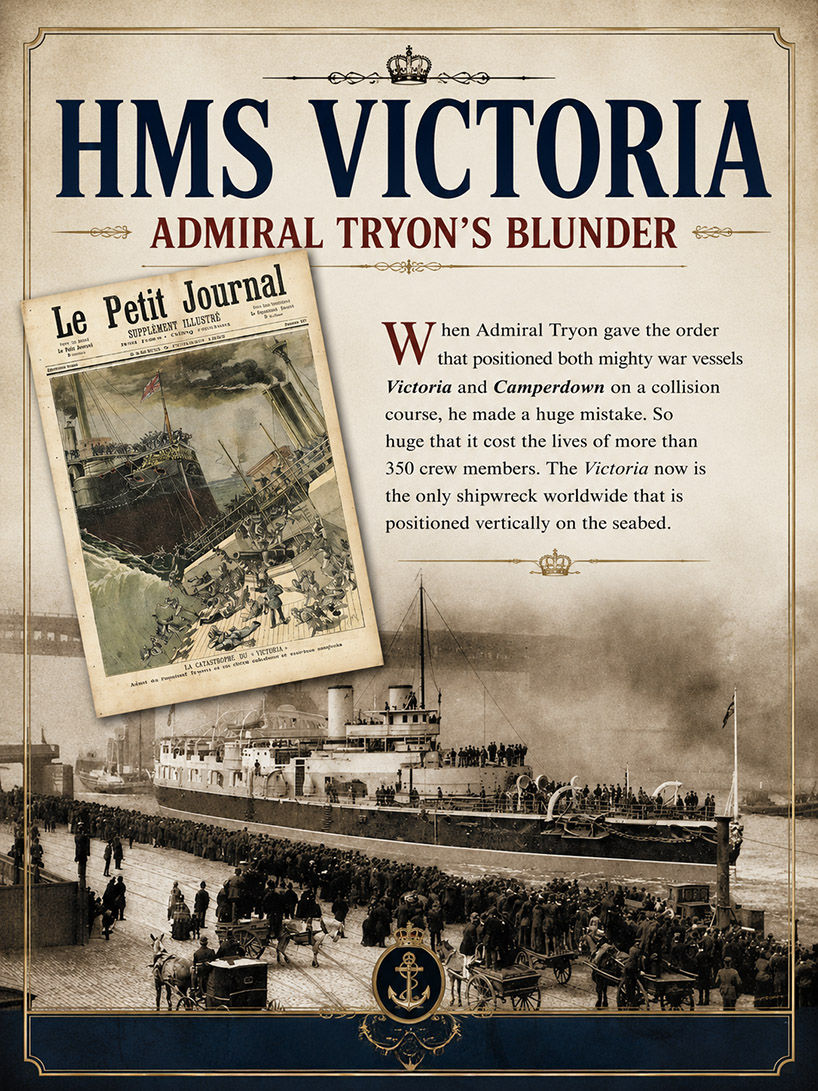

 On 22 June 1893, Admiral Tryon stood on the bridge of his flagship, HMS Victoria, commanding what was then the most powerful navy in the world. With the coastline of Tripoli, Lebanon, already in view, the admiral ordered his fleet to turn around. At the time, HMS Camperdown was steaming alongside HMS Victoria at a distance of approximately 1,100 meters (3,610 feet). According to the admiral's orders, both vessels were to make an inward turn before reversing course. The commanding officer advised Admiral Tryon that the distance between the two ships was insufficient to perform the maneuver safely. The turning circle of each battleship was more than 2 kilometers (1.24 miles), making a collision almost inevitable.