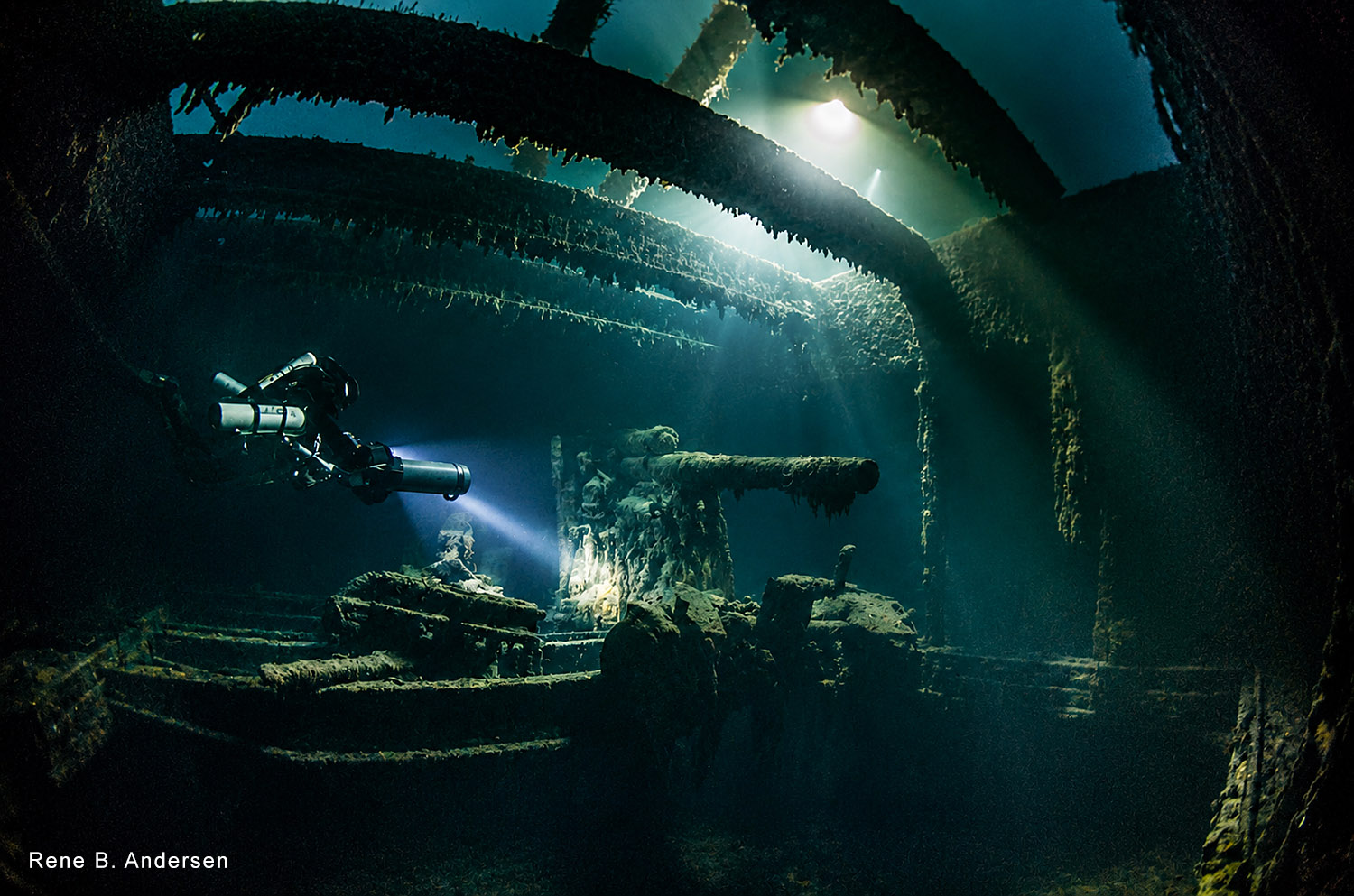
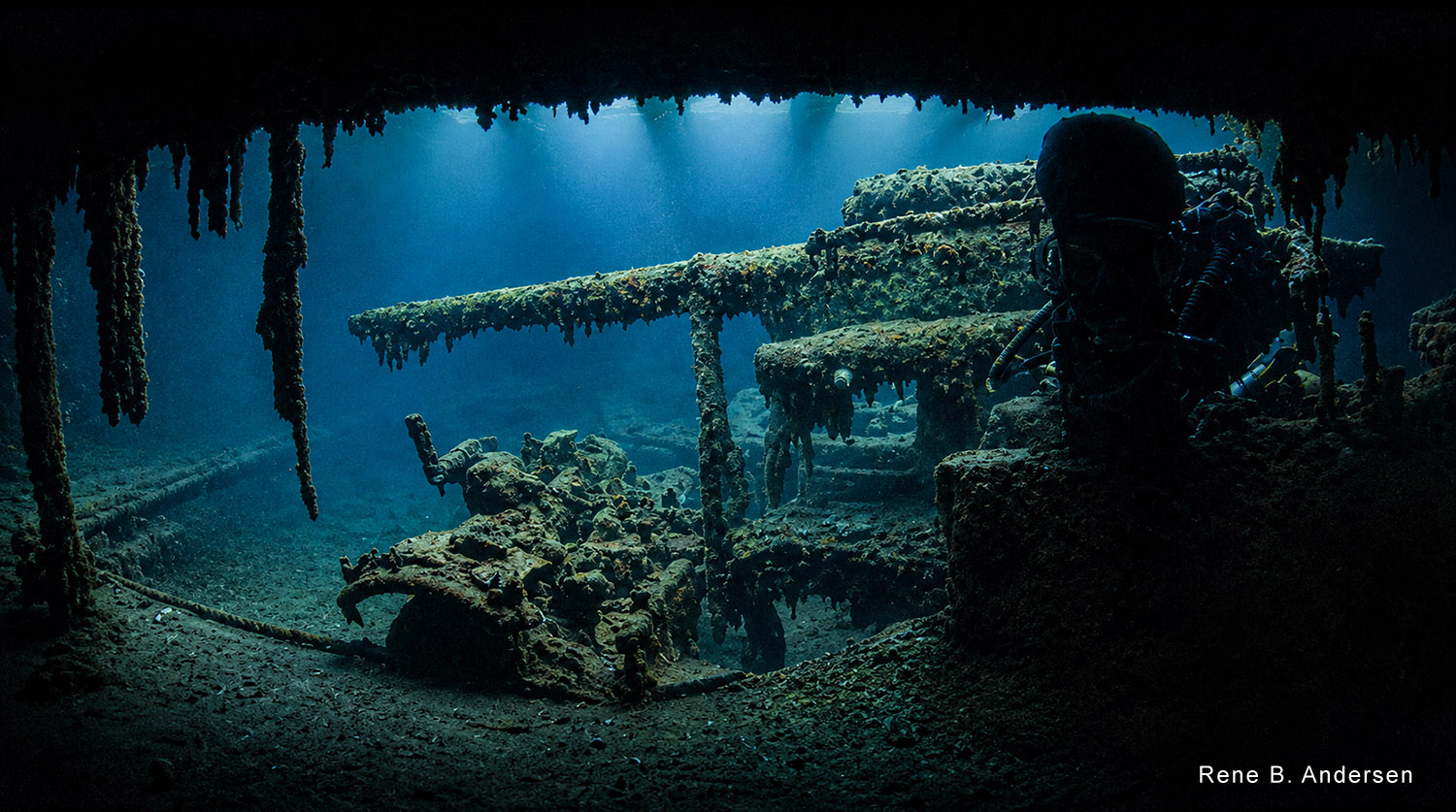
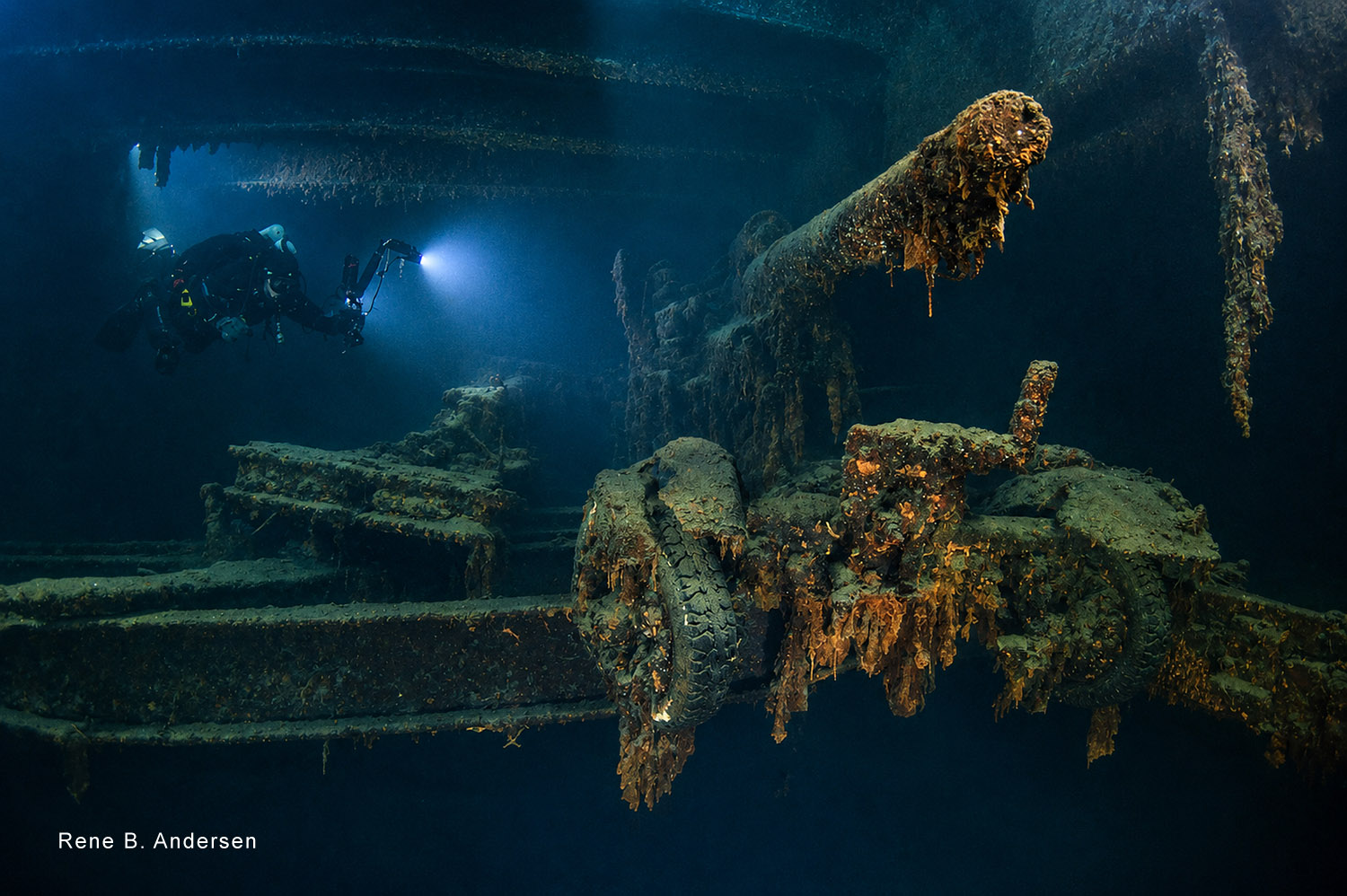
When we arrived at the cargo bay, I turned my scooter down between the iron beams. The first thing that caught my attention was the barrel of an 88-millimeter (3.46-inch) anti-aircraft cannon standing on the beams. It was lying freely in the water while my diving buddy hovered above it, illuminating it with his lights. It appeared as though it were displayed beneath cathedral lights, as if it belonged in a museum.
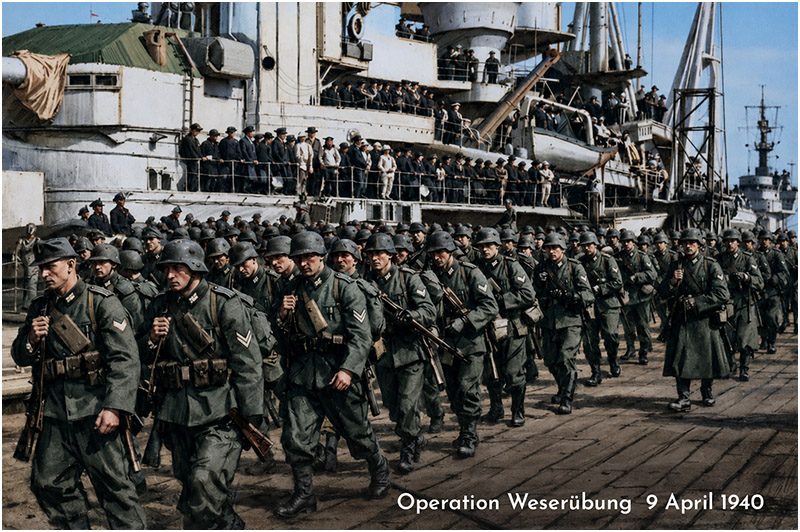
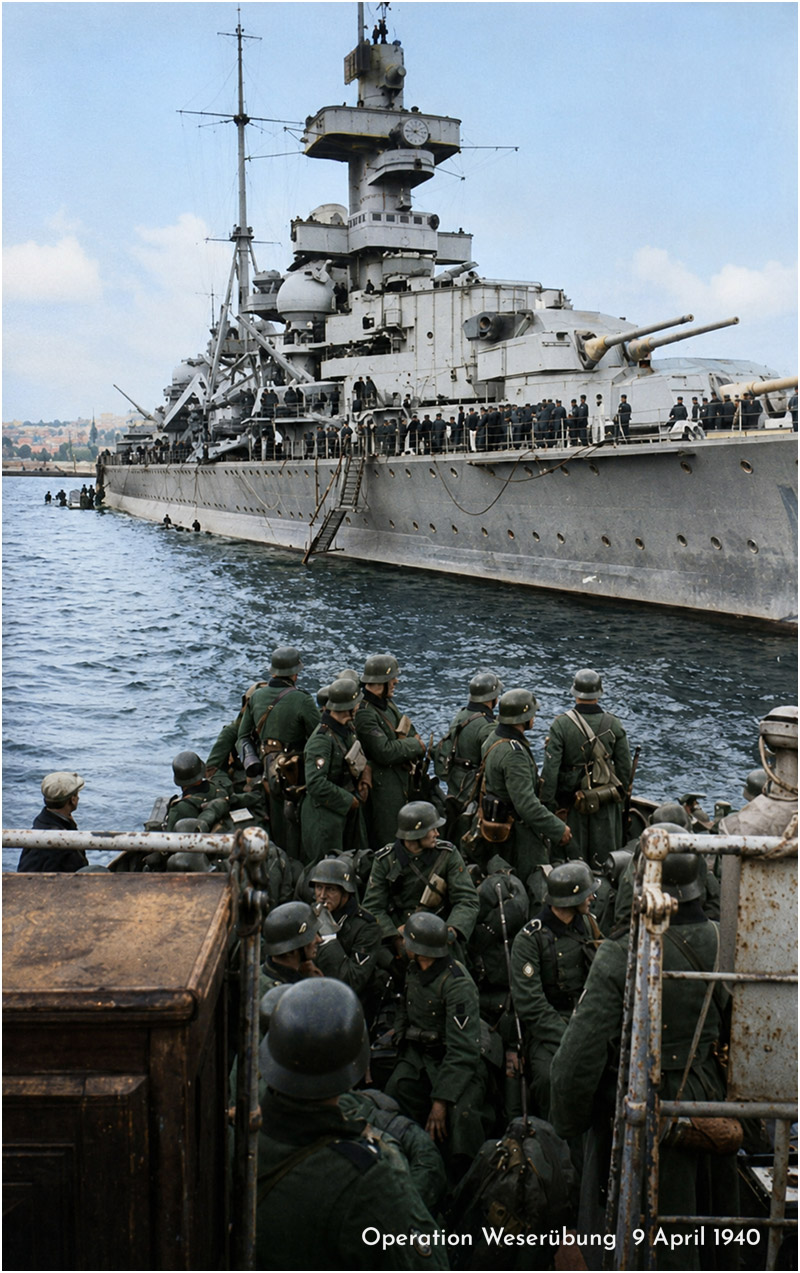
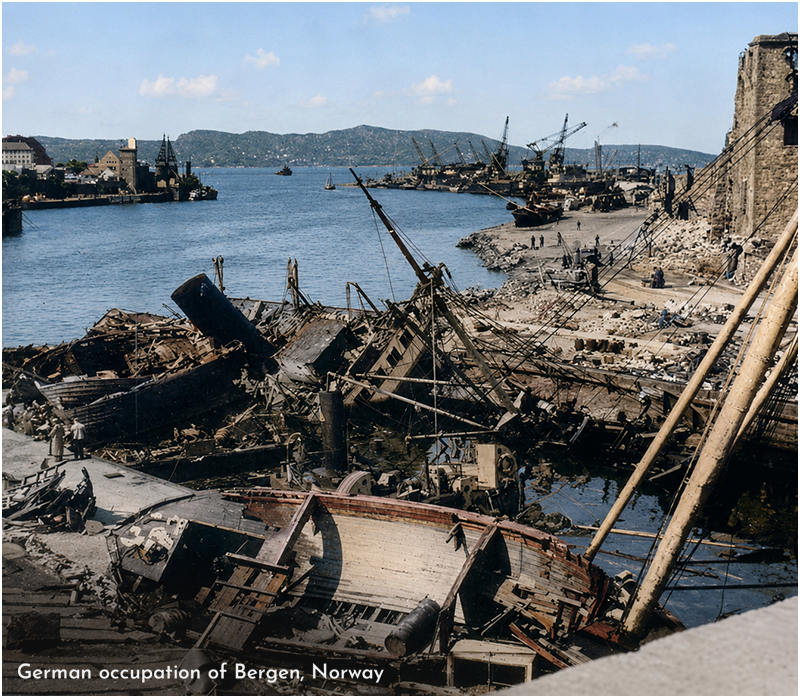
April 9th 1940 marked the beginning of Operation Weserübung—the German invasion of Norway. The plan was to capture Oslo and five other major cities along the Norwegian coast, including Bergen.
Admiral and Commander Carsten Tank-Nielsen in Bergen had already suspected a German invasion by 5 April. Information had been received from both English and Danish sources. I also found an old newspaper article online describing more than fifty German warships sailing through the Kattegat and farther north.
The Germans reported that they were sailing toward Norway for commercial purposes, namely to collect iron ore in Narvik. The commander did not believe this and prepared his units for war. On 7 April, he contacted the Naval Staff, who did not believe the ships were heading for Norway and ordered him only to observe.
On 8 April, the German troop ship Rio de Janeiro was sunk outside Lillesand, Norway, by a Polish submarine. Approximately half of the crew survived and informed the Norwegians that they were on their way to Bergen. After receiving this news, the commander was no longer in doubt—the Germans were coming to Bergen.
Unfortunately, neither the Naval Staff nor many of his own personnel shared his conviction, and several of his orders were not followed. For example, a land-based torpedo battery guarding the harbor entrance to Bergen was not prepared, and the torpedo boat crews should not have been granted leave.
Although the minelayer TYR managed to lay her mines, it became too late for the fuses to be activated before the German ships arrived. Consequently, the mines remained unarmed as the German invasion force sailed through the area. Bergen fell within only a few hours during the morning of 9 April, despite fierce resistance and several attempts to stop the invasion.
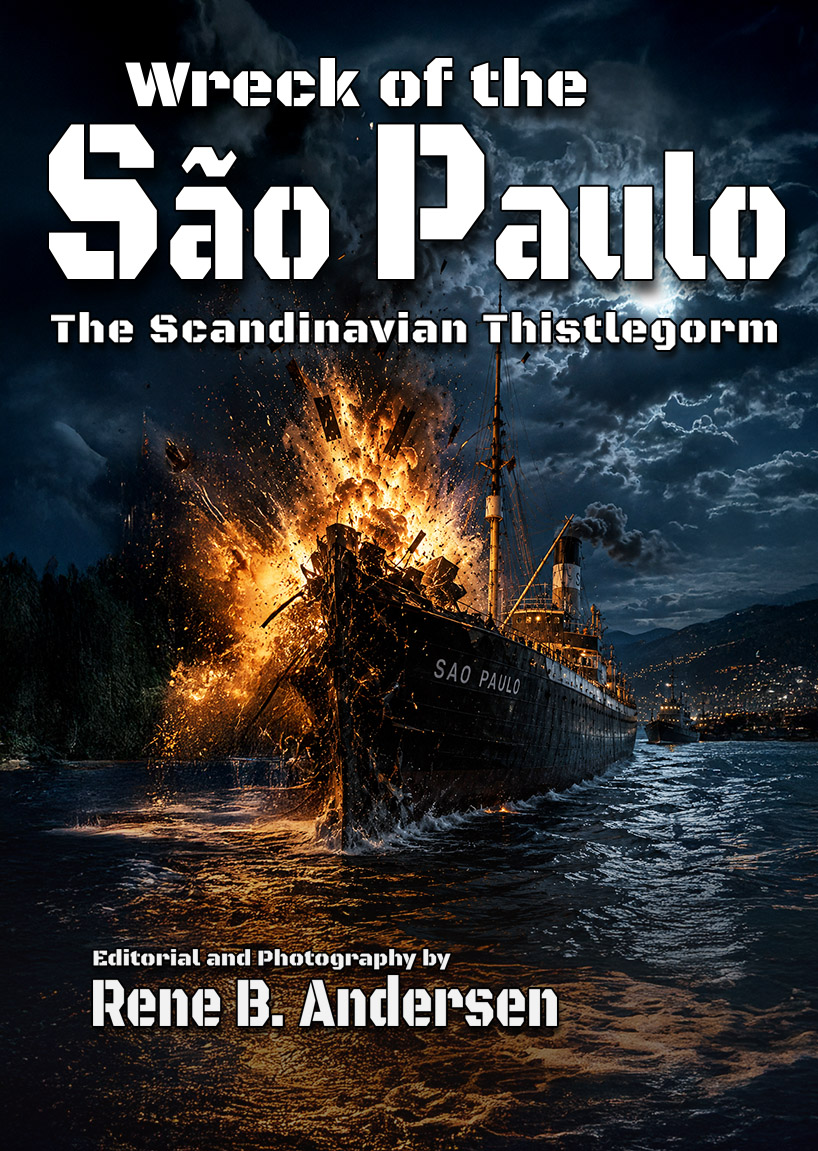
Later that same evening, the mines were armed. When the German supply ship São Paulo sailed through the area, she struck the Norwegian minefield and was sunk. Today, she lies at a depth of approximately 90 meters (295 feet) beneath the waters near Bergen.
For most people, São Paulo is little more than another wartime casualty of the Second World War. For technical divers, however, she has become something entirely different—a remarkably preserved time capsule from the opening hours of Germany's invasion of Norway.
More than eighty years later, motorcycles, military vehicles, artillery pieces, and countless wartime artifacts remain aboard the wreck, frozen in time. It is easy to understand why she has earned the nickname, "The Scandinavian Thistlegorm."
Diving the São Paulo is not an easy undertaking. She lies deep in an area of strong currents and heavy ship traffic. The wreck has already claimed the lives of two divers—one in 1995 who attempted to salvage the ship's bell and another in 2014. Following the accident in 1995, the Norwegian Navy removed the ship's bells so they would no longer tempt other divers.
I've dived many technical wrecks in Norway, but this would prove to be my most demanding dive. It was immediately clear that I would have to think things through more carefully than usual. We were four divers together, which also provides good support should any problems arise.
It takes time to scooter the long distance out to the wreck, and along the way we place some of our stage cylinders on the guideline so that we do not have to carry them around while exploring the wreck. This, of course, also means that whatever happens, we have to return the same way.
I dropped my last stage cylinder at 50 meters (164 feet) and could already feel the time pressure. It is important to choose the right place to leave it. The bottom begins to slope here, and valuable time can be lost on the wreck if you fumble with your equipment. Every minute on the way down counts, so it goes without saying that this is not a dive you would want to attempt without a scooter.
After 50 meters (164 feet), the light starts to disappear, and I need to concentrate more carefully on following the line as we travel approximately 8 to 10 meters (26 to 33 feet) above it to avoid unnecessary decompression. There was still a considerable distance to the wreck, and now it was so black that the light from my flashlight dazzled me. We had to stay close to the line because losing it at this point was simply not an option.
We did not see the wreck until we were approximately 5 meters (16 feet) from it. The visibility was good, but the wreck simply disappeared into the darkness.
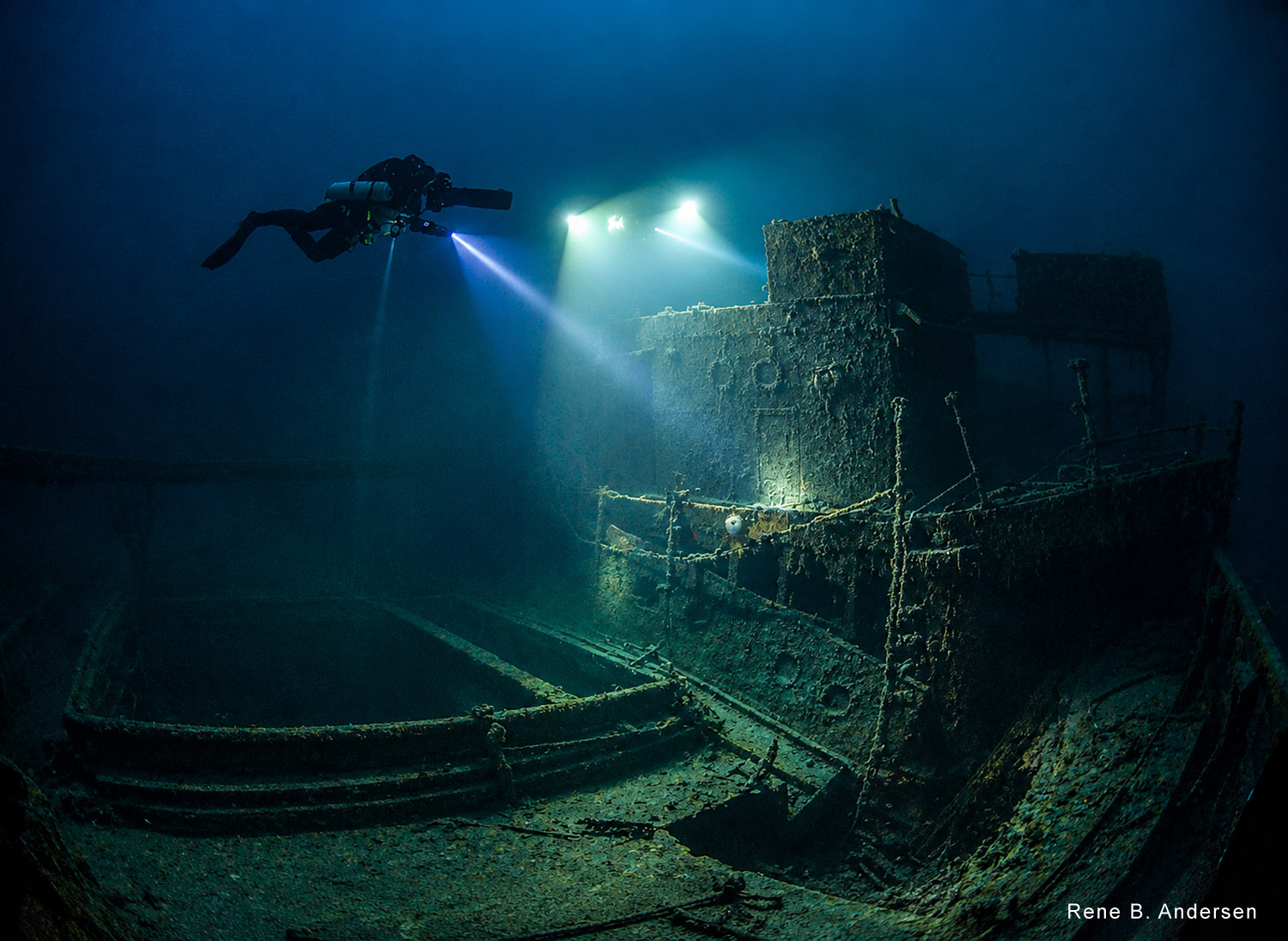
We all placed small strobes on the guideline so that no one would be left behind. The line was secured between the bridge and the funnel, making it easy to locate again on our return.
The first dive was primarily to familiarize ourselves with the wreck, which is why our bottom time was limited to only 20 minutes. We explored the wreck from the bridge down to the stern and could immediately see that very few divers had visited her. The amount of incredible detail still preserved throughout the wreck was simply astonishing.
We found the steering machinery in the stern and an 88-millimeter (3.46-inch) anti-aircraft cannon resting in the aft cargo hold. Unfortunately, time passes quickly on a dive like this. When we finally left the wreck, it was difficult to contain our excitement, but we had to remain focused in order to follow the guideline back.
Our first decompression stop was at 51 meters (167 feet), which gave us sufficient time to collect our stage cylinders on the way up. Then followed a long ascent with decompression stops all the way to the surface while remaining over the slope. Throughout the ascent, we could clearly feel the strength of the current.
I did not want to think about how strong it might become farther up, and we could also hear large ships passing overhead. This was neither the time nor the place to make a free ascent.
When we reached the shallower portion of the dive, we began removing our stage cylinders and securing them together so that we would not have to spend our decompression time carrying the extra weight.
Everything became faster on our subsequent dives as our routines improved. For example, by loosening the rear carabiner while scootering down, I only needed one hand to clip it onto the line. We also gained more knowledge about the different cargo holds and learned how to move more efficiently around the wreck.
Our bottom times became somewhat longer on our final dives. The total runtime was four hours, of which only 47 minutes were spent on the wreck itself. That is why we decided to bring water in CamelBak systems and smoothies that could easily be consumed by unscrewing the lid and squeezing out the contents. Next time, we may have to bring a board game to the shallow decompression stops as a distraction.
São Paulo rests remarkably upright on the seabed and reminds me of a German version of the Thistlegorm, although she is in even better condition because her depth limits the number of visiting divers. There are only a few places that have sustained visible damage aside from the two mine explosions in Cargo Hold No. 2 at the stern and on the starboard side of the engine room. I do not, however, claim to have one hundred percent knowledge of the wreck after only five dives.
With such long dives, we had to adapt our plans to the tides. This limited us to only one dive each day.
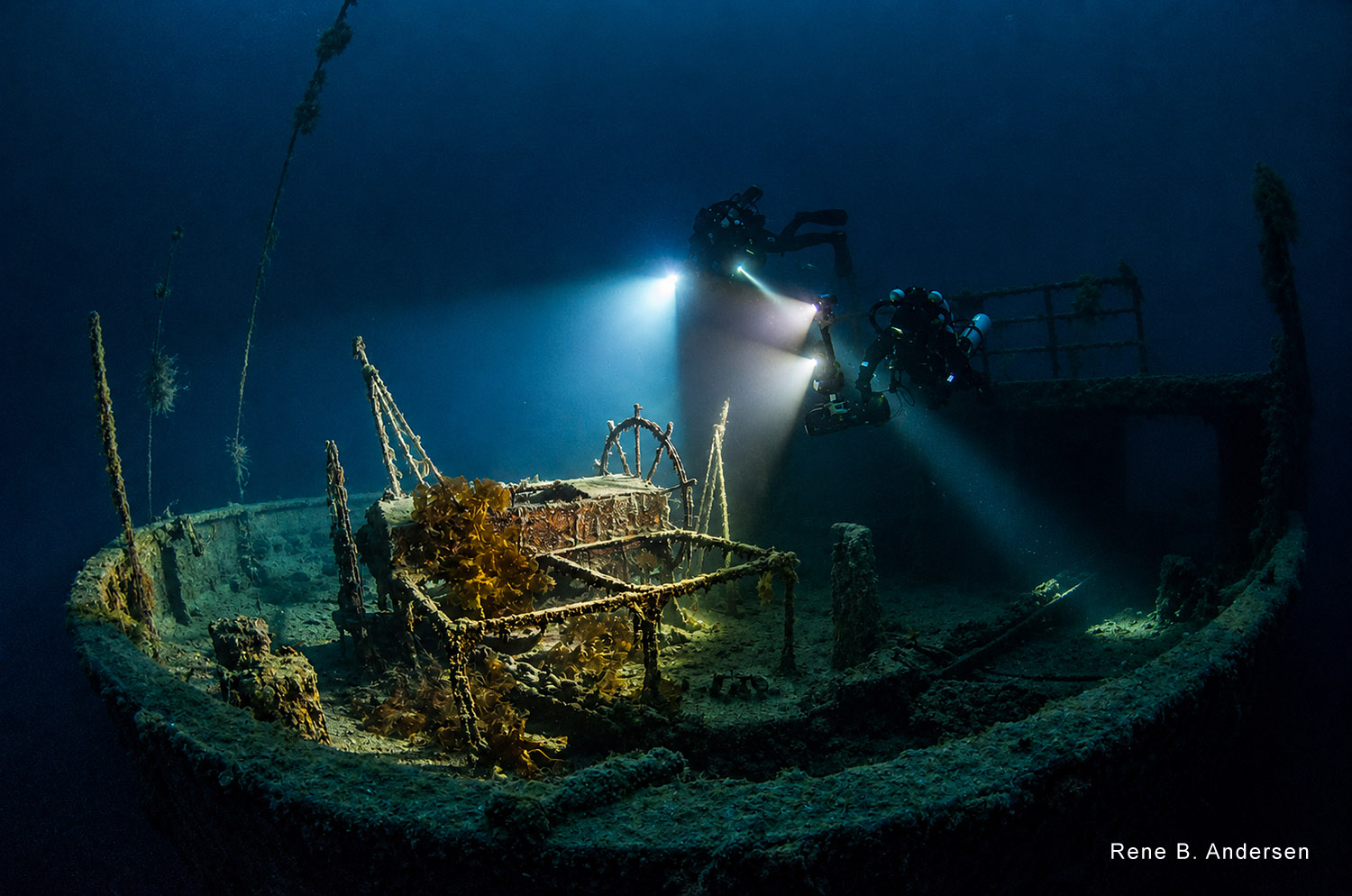
The propeller and rudder are completely exposed, and the masts are still standing, although several meters (feet) are missing from their upper sections. The funnel has collapsed, leaving only a few meters (feet) remaining. The wooden bridge has long since disappeared, but someone has placed the ship's wheel outside the structure. Overall, many portholes remain intact, and there is access down into the engine room. The cargo hatch was open, allowing us to swim inside, and it is also possible to enter through the mine damage on the starboard side.
I entered one of the compartments beneath where the bridge once stood and was surprised to discover that I was not alone. Opposite me was a large Ling cod. It was lying only 2 meters (6.5 feet) away, and it quickly became a staring contest to determine who would retreat first. In the end, it seemed entirely unconcerned by my presence and slowly swam away without disturbing the visibility.
There were also several interesting artifacts inside, including porcelain lamp rosettes and various glass objects.
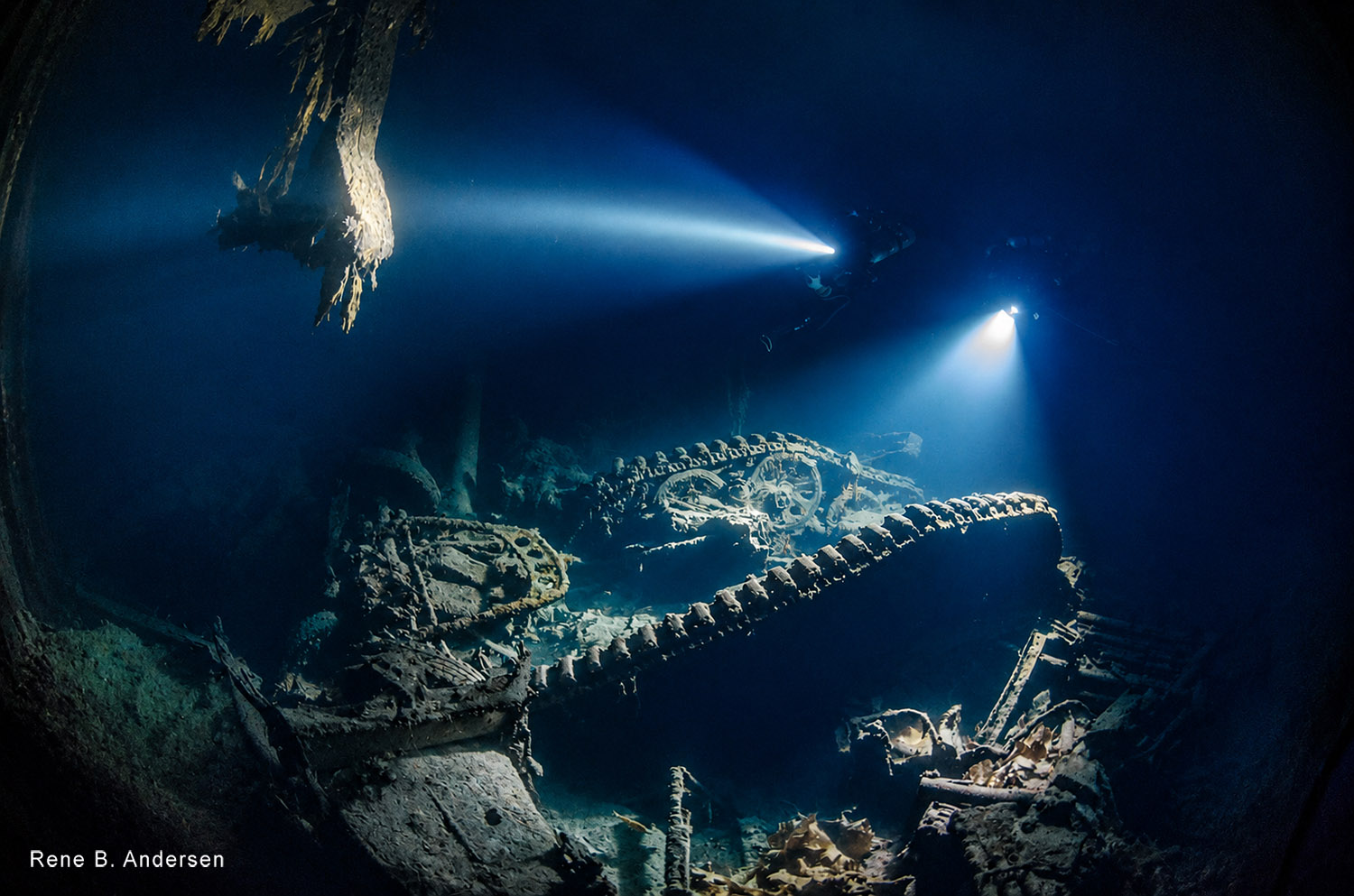
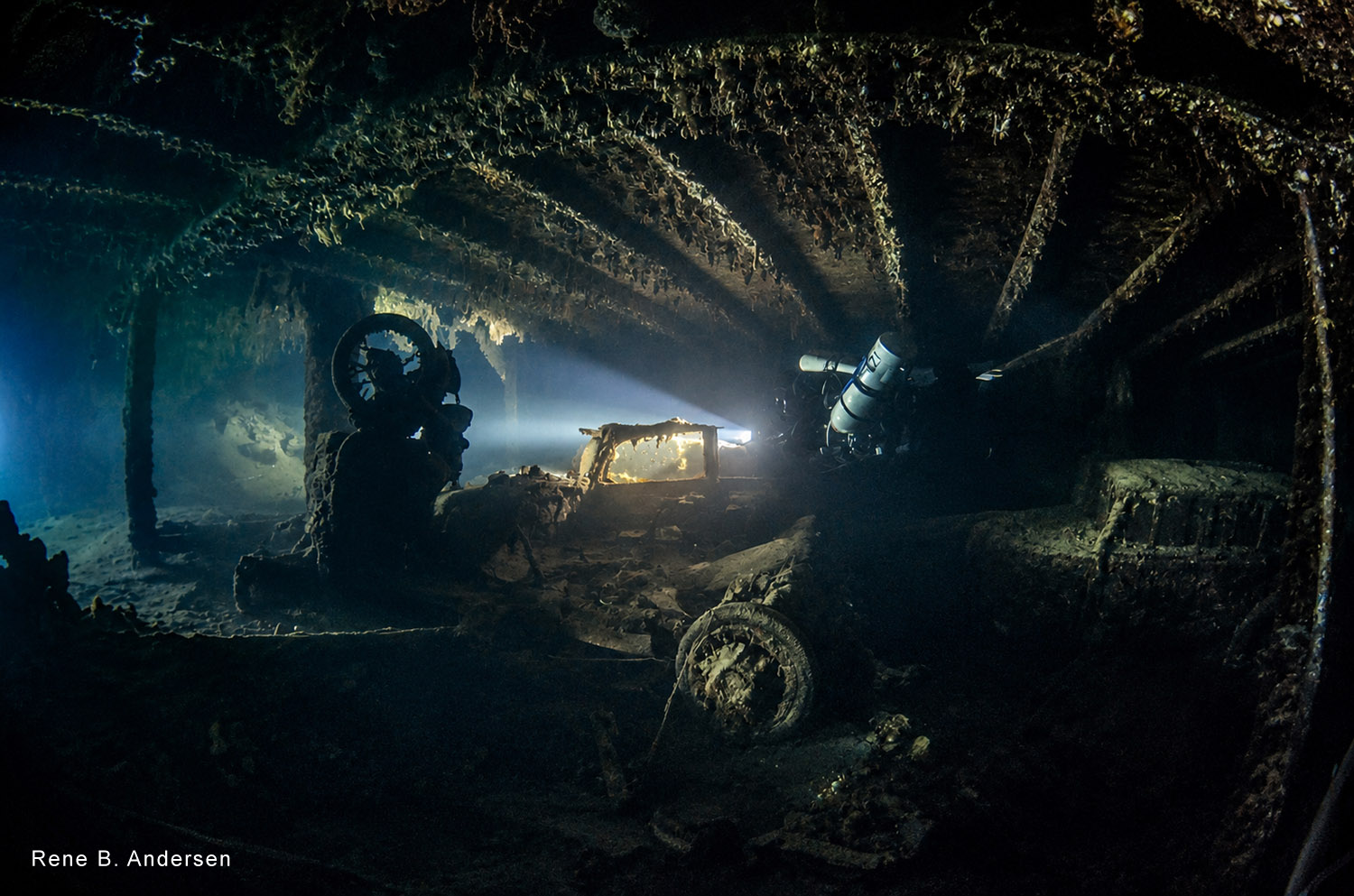
With her length of 110 meters (361 feet) and four cargo holds spread over two decks, it takes some time to gain an appreciation for where everything is located. It is easy to divide the wreck into separate cargo areas. To describe every individual artifact would require a very long list, so I will let the photographs speak for themselves. However, it was an amazing experience to weave between motorcycles, military vehicles, trucks, cannons, and other Nazi hardware while maneuvering my scooter through the wreck.
Normally, when we dive wrecks, the ship itself is the primary attraction because the cargo has usually disappeared long ago. Here, however, it is exactly the opposite. When the others wanted to enter the engine room, I chose to continue exploring the cargo areas. While I was there, I could hear their helium laughter over the communications system. They thought they had completed an impressive penetration from the engine room into a large compartment, only to discover that they had simply swum out through the mine hole.
Finding your way around the cargo holds was relatively straightforward. Most areas are spacious, and the openings between the different decks are excellent. There is, however, always a muddy bottom that demands careful attention.
On this trip, I prioritized the larger photographic subjects that were easy to locate. Next time, I will need to work more systematically and explore the cargo one section at a time. I am certain there are many more remarkable photographic opportunities waiting to be discovered.
There was one subject, for example, that shocked me a little. After accidentally scootering the wrong way and finding myself in a remote corner of the wreck, it appeared as though someone had stacked human skulls in a pile. As I got closer, I realized they were merely military water bottles that had become discolored over time. Next time, I will remember to take some close-up photographs because the original leather straps were still attached.
I have seen photographs and videos of the wreck before, but never anything showing the 88-millimeter (3.46-inch) anti-aircraft cannon. It is actually the artifact that impressed me the most—probably because it is not buried in the mud and requires very little imagination to picture it standing on land, waiting to be pulled into battle by a half-track vehicle.
After returning home, I asked a friend to make a drawing of the wreck based upon my photographs. The world simply is not fair when some people have a wreck of this class resting in their own backyard. Perhaps that is why my buddies were so happy to model for my photographs, which I was extremely pleased with.
This is definitely not my last trip to the wreck. However, it is also a dive that requires reasonable water temperatures, so winter and early spring are excluded. As I have said, this is the most demanding dive I have undertaken since I began rebreather diving nine years ago.
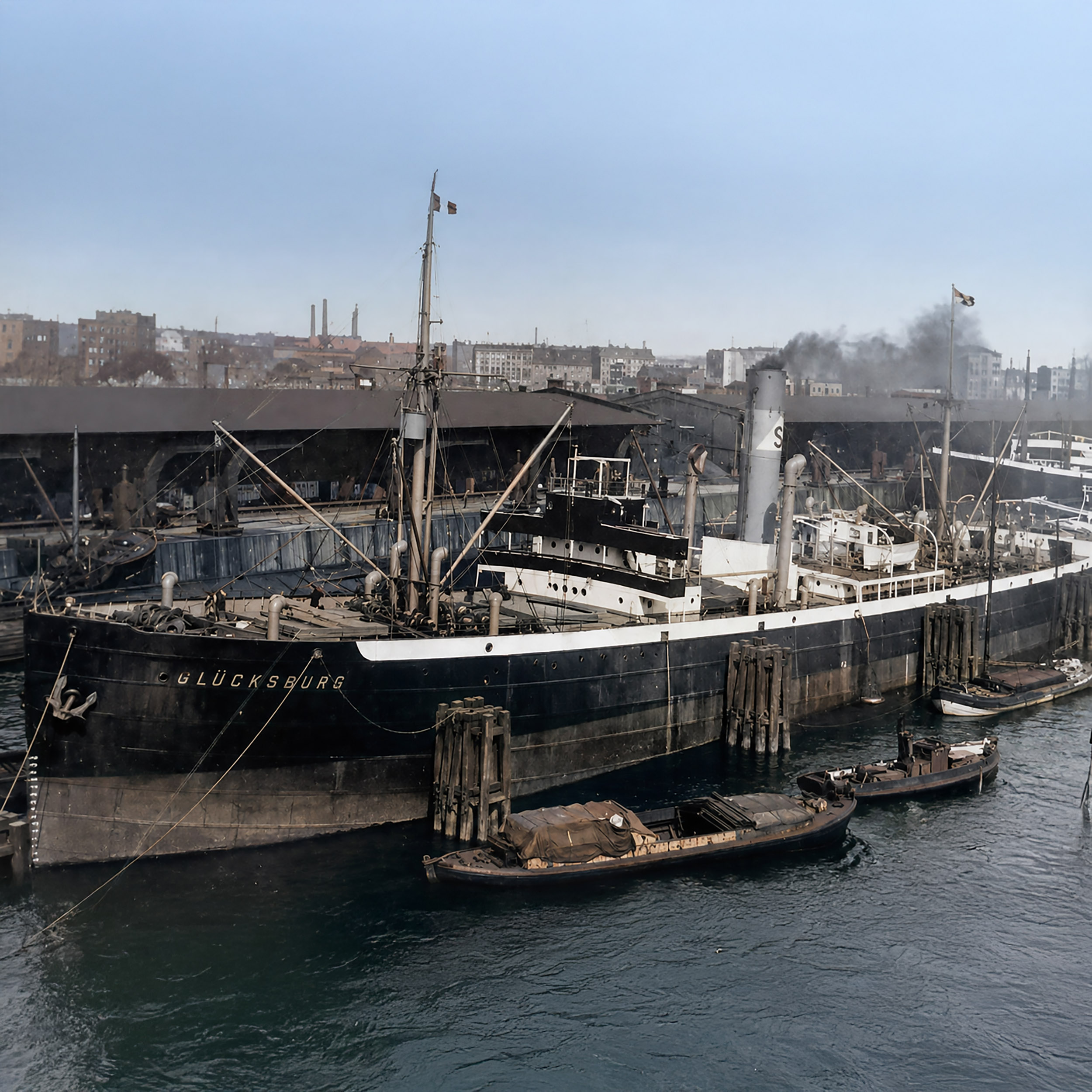
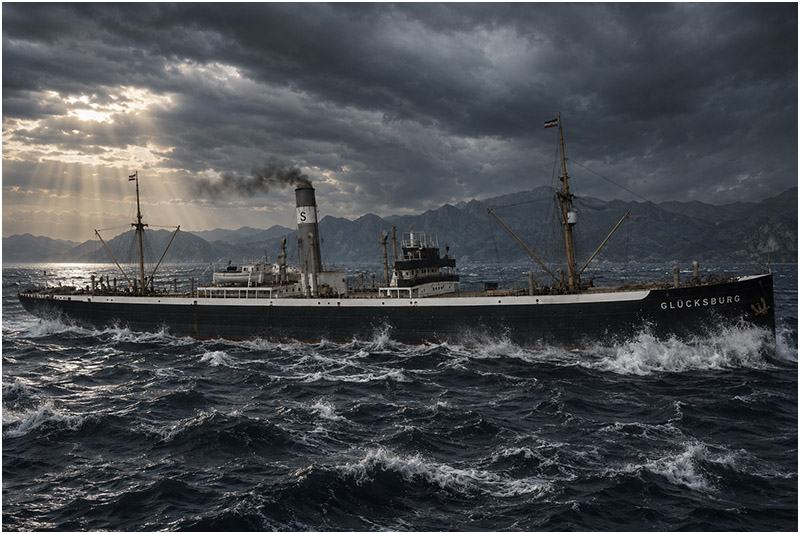
Above: Originally built as Glücksburg in 1921, the vessel was renamed Alrich in 1923 before becoming São Paulo in 1937, the name she carried when she was sunk during the German invasion of Norway on 9 April 1940.
This article was originally written in 2016. I returned to the wreck in 2019 and completed nine dives, with runtimes of up to six hours. These longer dives allowed us to accumulate more than one hour of bottom time on the wreck, making it possible to improve my photographic documentation significantly.
Every dive was carefully planned and coordinated with either a tripod or my diving buddy. Nothing was left to chance. On a wreck of this size and complexity, time passes quickly, and every minute spent at depth is precious.
Even after fourteen dives on São Paulo, I feel that I have only begun to understand what she has to offer. There are still countless artifacts waiting to be photographed and explored. The deeper I venture into her cargo holds, the more I am reminded that this wreck is far more than a ship resting on the seabed—it is a perfectly preserved moment from one of the opening chapters of the Second World War.
Few wrecks in the world allow divers to swim among motorcycles, military vehicles, artillery pieces, and wartime equipment exactly where they came to rest more than eighty years ago. For technical divers fortunate enough to visit her, São Paulo offers an experience unlike any other.
She is demanding, unforgiving, and certainly not a dive for everyone. Strong currents, heavy ship traffic, extreme depth, and long decompression obligations ensure that every dive must be approached with careful planning and considerable respect. Yet it is precisely these challenges that make her so extraordinary.
Without question, São Paulo is one of Norway's finest technical wreck dives and has rightfully earned her nickname—The Scandinavian Thistlegorm.
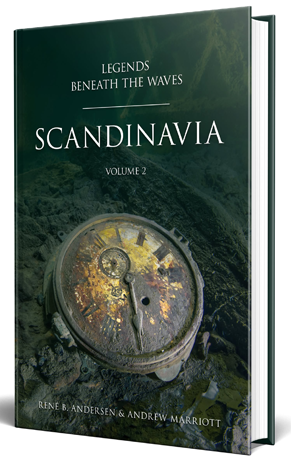
If you would like to learn more about the wreck and its remarkable history, it can be found in my ebook,
Legends Beneath the Waves: Scandinavia. (see bottom of page)
( Click Image to Enlarge )
Above: Thrown from its original position as D/S São Paulo struck the seabed in 1940, the famous 8.8 cm (88 mm) anti-aircraft gun remains one of the wreck's most iconic sights—a silent witness to the opening hours of Germany's invasion of Norway more than eighty years ago.
Above: The remarkably preserved bridge of D/S São Paulo still retains many of its original portholes, offering divers a haunting glimpse into the ship's final moments more than eighty years after her sinking.
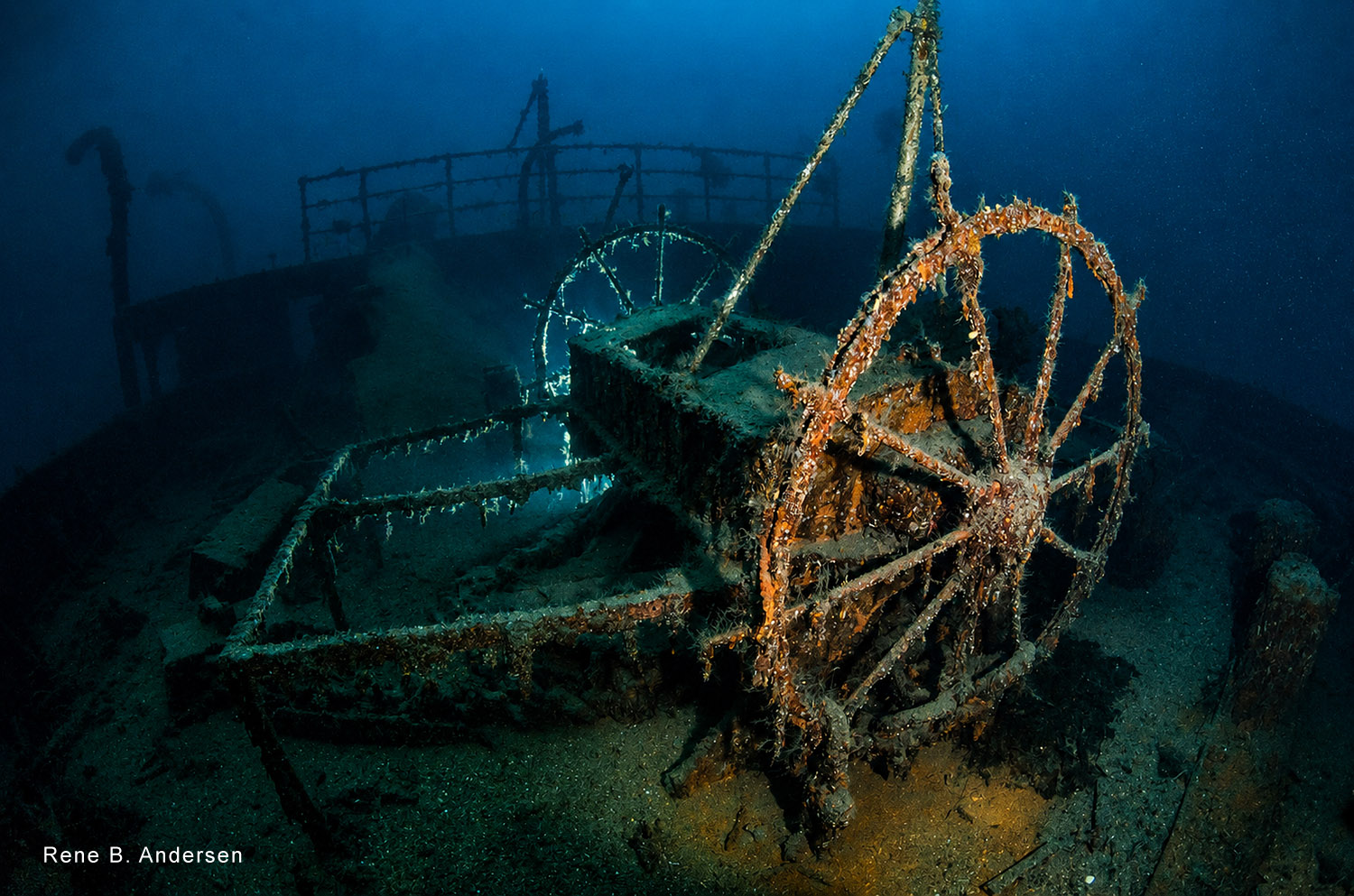
Above: At the stern of D/S São Paulo, CCR divers explore the ship's emergency steering station. The wheel and surrounding deck fittings remain remarkably intact, offering a rare glimpse into the vessel's secondary means of control preserved beneath the cold Norwegian waters.
Above: Hidden deep within one of D/S São Paulo's cargo holds lie several half-track vehicles, now resting upside down after the violence of the sinking.
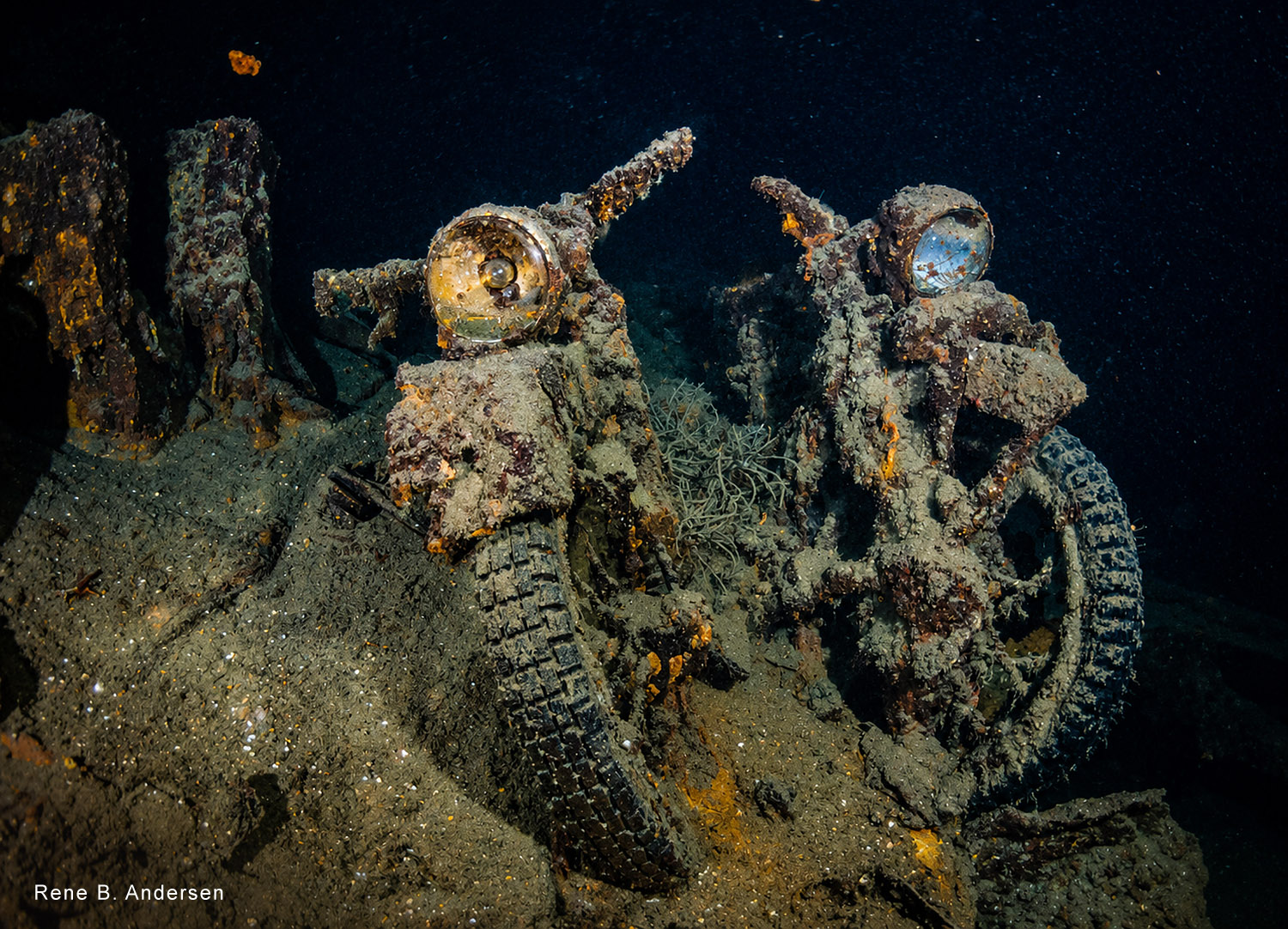
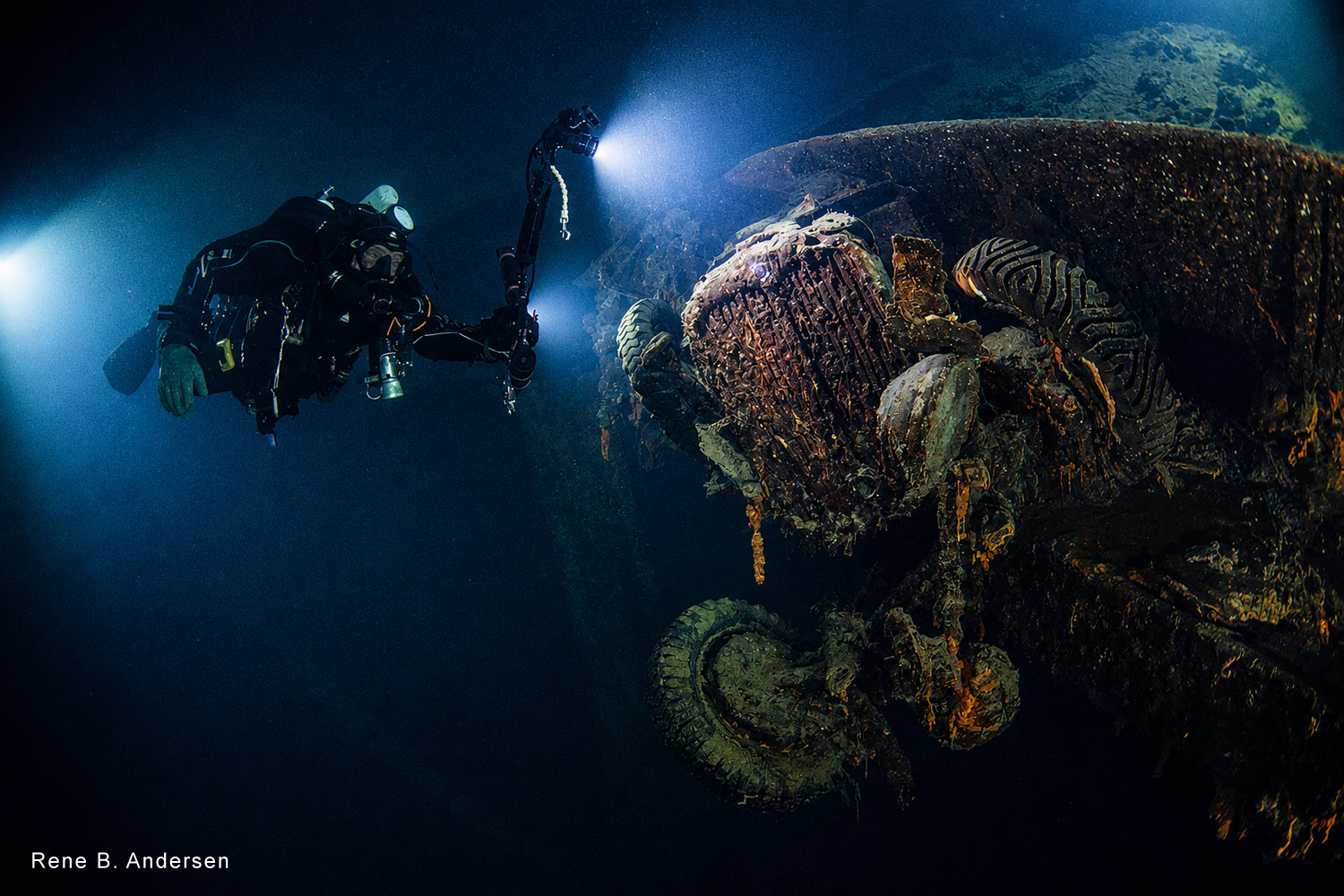
Above: D/S São Paulo's cargo holds are filled with military vehicles and BMW motorcycles destined for Operation Weserübung. Many of the motorcycles still retain their original BMW emblems, preserved beneath layers of marine growth and sediment.
Above: Capturing the famous 8.8 cm (88 mm) anti-aircraft gun in its entirety proved to be one of the most challenging photographs of the expedition. To frame the gun in side profile, I had to squeeze into less than 1.6 feet (0.5 meters) of space between the wreck and the muddy seabed—a tight fit that was well worth the effort.
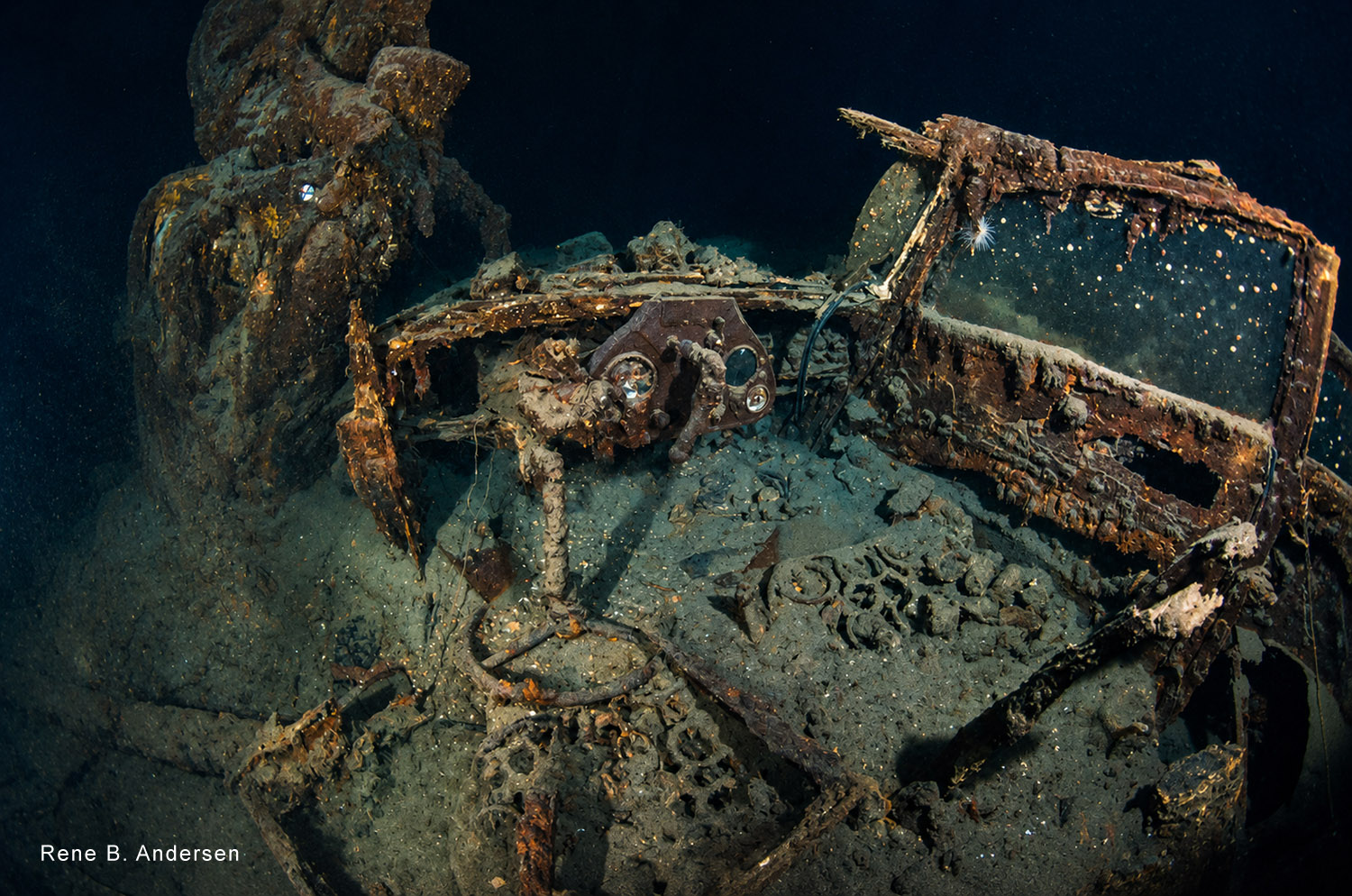
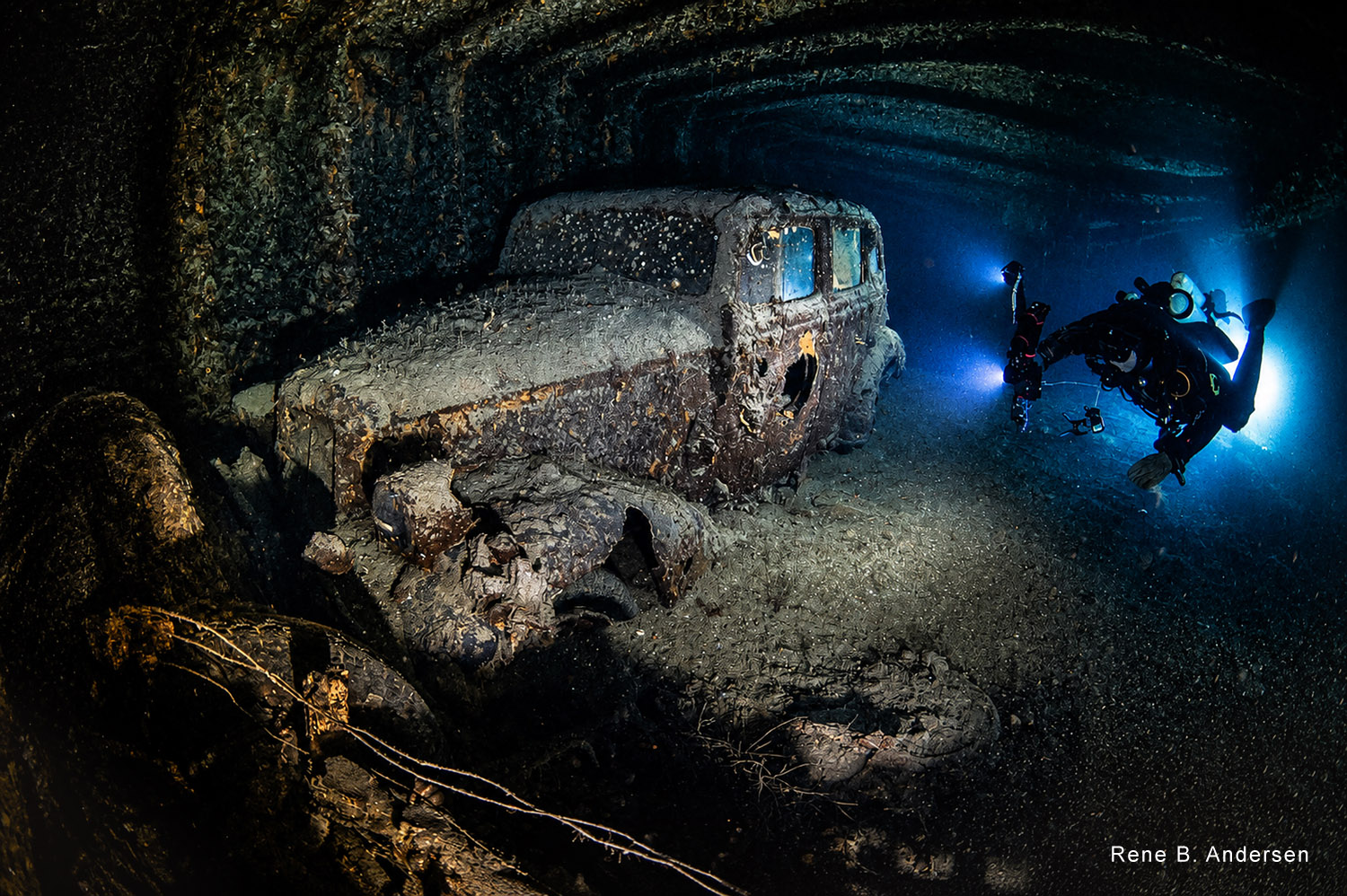
Above: Not all of D/S São Paulo's cargo has survived in pristine condition. This heavily deteriorated automobile offers a stark contrast to the remarkably preserved motorcycles found elsewhere on the wreck. Decades of exposure to salt water have reduced much of the vehicle to little more than rusted steel and fragile remnants of its former shape.
Above: These two BMW motorcycles are among the best-preserved examples found within D/S São Paulo's cargo holds. Their remarkable state of preservation has made them favorite subjects for underwater photographers visiting Norway's Scandinavian Thistlegorm.
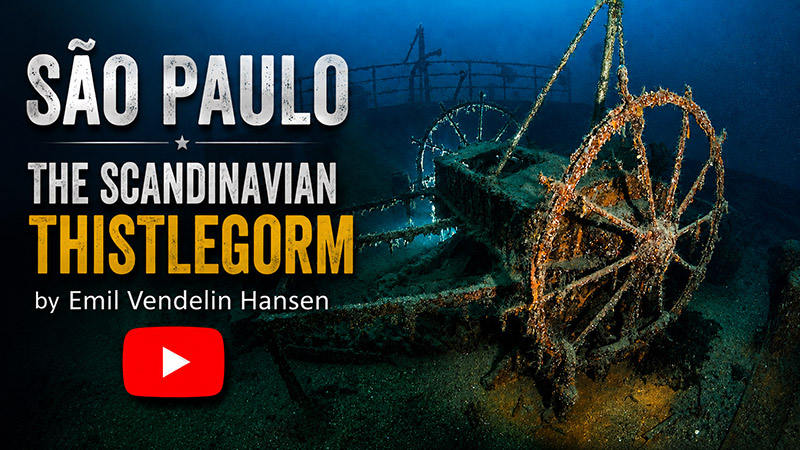
Above: Time has claimed the wooden rim of D/S São Paulo's emergency steering wheel, exposing the steel core that once lay hidden beneath. Today, it remains one of the most distinctive features found at the ship's stern.
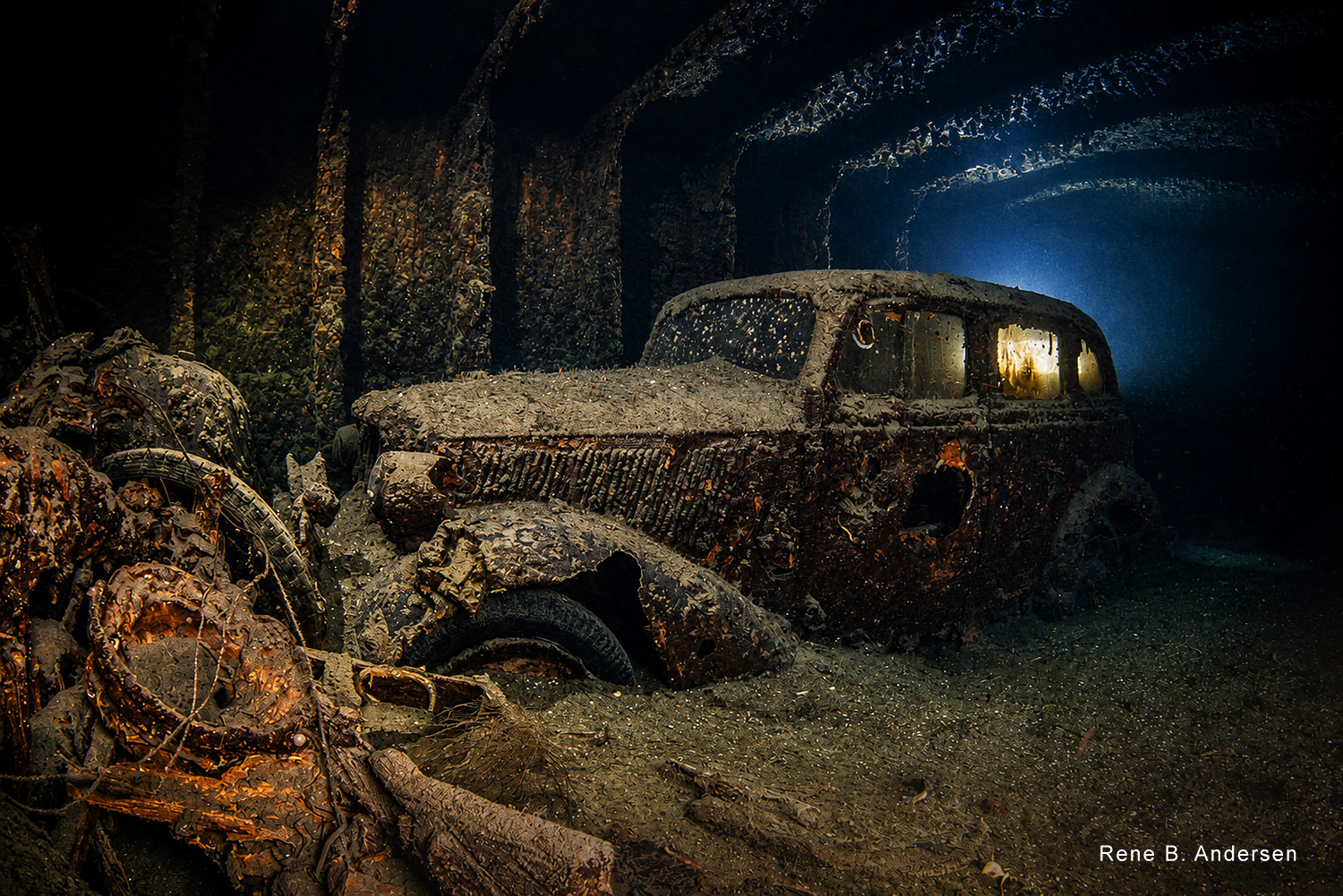
Above: This remarkably preserved automobile is considered one of the finest examples found aboard D/S São Paulo. In the lower left corner of the photograph rests a German helmet and a Karabiner 98k rifle, still lying in the vehicle's trunk exactly as they were loaded for Operation Weserübung.
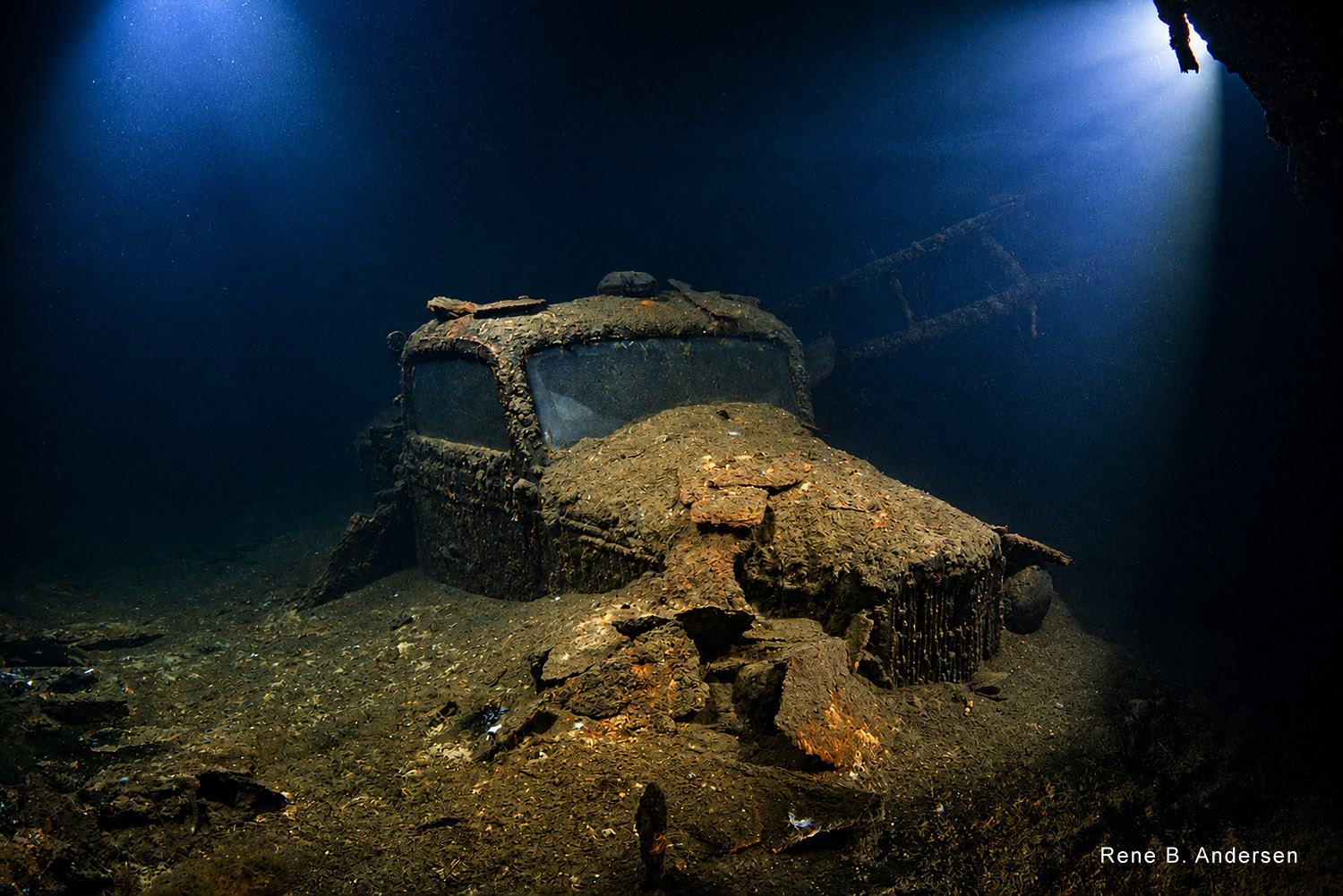
Above: Partially claimed by the seabed, this military truck rests with its lower tires hidden beneath the mud. The vehicle remains an impressive reminder of the vast quantity of military equipment being transported aboard D/S São Paulo during her final voyage.
Above: This Stoewer staff car was once among the wreck's most impressive military vehicles. Unfortunately, the passage of time has taken its toll, and the vehicle has now completely collapsed, leaving only portions of its frame and bodywork to hint at its former appearance.
Above: Divers illuminate an old automobile resting deep within one of D/S São Paulo's cargo holds. Hidden in the darkness of the wreck, it serves as a striking reminder of the vast array of vehicles being transported aboard the ship on her final voyage.
Above: With the wooden decking long since rotted away, this large artillery gun now rests exposed upon the ship's steel beams. Its elevated position provides a unique perspective rarely seen on shipwrecks, revealing both the gun itself and the underlying structure that once supported the deck above.
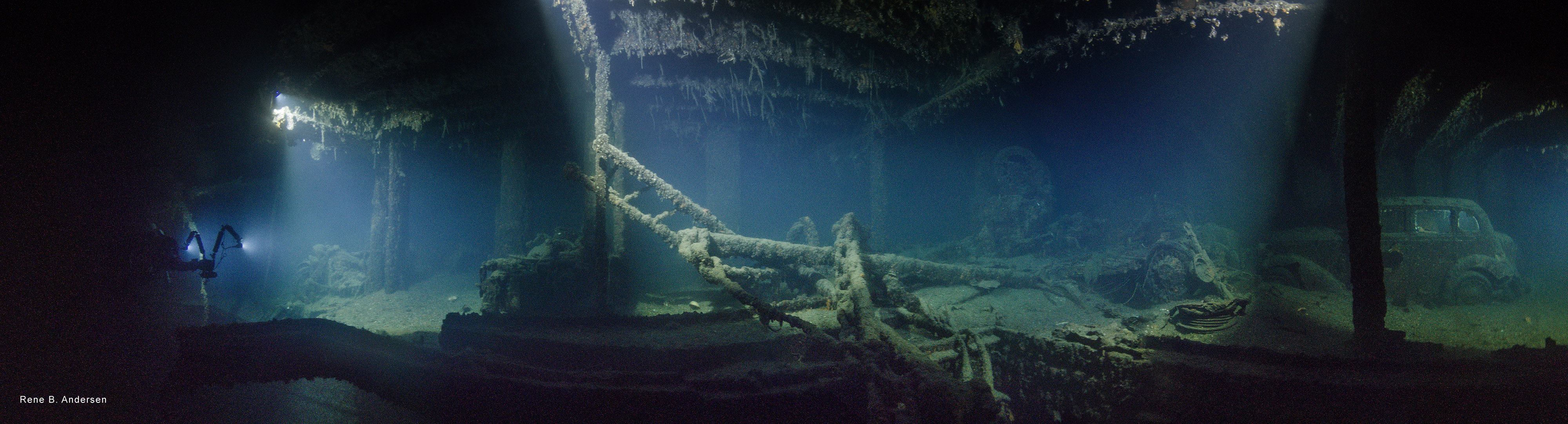
Above: Created from thirty individual photographs, this panoramic image showcases the immense scale of one of D/S São Paulo's cargo holds and the extraordinary military cargo still preserved within.
Suggested Reading
Legends Beneath the Waves: Scandinavia Vol. 1
Legends Beneath the Waves - Scandinavia is a two-volume collection of extraordinary underwater wreck photography from the cold, challenging waters of Scandinavia. Each image is backed by years of research, uncovering the dramatic histories behind these lost ships.
Strong currents, low visibility, and deep dive sites make this some of the most demanding wreck photography in the world. Capturing these images required advanced technical diving, rebreathers, and long decompression dives.
From Viking-era vessels to wartime casualties, Scandinavia’s seas hold centuries of maritime history. Preserved in dark, cold waters, these wrecks remain hauntingly intact - silent witnesses to battle, disaster, and survival.
Legends Beneath the Waves: Scandinavia Vol. 2
Legends Beneath the Waves - Scandinavia is a two-volume collection of extraordinary underwater wreck photography from the cold, challenging waters of Scandinavia. Each image is backed by years of research, uncovering the dramatic histories behind these lost ships.
Strong currents, low visibility, and deep dive sites make this some of the most demanding wreck photography in the world. Capturing these images required advanced technical diving, rebreathers, and long decompression dives.
From Viking-era vessels to wartime casualties, Scandinavia’s seas hold centuries of maritime history. Preserved in dark, cold waters, these wrecks remain hauntingly intact - silent witnesses to battle, disaster, and survival.
This book reveals a hidden world beneath the surface and brings Scandinavia’s underwater legends back to life.




 April 9th 1940 marked the beginning of Operation Weserübung—the German invasion of Norway. The plan was to capture Oslo and five other major cities along the Norwegian coast, including Bergen.