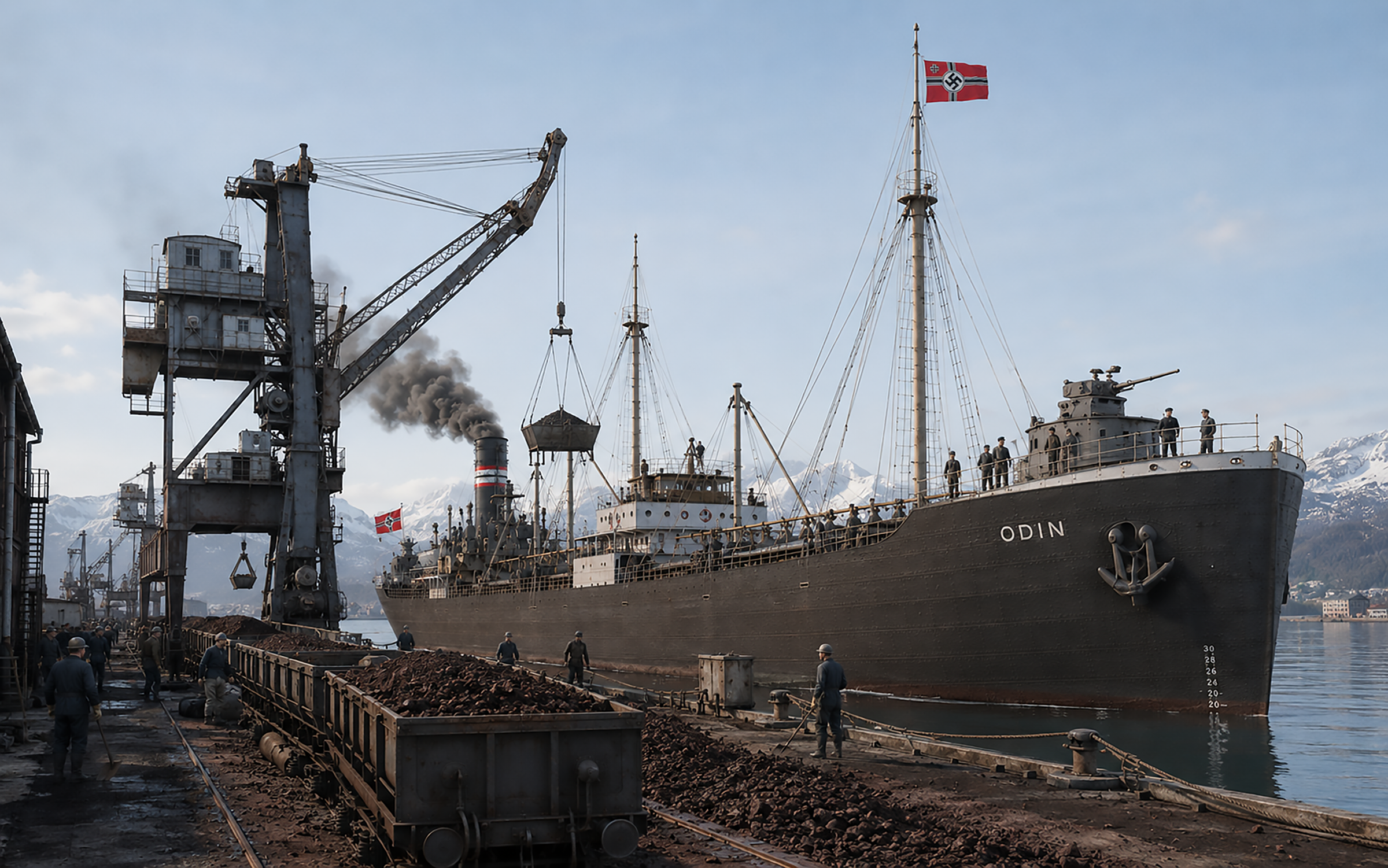
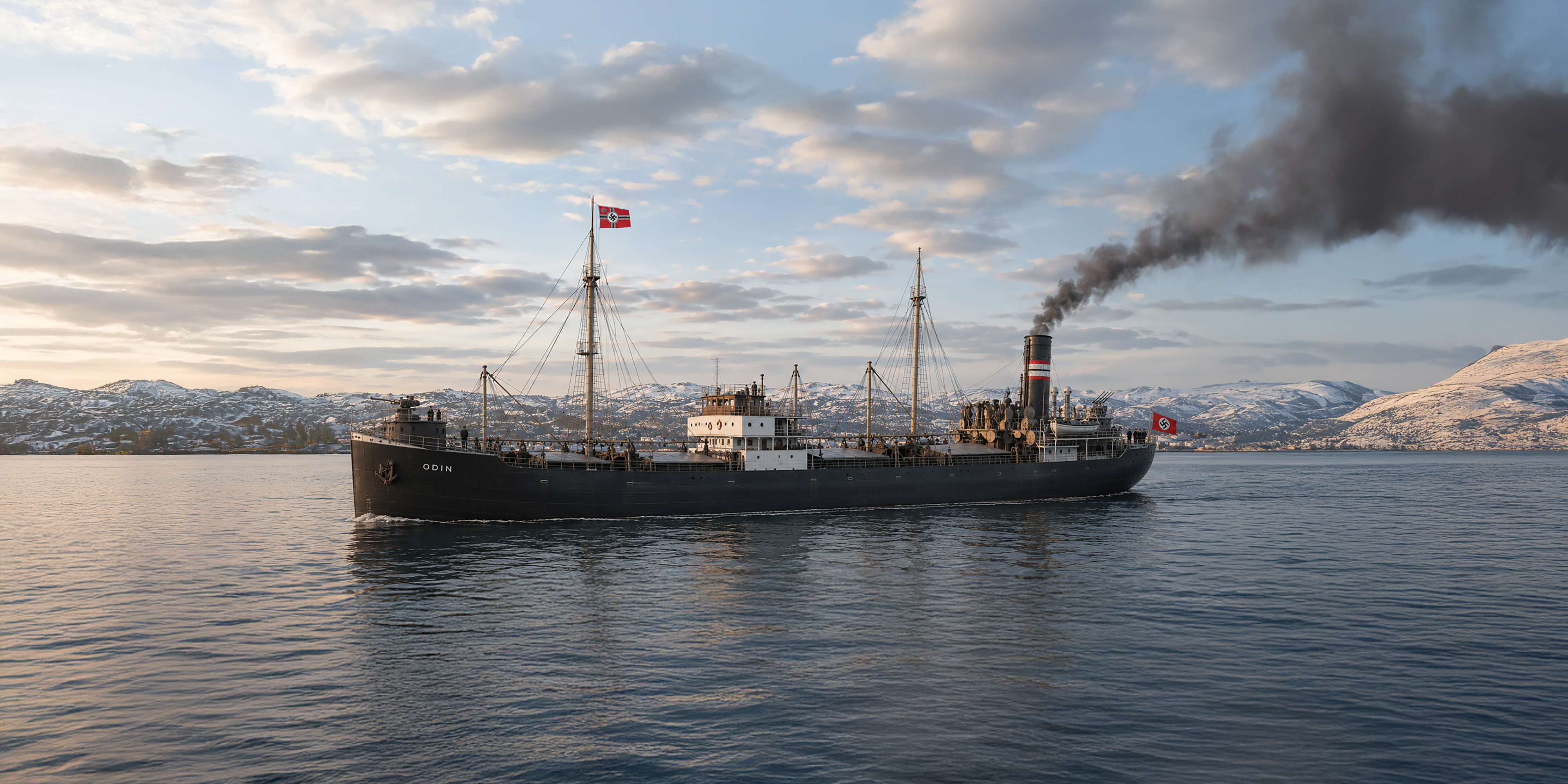
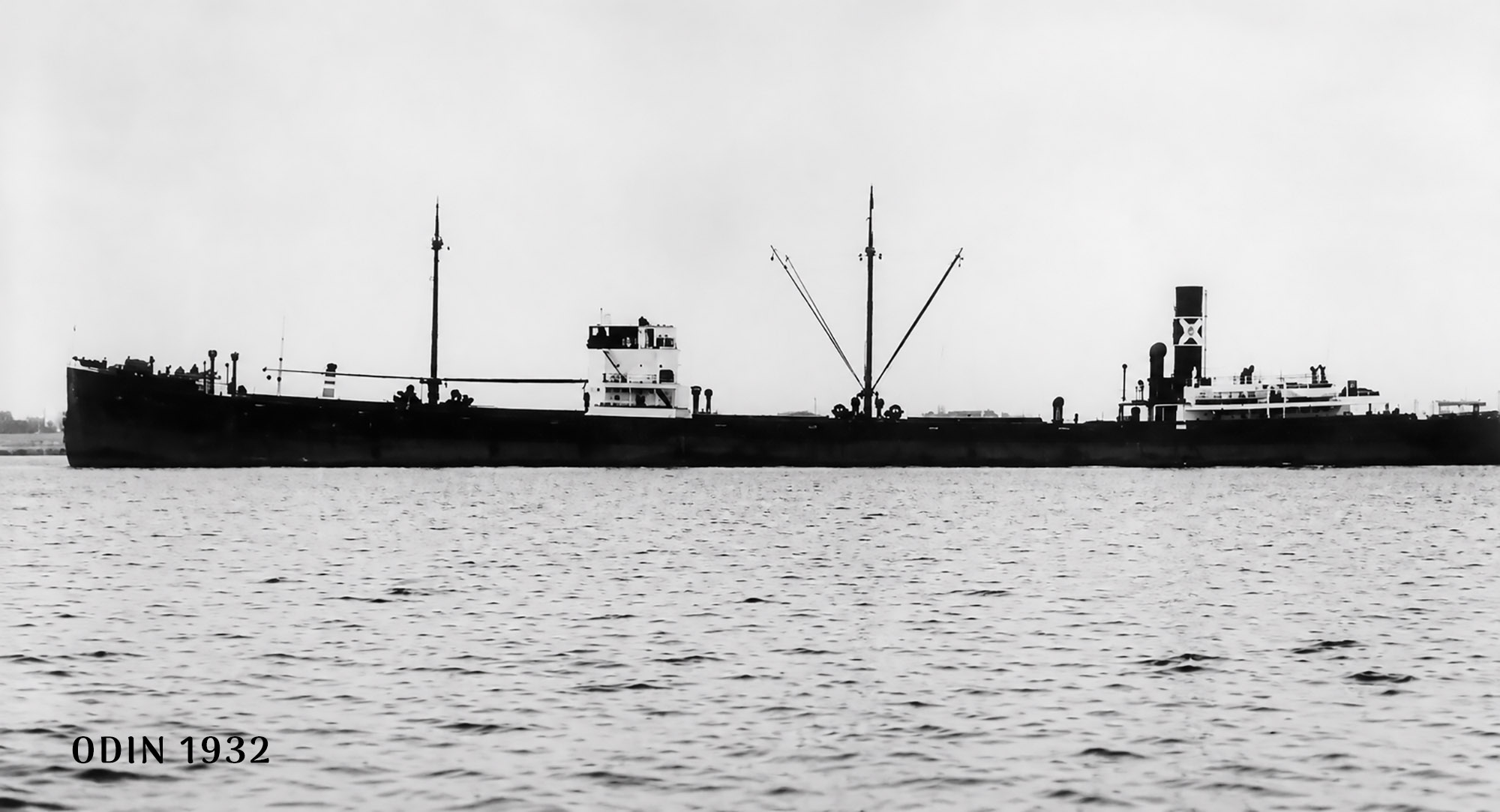
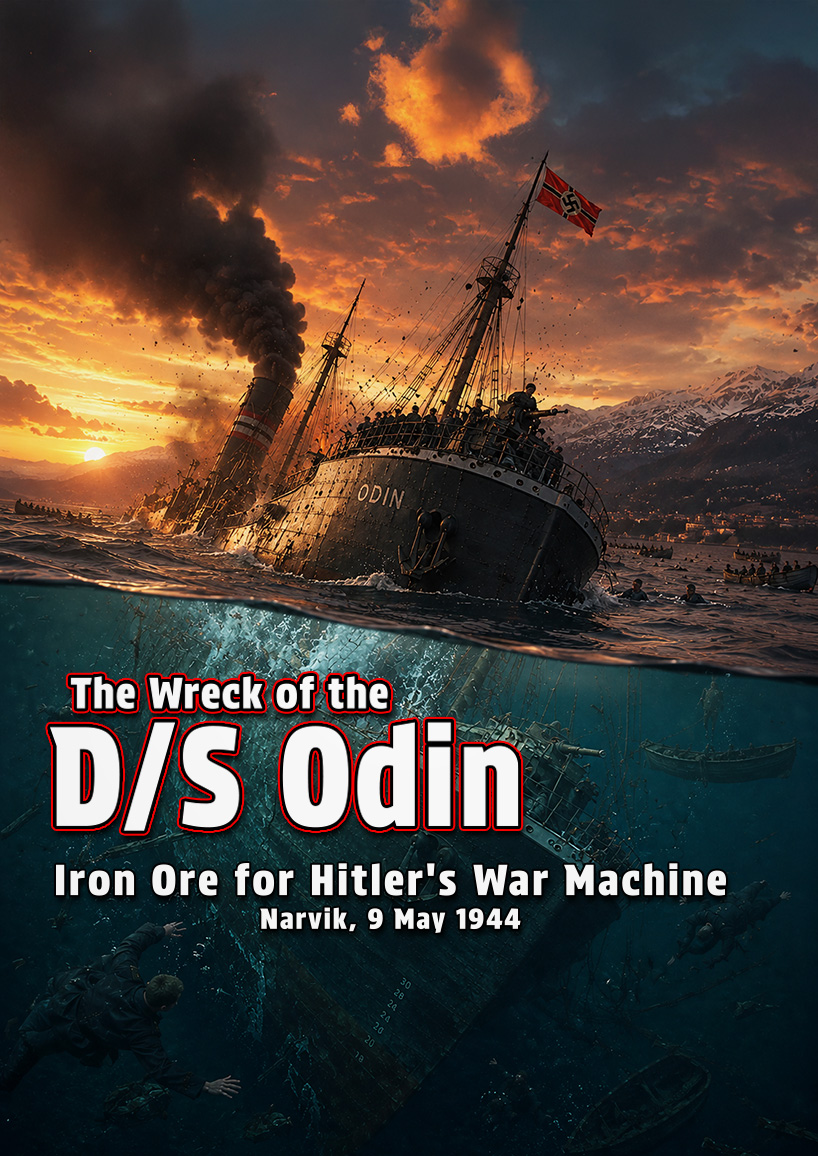
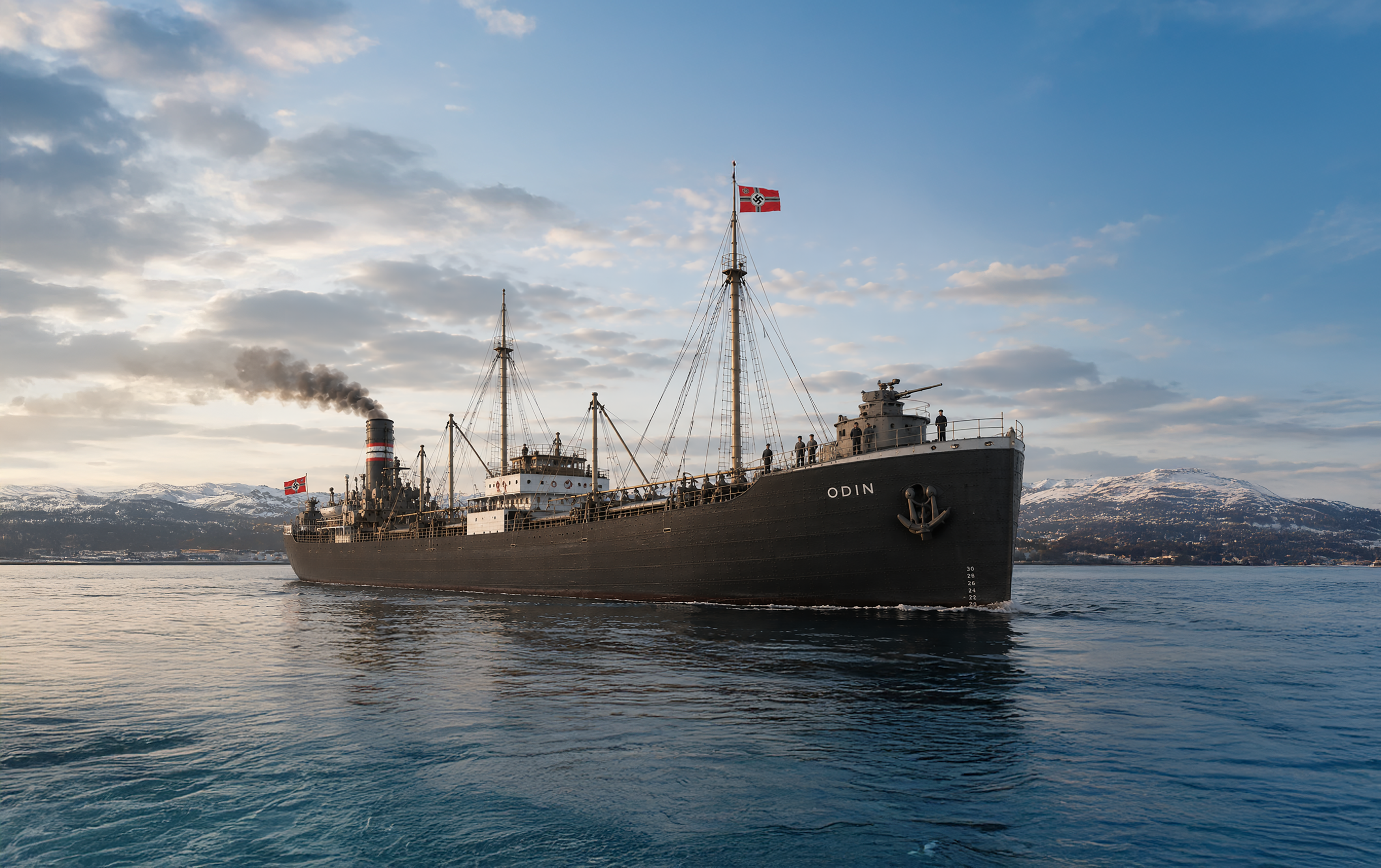
On the evening of 9 May 1944, the German ore carrier Odin lay fully loaded in Narvik Harbor, awaiting clearance for what would become her final voyage.
By the spring of 1944, four years had passed since German forces had recaptured Narvik from the Allies and resumed the export of Swedish iron ore. Nearly every ton shipped through the port was now destined for Germany's wartime steel mills and weapons factories.
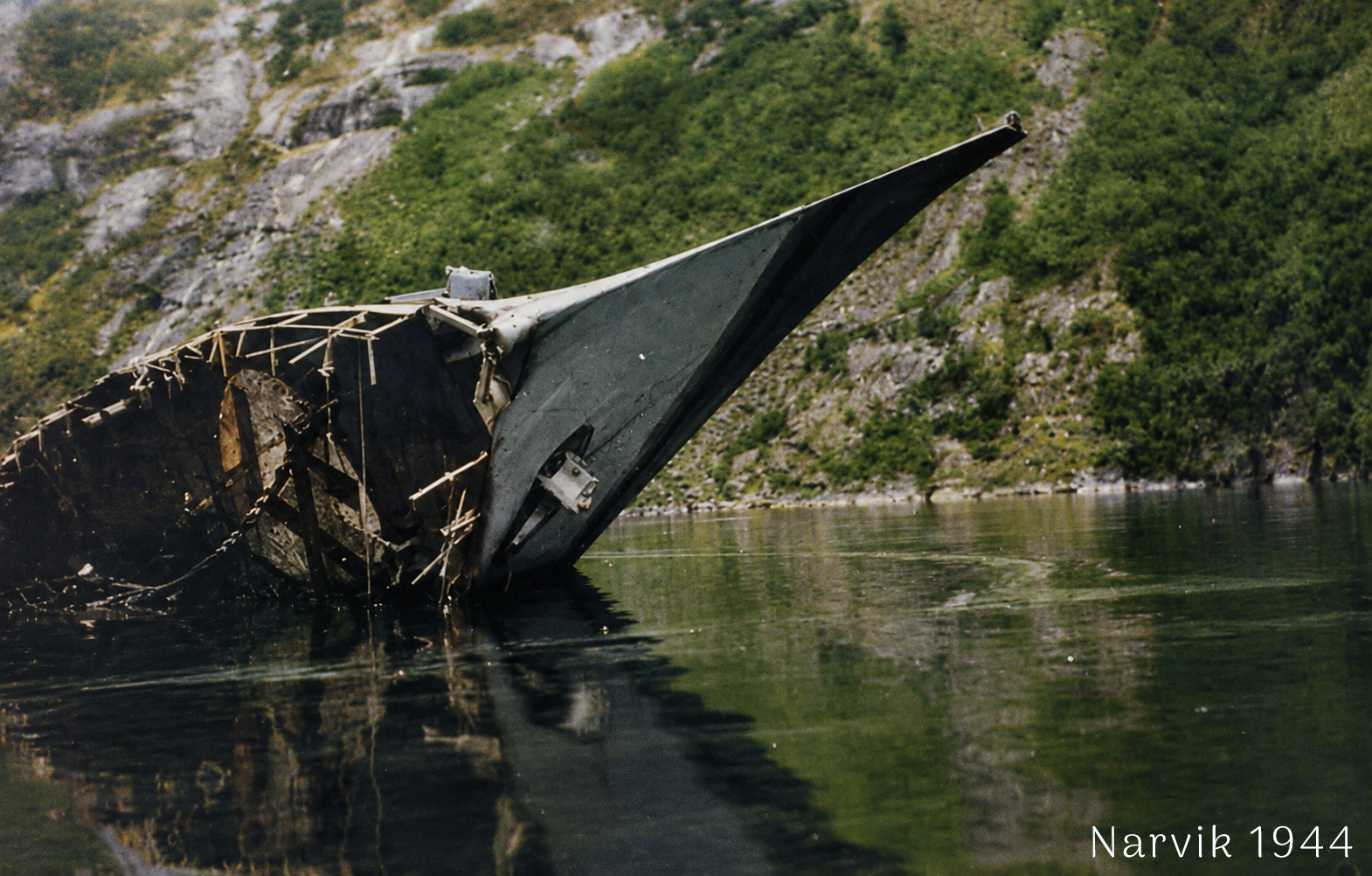
The German Navy had paid dearly for control of Narvik during the naval battles of 10 and 13 April 1940. Ten German destroyers, one submarine, and several supply ships were sunk by British naval forces. In addition to the Swedish ore carrier M/S Stråssa, nearly 30 other ore ships eventually came to rest on the floor of Narvik Harbor, creating one of the world's most remarkable underwater graveyards.
Most of these wrecks initially remained partially above the surface, their masts and bridges protruding from the water. To reopen the harbor, the bridges and masts were demolished with explosives, allowing ships to safely pass overhead. With only minimal clearance, vessels continued sailing directly above these wartime relics—and above the remains of many sailors who were never recovered following the fighting in 1940. Today, the paddle steamer PS Norge rests beneath only 52 feet (16 meters) of water, just a few hundred meters from Pier 1.
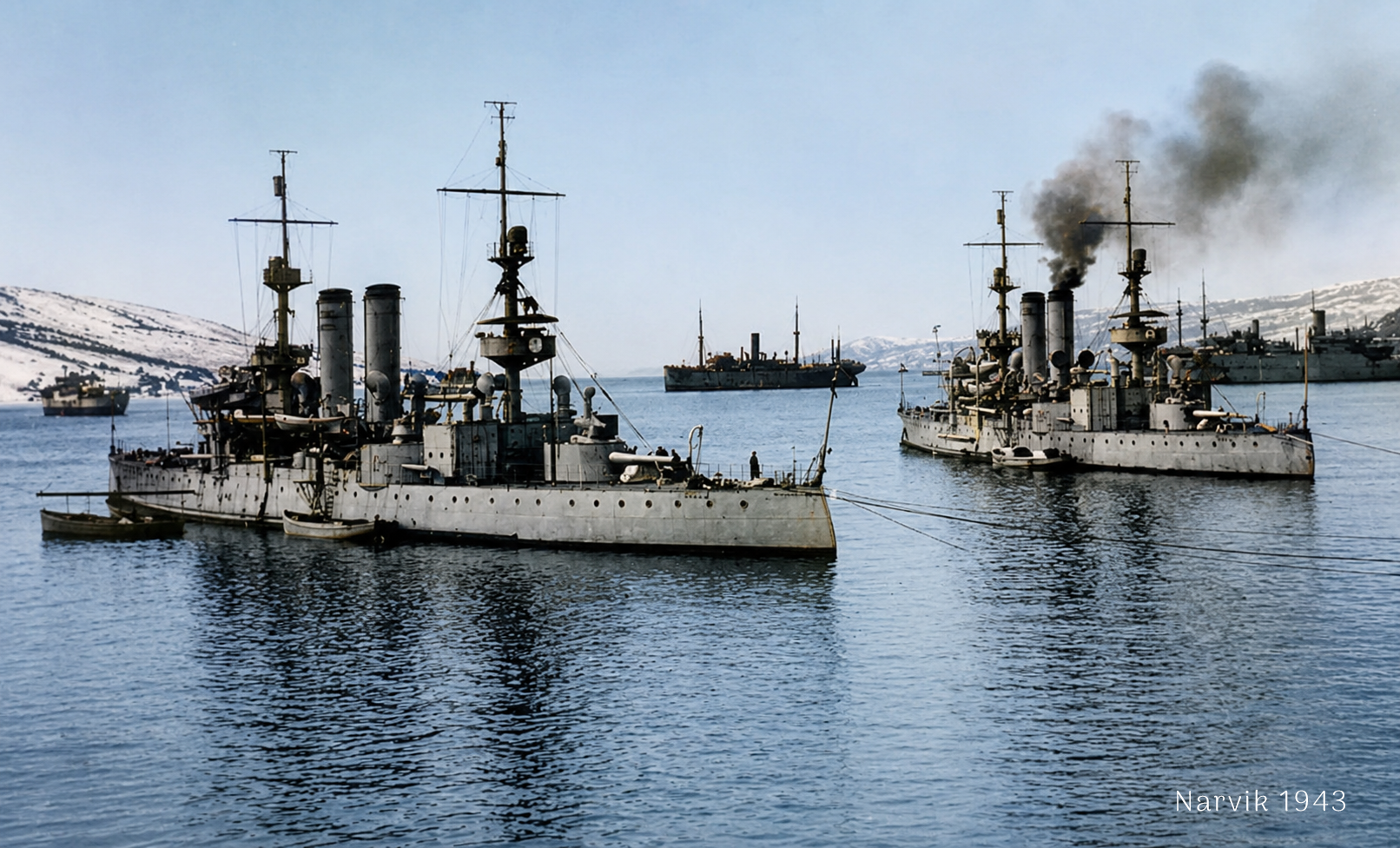
After the Allied withdrawal in the spring of 1940, German forces transformed Narvik into a heavily fortified port. Defensive positions surrounded the harbor, while Framnes became one of the most strategically important locations, overlooking the length of the Ofotfjord toward the Vestfjord. Towering mountains lined both sides of the deep fjord, creating one of Norway's most spectacular—and heavily defended—natural harbors.
A defensive minefield and anti-submarine net stretched from Båtberget on Ankenes to Framnesodden on the Narvik Peninsula. Merchant ships could only enter and leave the harbor through a narrow, carefully marked opening.
Odin Leaves the Safety of the Harbor
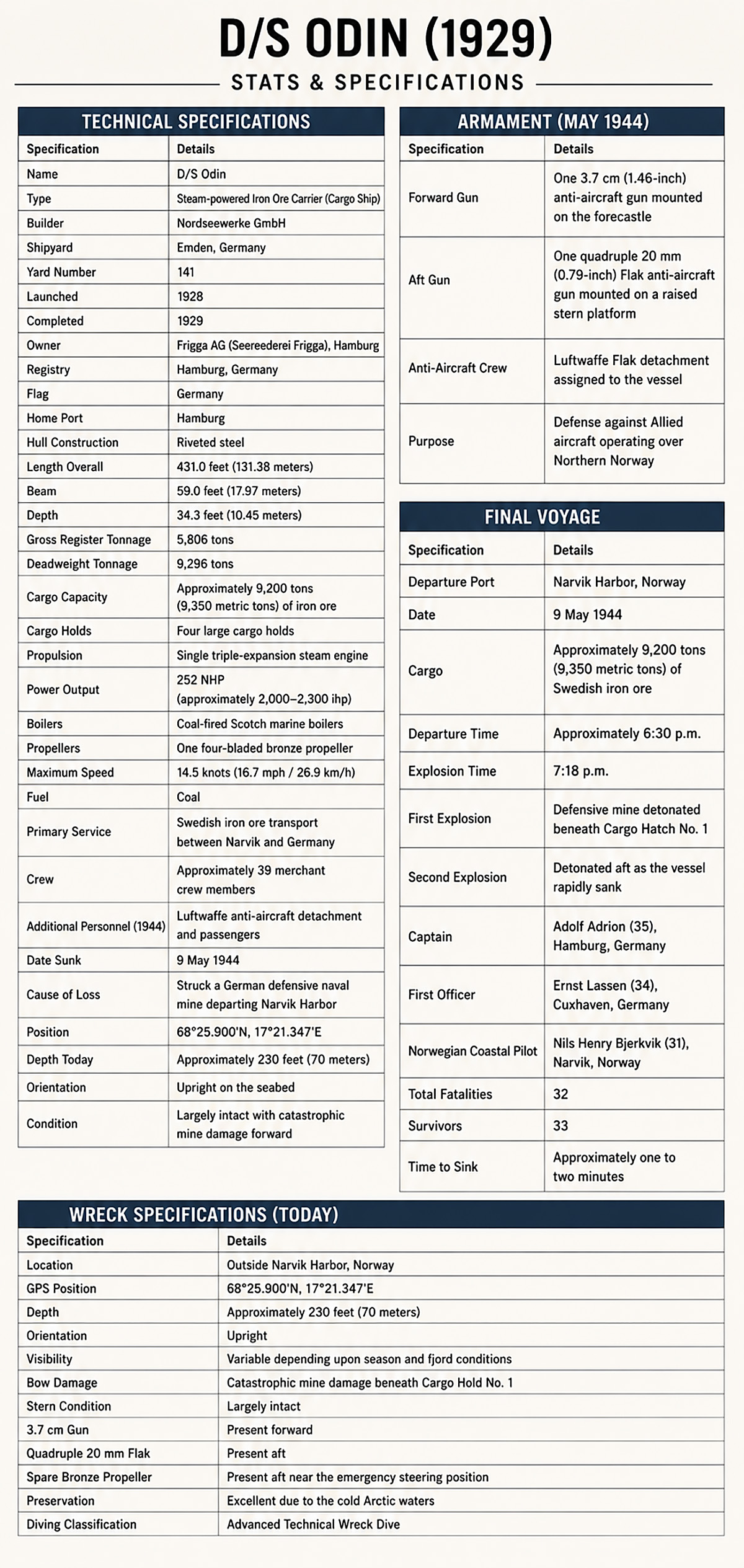
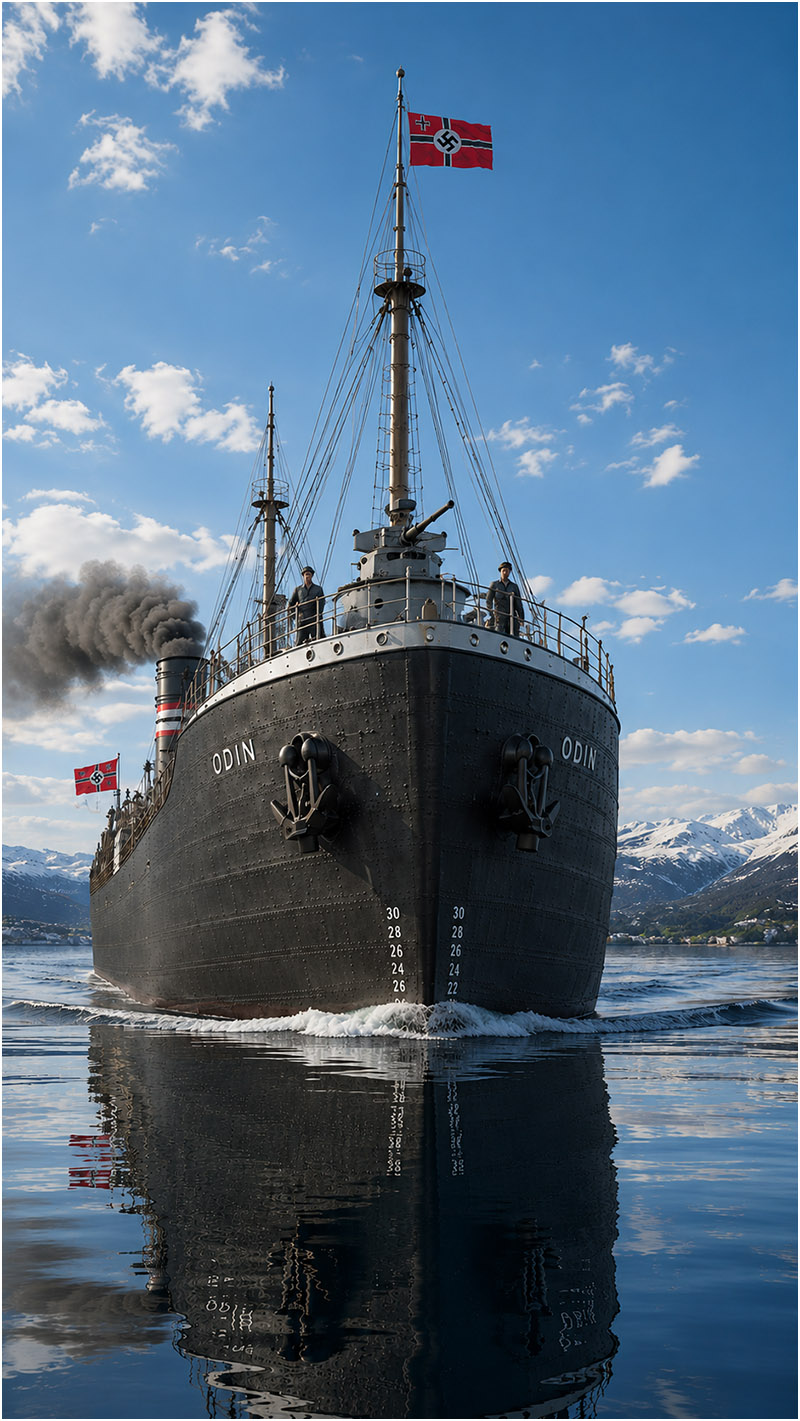
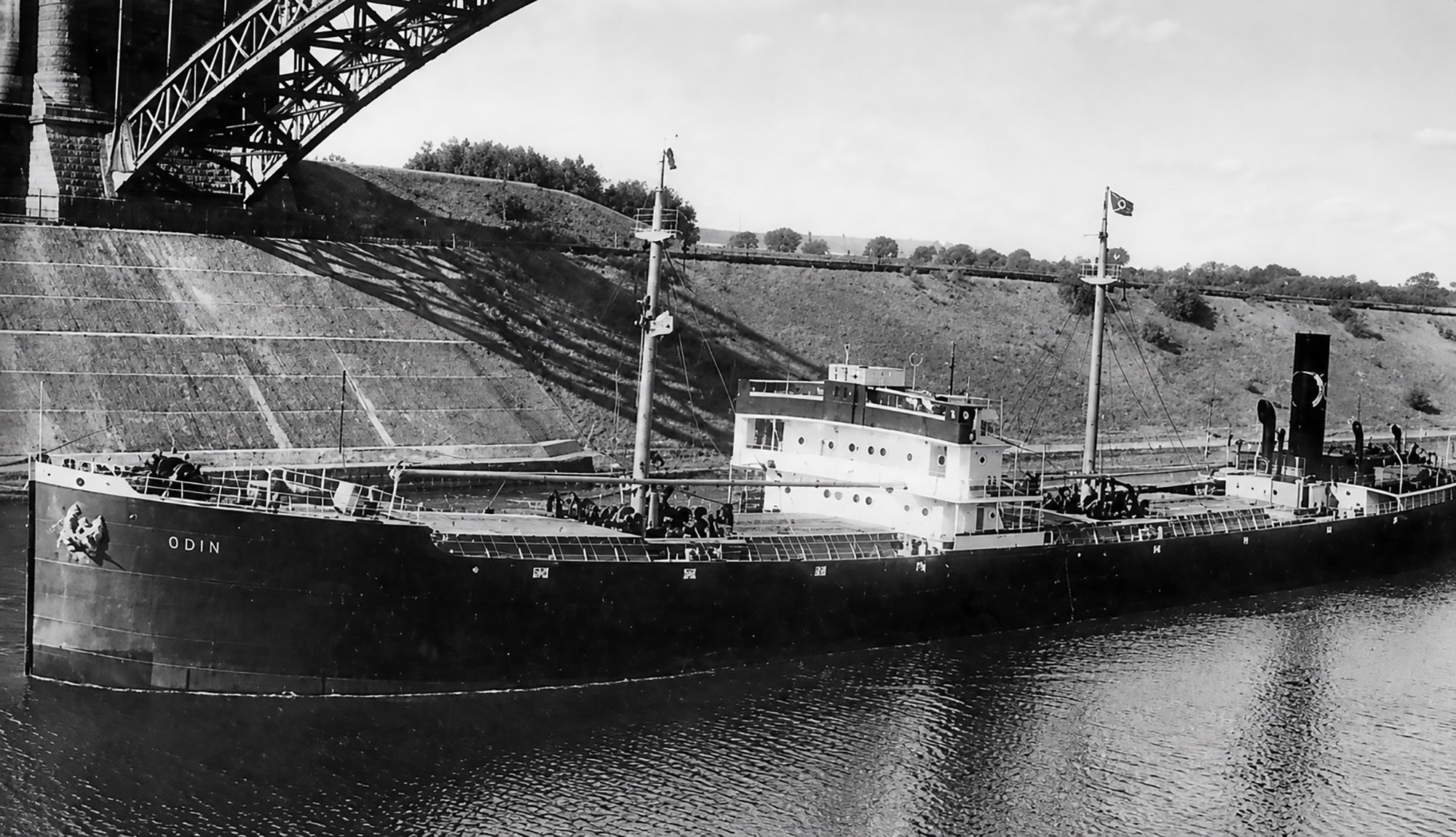
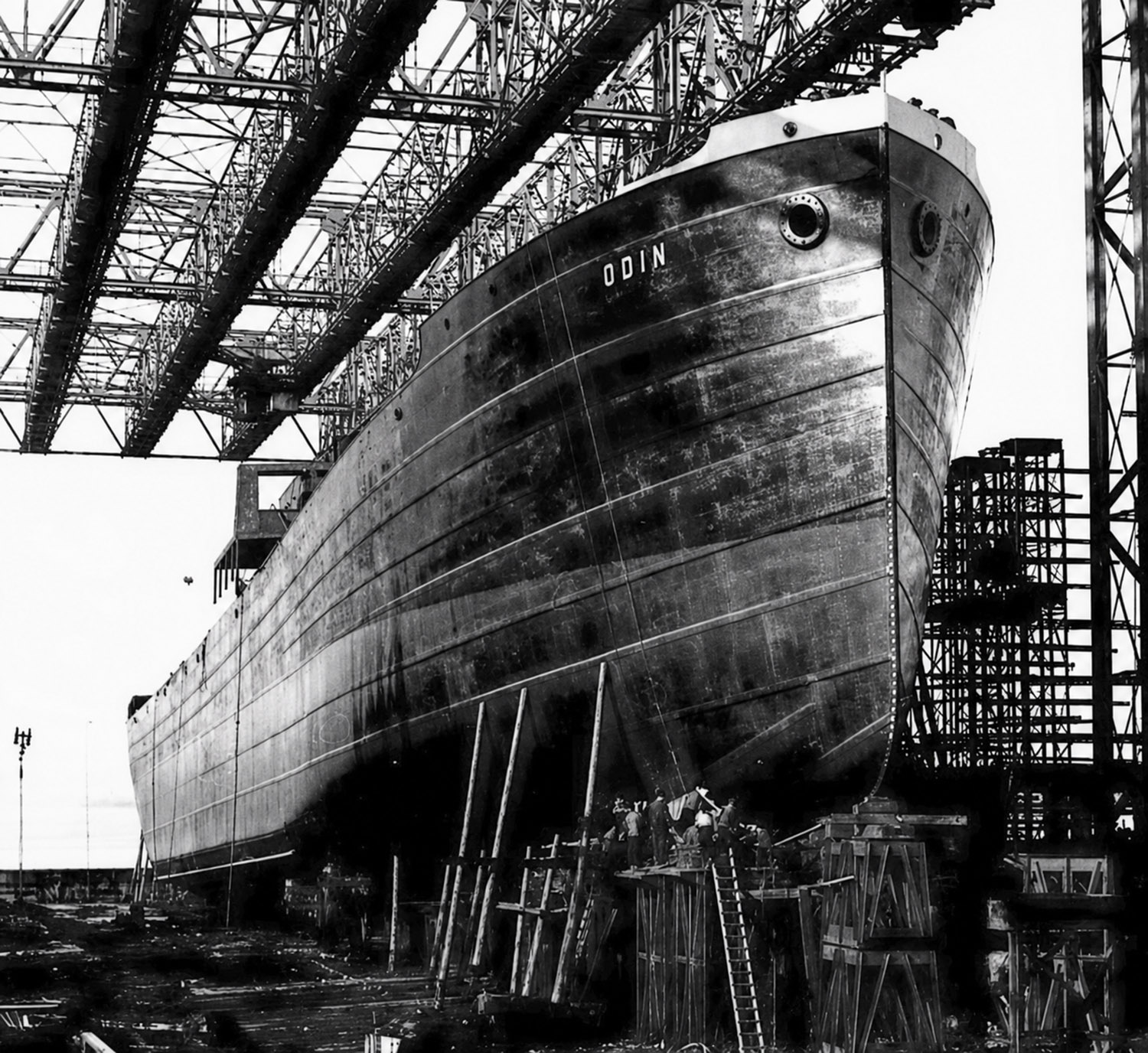
Completed in 1929 at Nordseewerke in Emden, Germany, Odin was one of Germany's modern steam-powered ore carriers. Measuring 431 feet (131.4 meters) in length and capable of carrying more than 9,200 tons (9,350 metric tons) of iron ore, she had become a familiar sight on the Narvik route transporting Swedish ore to Germany.
The afternoon had passed, and the evening remained bright on 9 May 1944. Odin had completed loading her cargo and was preparing for another dangerous voyage south.
By 1944, the ship had been fitted with defensive armament against Allied aircraft. A single 3.7 cm (1.46-inch) anti-aircraft gun occupied the forecastle, while a quadruple 20 mm (0.79-inch) Flak anti-aircraft gun had been installed on a raised platform above the stern. Beneath the gun platform, the ship's spare four-bladed bronze propeller remained secured to the aft deck alongside the emergency steering position. The engine room and coal bunkers occupied the stern, while the bridge stood amidships between the cargo holds.
At 5:30 p.m., the ship's engines came to life. Thick black smoke drifted from the funnel positioned well aft behind Cargo Hold No. 4, giving Odin a distinctive profile unlike most merchant ships entering Narvik Harbor.
Seven-year-old Harry Opdal later recalled the scene:
"Egil Jensen and I were sitting on a rock along Henryveien at Oscarsborg. There was a great deal of activity among the Germans and the ever-present Russian prisoners of war.
It was a sunny, beautiful day. On the other side of the fence surrounding the administration garden, five or six German soldiers were playing dice. They had taken off their uniform jackets to enjoy the warmth of the sun."
The fully loaded ore carrier slowly departed the loading quay.
Everything appeared peaceful. The water was calm, the evening sky remained bright, and nothing suggested that Odin would never clear Narvik Harbor.
As the ship rounded Framnesodden, disaster struck.
Harry Opdal continued:
"The German soldiers sitting below us grabbed their uniform jackets and ran down toward the camp while one of them shouted, 'Sabotage!'
After they had disappeared, Egil and I crawled under the fence and collected what they had left behind, including a board game."
On the bridge stood Captain Adolf Adrion, 35, of Hamburg, together with First Officer Ernst Lassen, 34, of Cuxhaven, and Norwegian coastal pilot Nils Henry Bjerkvik, 31, of Narvik. Also on the bridge were the helmsman and an anti-aircraft gunner. Unaware of the fate awaiting them, they carried out their duties as they had on countless previous voyages.
Shortly after 6:30 p.m., Odin cast off from the ore-loading pier in Narvik's inner harbor. She made a broad turn to starboard toward Framnesodden, proceeding slowly through the narrow opening in the defensive minefield that protected the harbor from enemy ships. German fortifications lined the shoreline from the water's edge to the highest point overlooking the fjord.
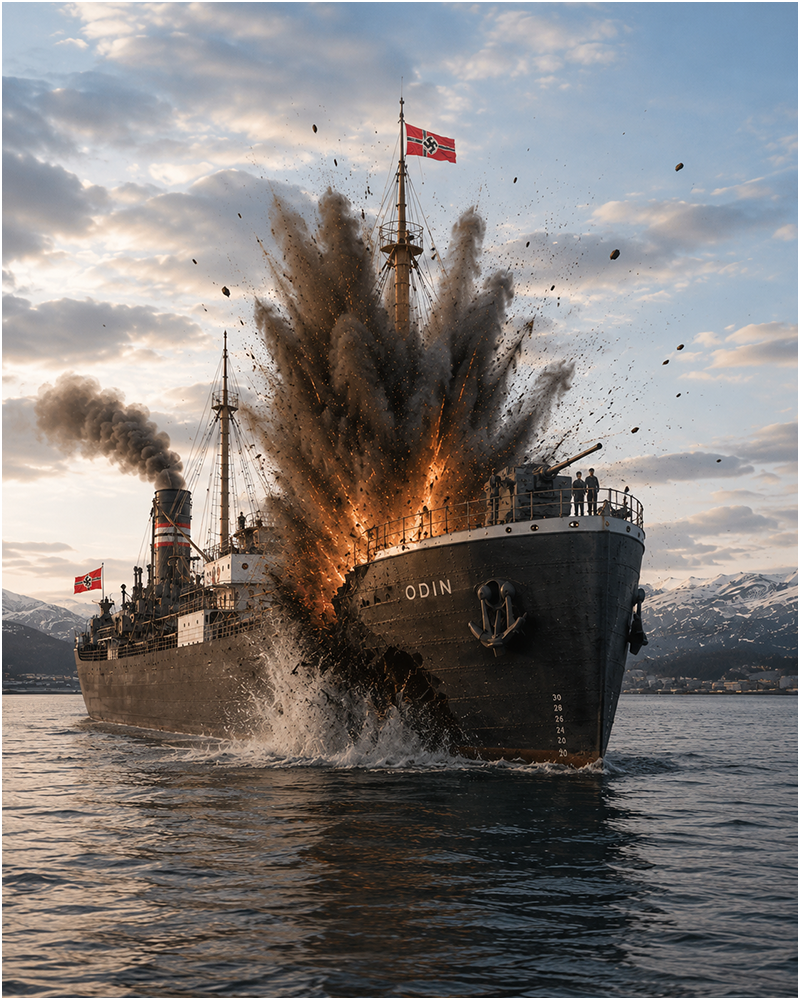
At 7:18 p.m., a violent explosion erupted beneath Cargo Hatch No. 1. Thousands of tons of iron ore were hurled into the air as a defensive mine ripped open the forward hull.
Captain Adrion immediately attempted to beach the rapidly sinking ship in shallower water. First Officer Ernst Lassen put the helm hard to starboard, steering directly toward Framnesodden. Water poured through the shattered hull with frightening speed. Within moments, the captain realized there was no hope of saving the vessel. He ordered the engine telegraph set to STOP, but there was no response from the engine room.
Captain Adrion then gave the order to abandon ship.
There was almost no time.
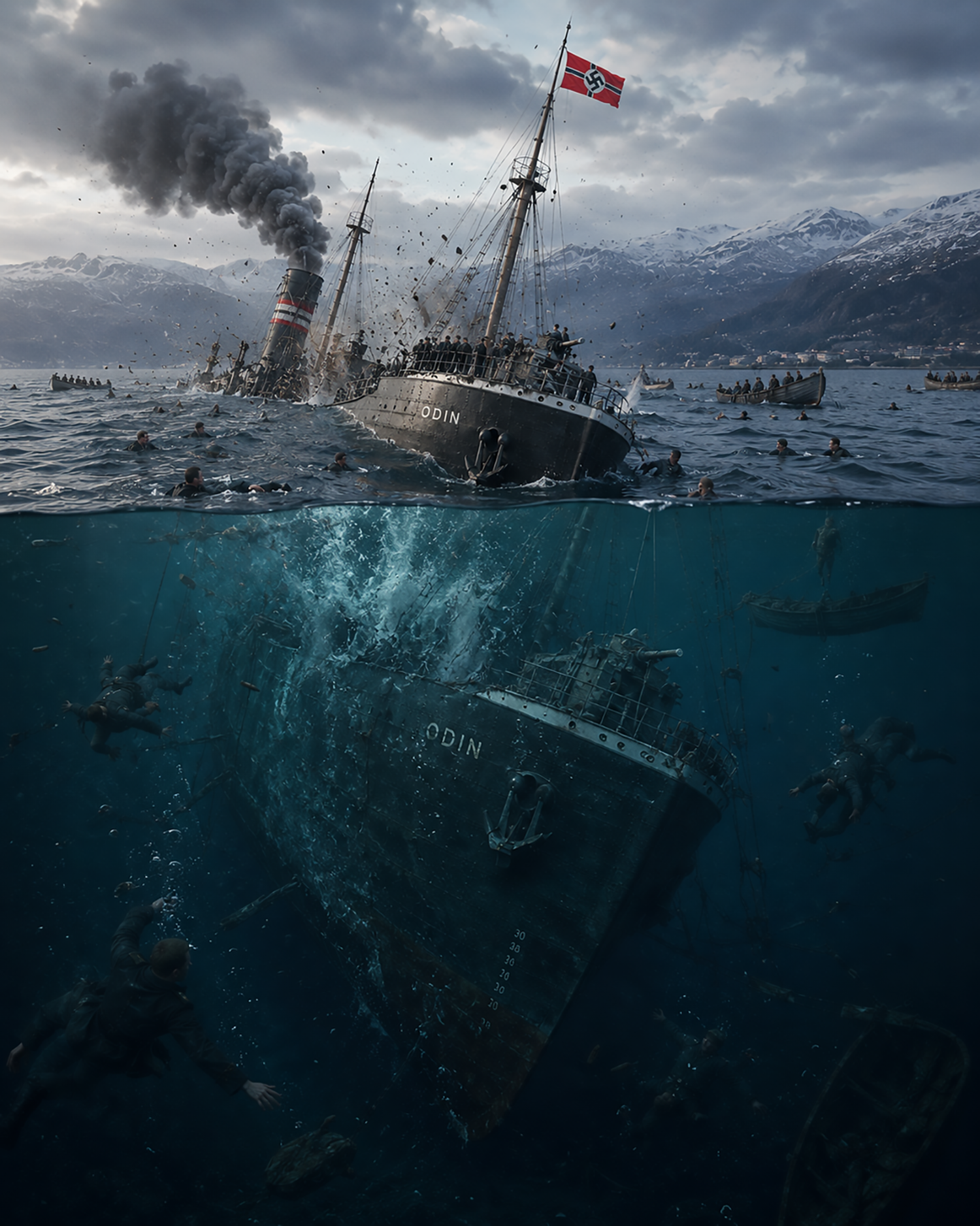
Within a minute, Odin was beyond saving. Those still visible on deck were ordered to put on their life jackets and save themselves, while others struggled to escape the rapidly flooding compartments below.
Conditions aboard the ship quickly descended into chaos. Water surged through the holds and machinery spaces. Witnesses ashore later recalled that the vessel seemed to rear almost upright before beginning her final plunge.
Moments after the first explosion, a second violent blast thundered near the stern. Chaos engulfed the fully laden ore carrier as she slipped beneath the surface, while the cries of those trapped aboard echoed across the otherwise peaceful spring evening.
A harbor patrol boat, several cutters, and local rowboats rushed to the scene in a desperate effort to rescue survivors.
There were many more people aboard Odin than just her merchant crew bound for Germany.
The sinking claimed the lives of 21 crew members, nine anti-aircraft artillery personnel, one German soldier traveling on leave, and Norwegian coastal pilot Nils Henry Bjerkvik of Narvik. Another 18 crew members and 15 anti-aircraft gunners were rescued from the icy waters.
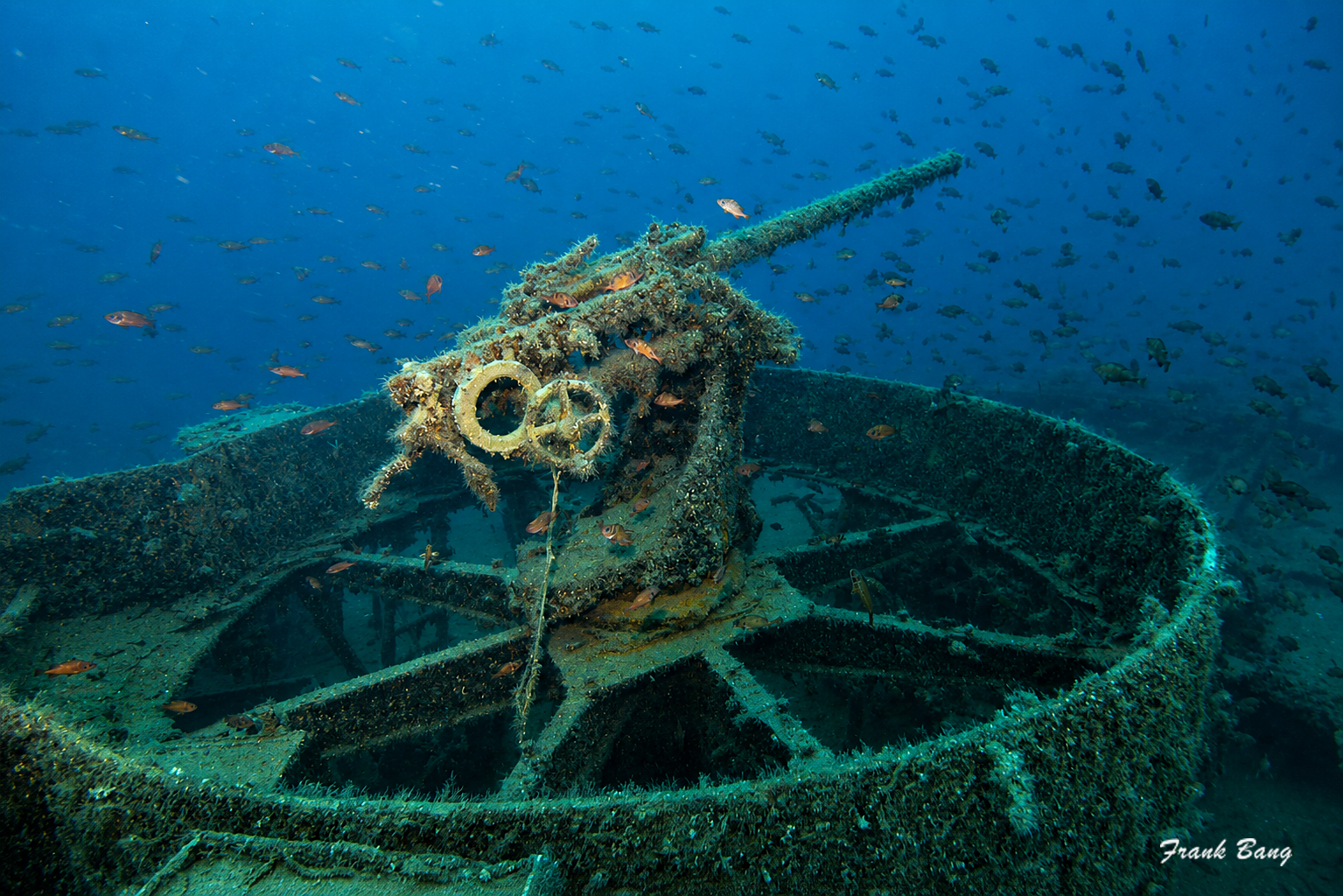
Within only a few minutes, Odin had disappeared beneath the waters of Narvik Harbor, taking 32 lives with her. Today she rests upright on the seabed in approximately 230 feet (70 meters) of water, remarkably preserved by the cold Arctic environment. Her bow-mounted 3.7 cm (1.46-inch) anti-aircraft gun and the quadruple 20 mm (0.79-inch) Flak mount at the stern remain among the most recognizable features of the wreck. For technical divers, Odin has become one of Norway's finest deep wreck dives—a haunting time capsule and a powerful reminder of the human cost of the Second World War.
Special Thanks to divers: Bjørn Stenvold and Frode Richardsen. Boat support team: Terje Seiness, Robert Berg, Mats Jorgensen.
The images in this article are CGI-generated historical reconstructions created to accurately depict a documented historical event based on available evidence and historical records.
( Click image to Enlarge )
Above: The 3.7 cm (1.46-inch) anti-aircraft gun remains remarkably preserved on Odin's bow, where it stood during her final voyage from Narvik on 9 May 1944. It was manned by a Luftwaffe Flak detachment assigned to defend the ore carrier from Allied aircraft.
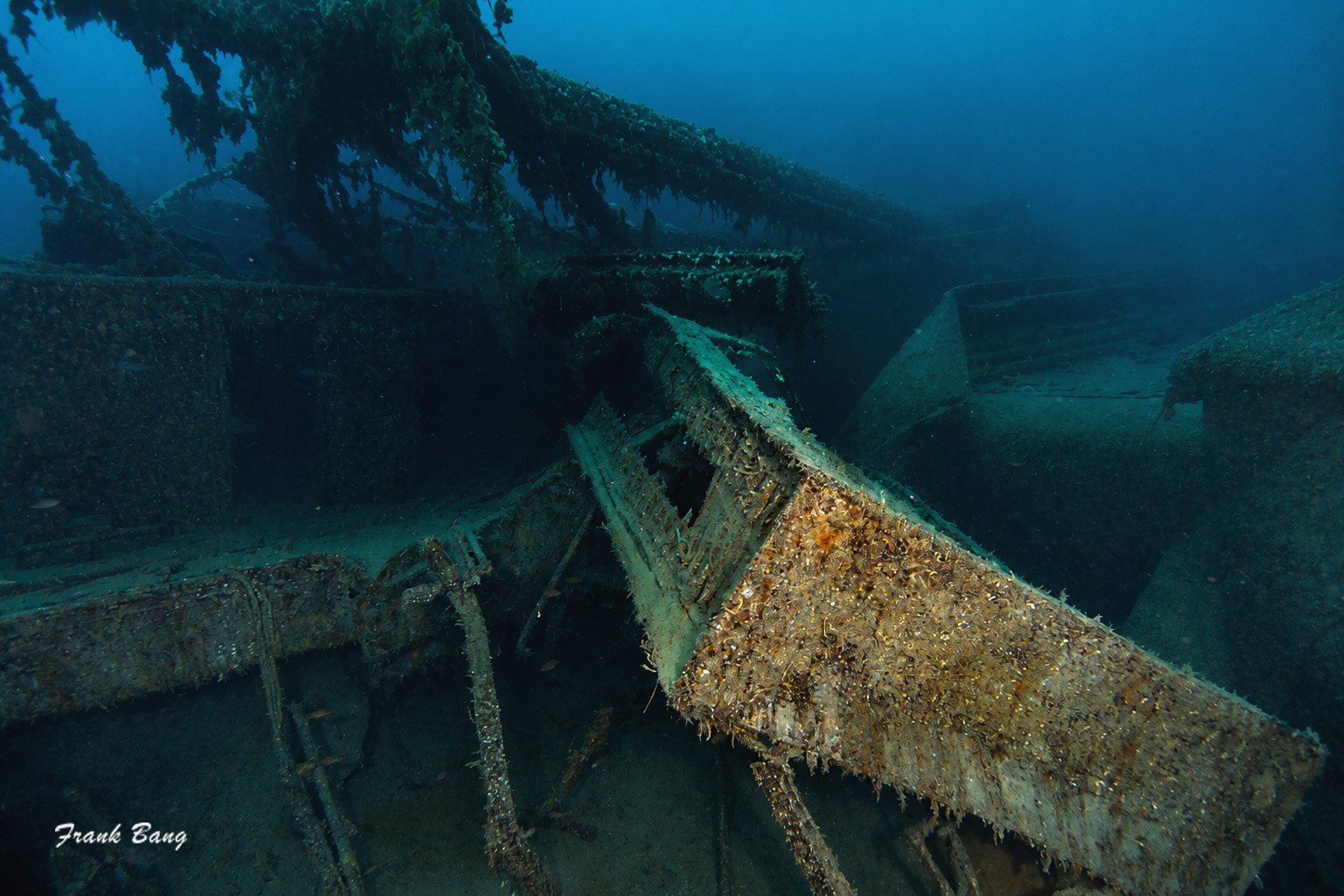
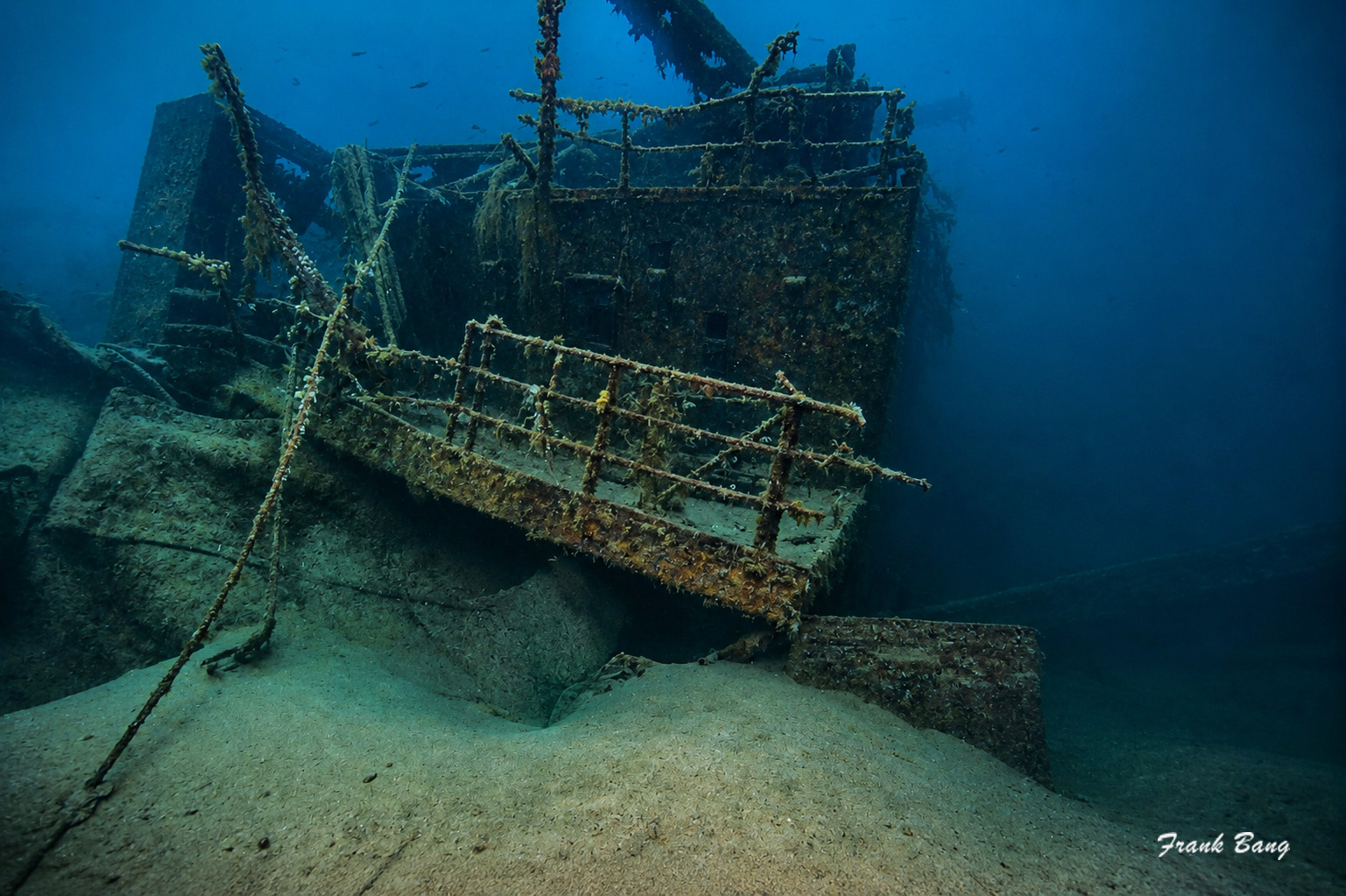
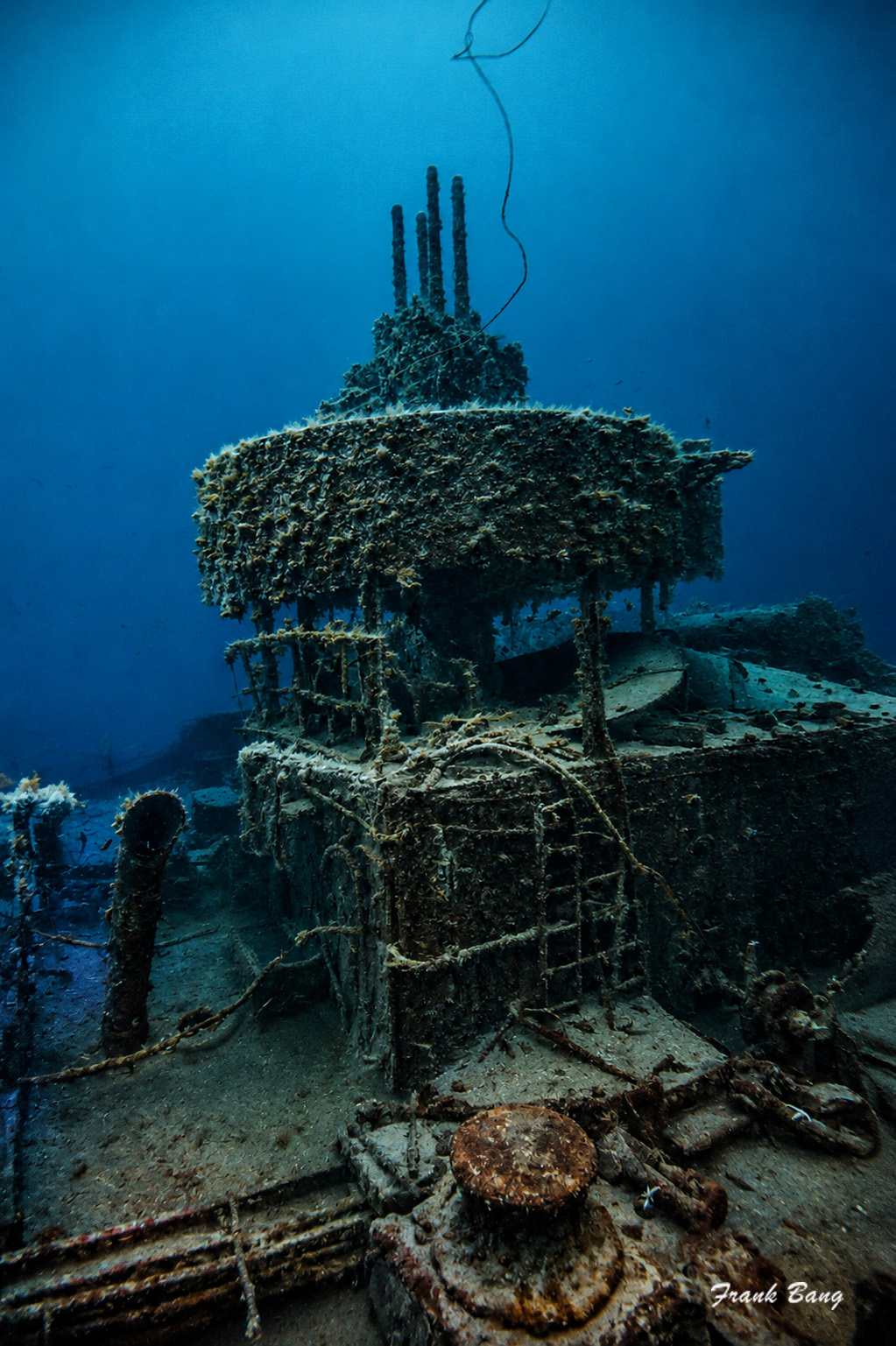
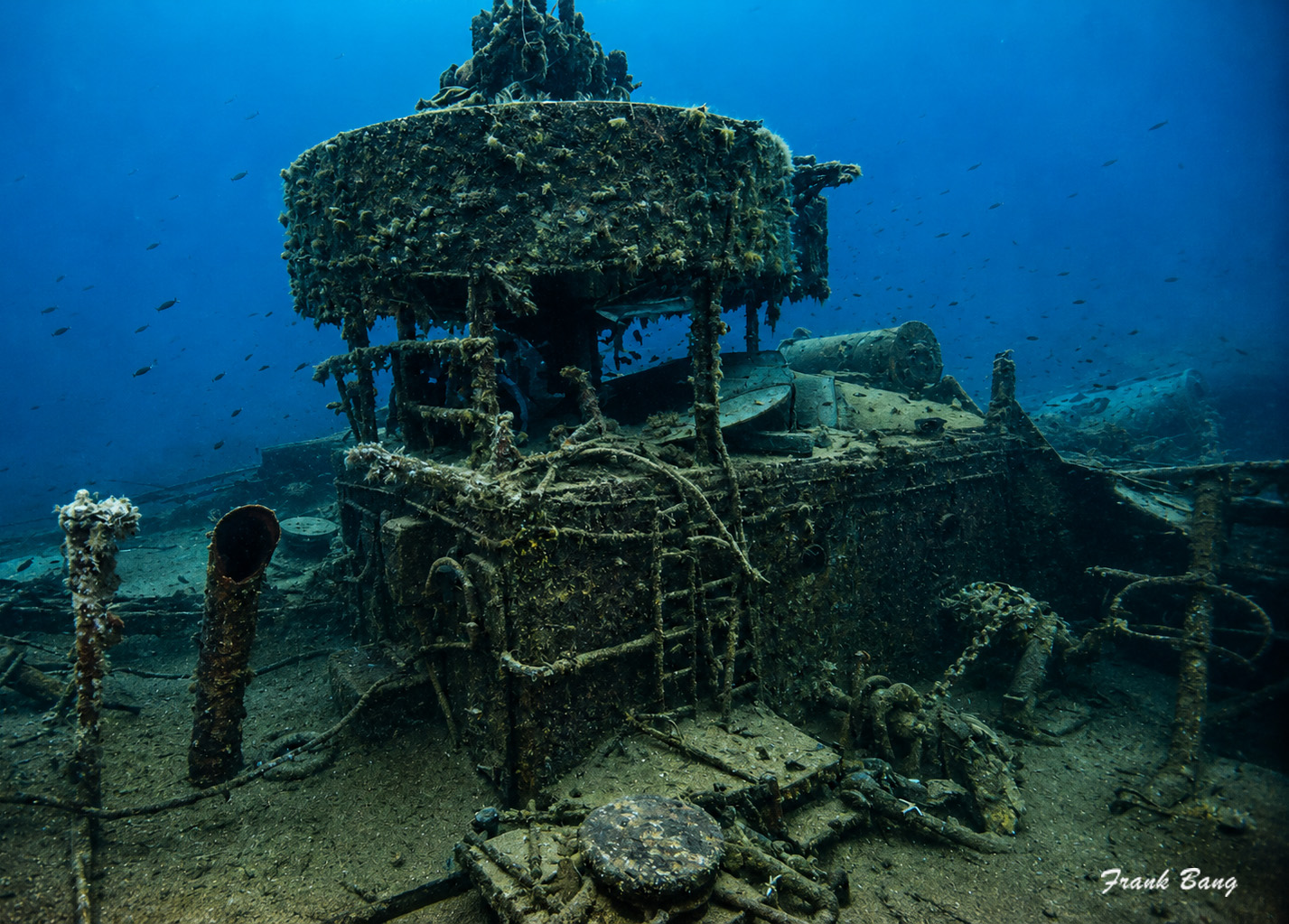
Above: The port side of Odin's bridge remains remarkably well preserved at a depth of 230 feet (70 meters). Once occupied by Captain Adolf Adrion and his officers during the ship's final voyage, it now rests silently beneath the cold waters of Narvik Harbor.
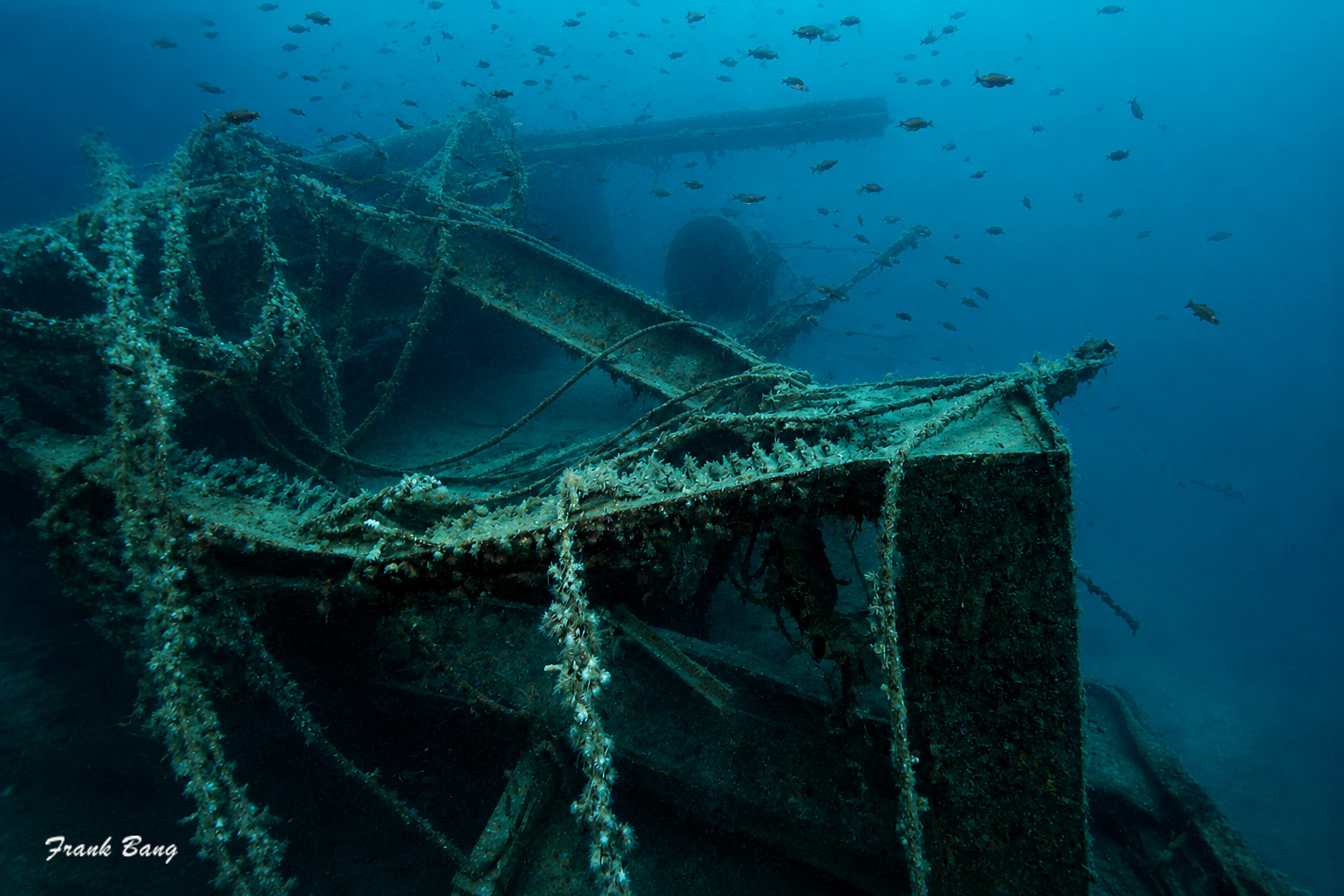
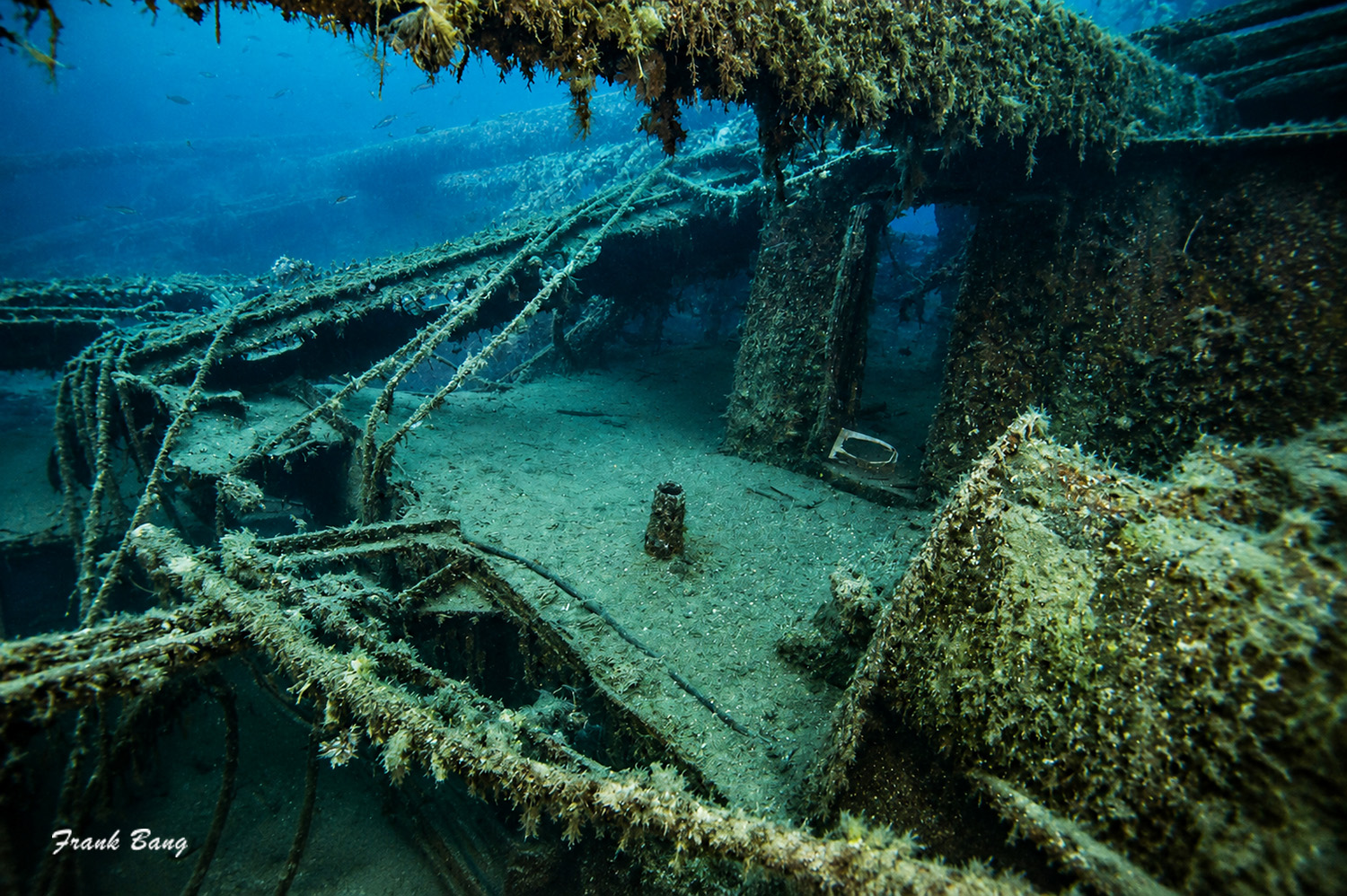
Above: Looking forward from the starboard side of the bridge, divers can peer toward Cargo Hold No. 1 where the defensive mine detonated. The explosion ripped open Odin's forward hull, sending thousands of tons of iron ore skyward and sealing the ship's fate.
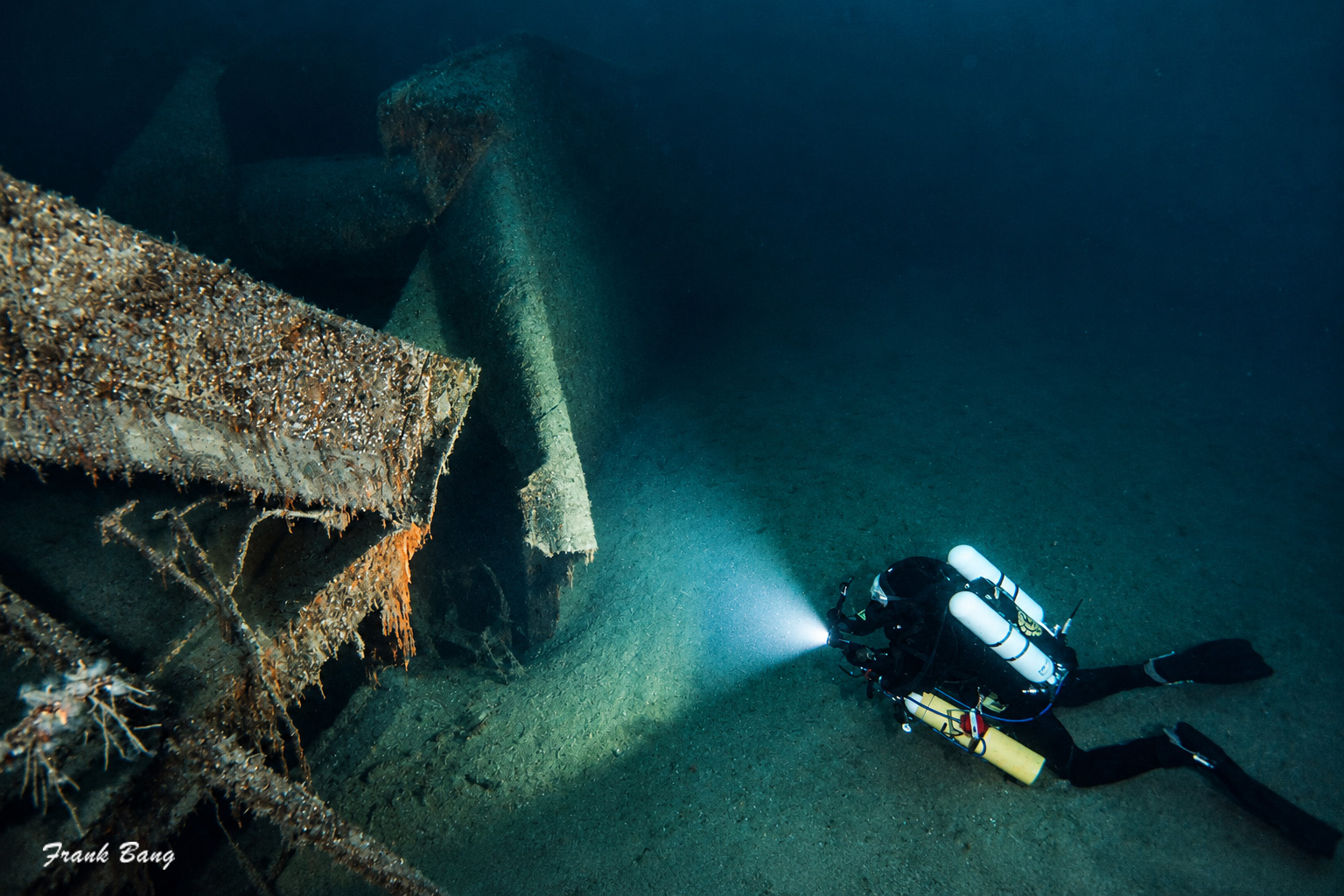
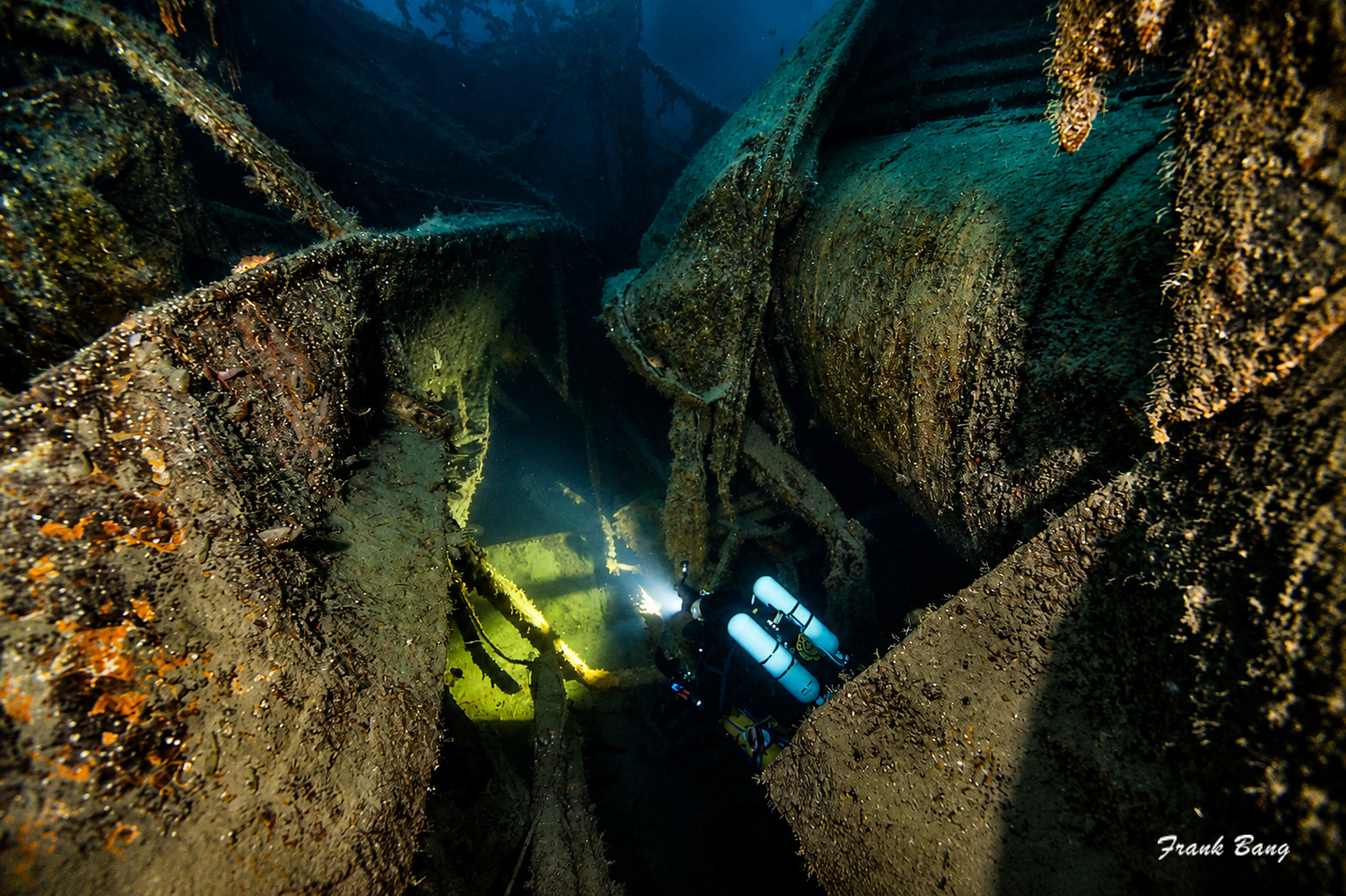
A CCR diver illuminates the catastrophic mine damage beneath Odin's starboard bridge, where heavy steel plating was violently torn apart by the explosion.
Above: The force of the mine blast tore open Odin's starboard deck immediately forward of the bridge, peeling back heavy steel plating as if it were paper. More than 80 years later, the catastrophic damage remains a stark reminder of the violent explosion that doomed the ore carrier in less than two minutes.
Above: A CCR diver peers into the twisted steel wreckage created by the mine blast beneath Odin's starboard bridge. The explosion peeled back massive deck plates and tore open the forward section of the ship, leaving behind one of the wreck's most dramatic and haunting scenes.
Above: The port side of Odin's bridge has collapsed onto the deck below, a victim of the tremendous forces unleashed by the mine explosion. Despite the devastation, the bridge structure remains remarkably well preserved in the cold Arctic waters outside Narvik Harbor.
Above: Looking forward from the port side of the bridge, twisted railings and collapsed deck plating reveal the immense violence of Odin's final moments.
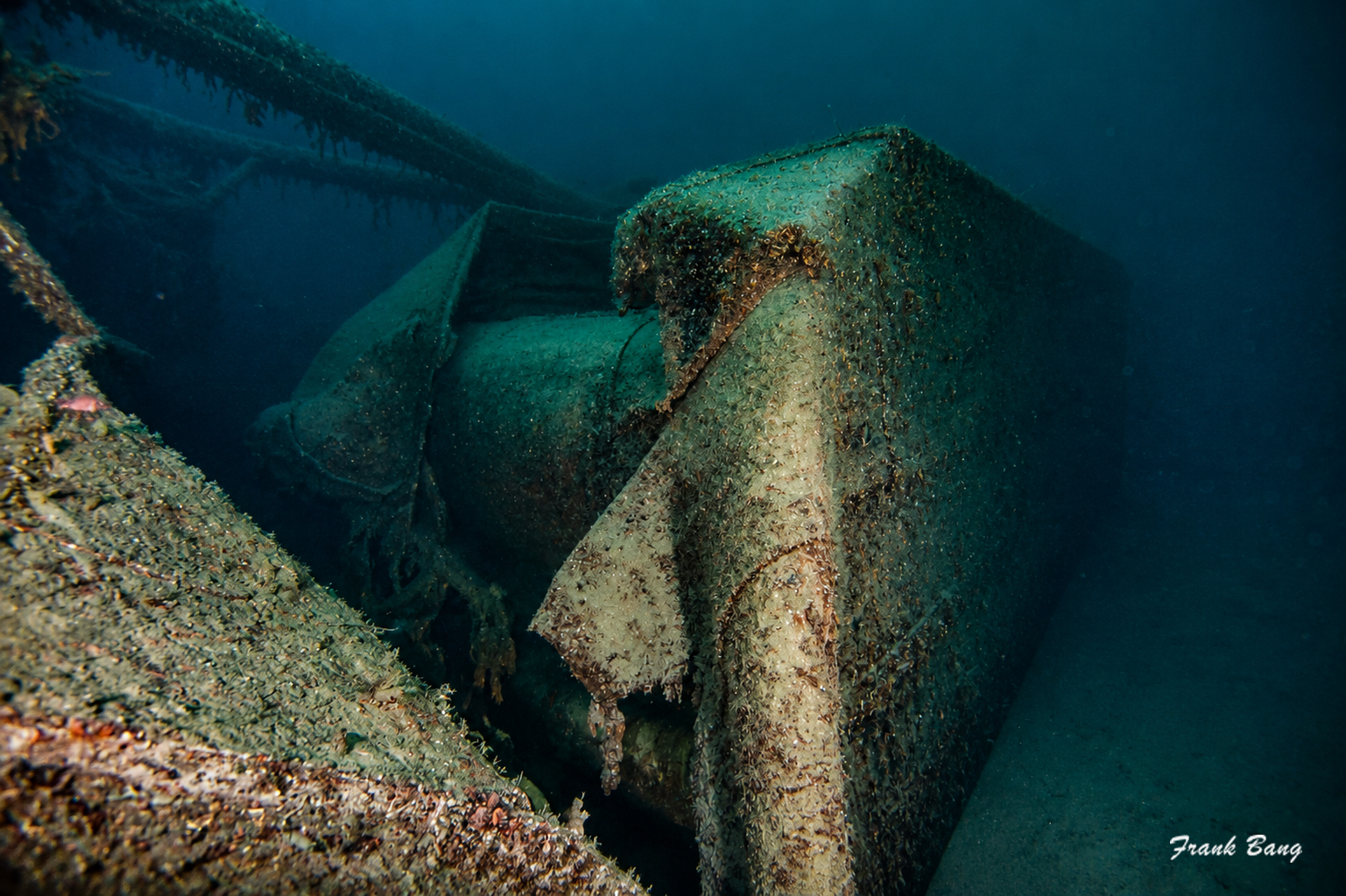
Above: Mounted above Odin's spare four-bladed bronze propeller, the quadruple 20 mm (0.79-inch) Flak anti-aircraft gun remains one of the wreck's most recognizable features. Manned by a Luftwaffe Flak detachment, it provided close-range defense against Allied aircraft.
Above: Silent sentinels of Odin's final voyage, the quadruple 20 mm Flak mount and spare bronze propeller remain exactly where they were on 9 May 1944. Together they tell the story of a merchant ship transformed by war and lost beneath the waters of Narvik Harbor.
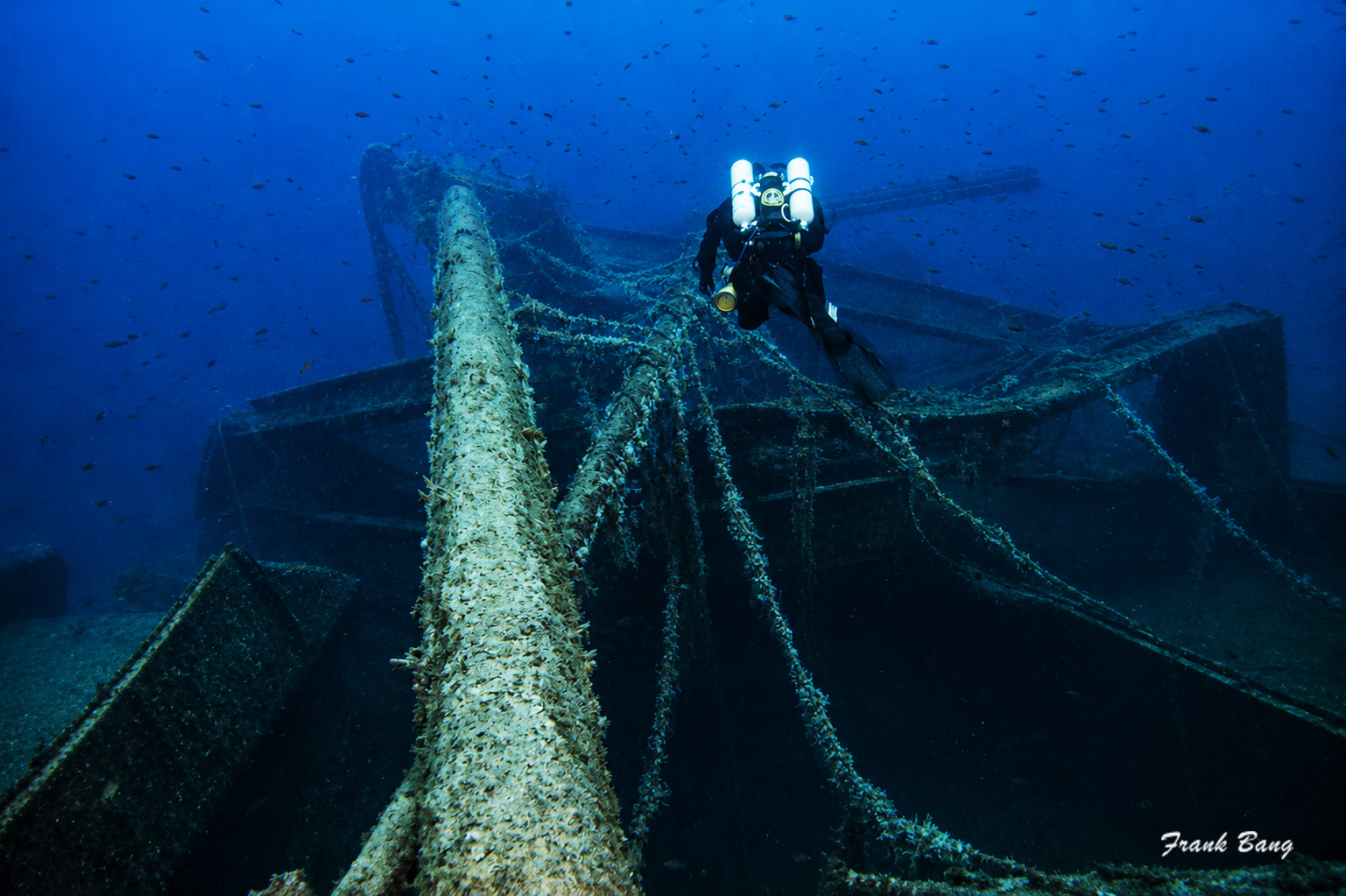
Above: A CCR diver explores Odin's fallen forward mast as it stretches across the open cargo hold toward the bridge. In the distance lies the catastrophic damage caused by the mine blast that tore through the ship's starboard side, sending the 431-foot (131.38-meter) ore carrier to the bottom.
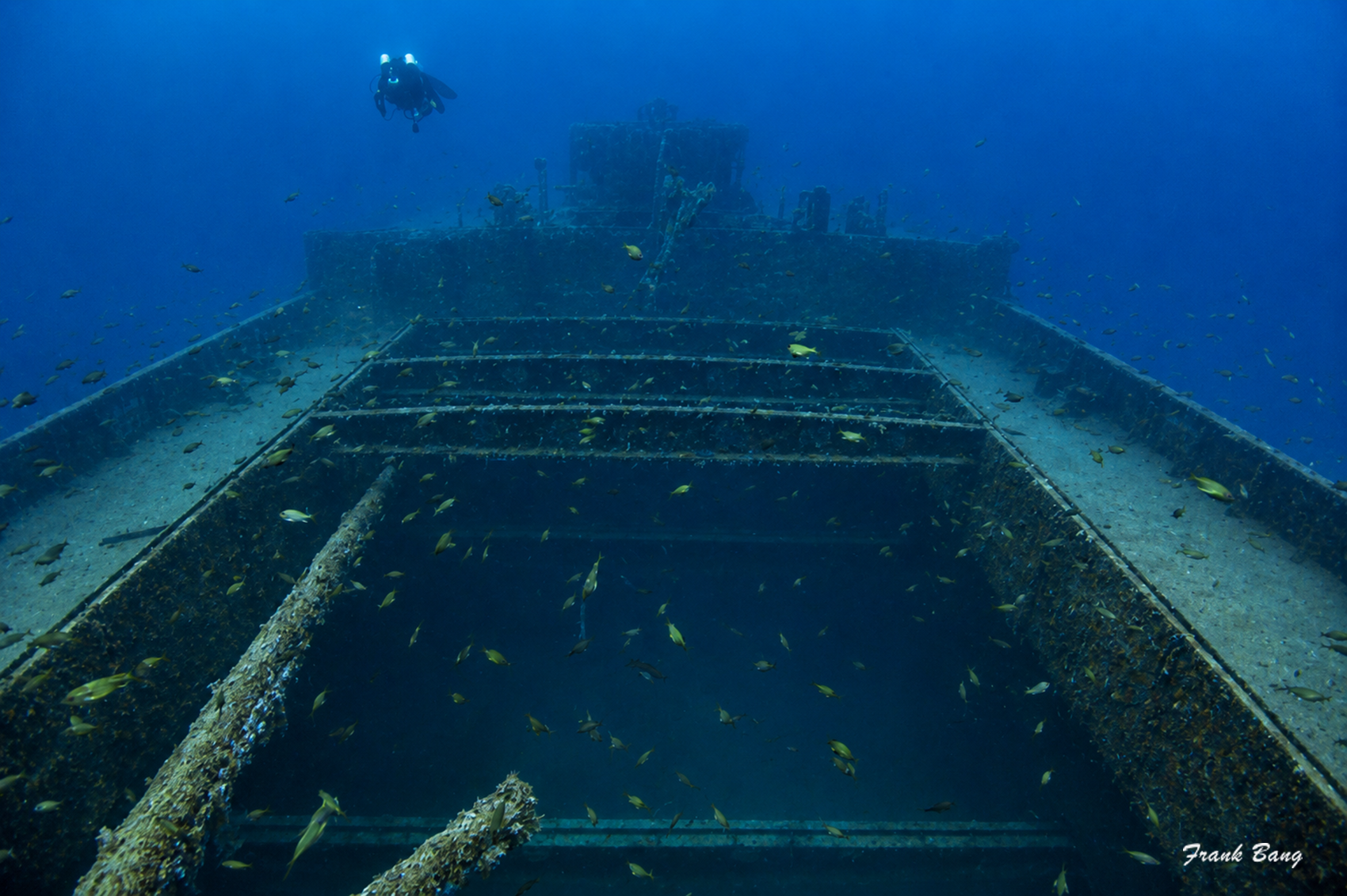
Above: A CCR diver hovers above Odin's massive forward cargo hold, offering a sense of the immense scale of the 431-foot (131.38-meter) ore carrier.
( Click image to Enlarge )
When Germany invaded Norway on 9 April 1940, one small Arctic port became one of the most fiercely contested places in Europe. Nestled at the head of Ofotfjord, Narvik was a quiet community whose importance extended far beyond its modest size. It served as the year-round, ice-free export terminal for the rich iron ore mines of Kiruna, Sweden. Each winter, millions of tons of high-grade ore passed through Narvik, providing Germany with the raw material needed to manufacture tanks, warships, artillery, and ammunition. Whoever controlled Narvik controlled one of the most valuable supply routes of the Second World War.
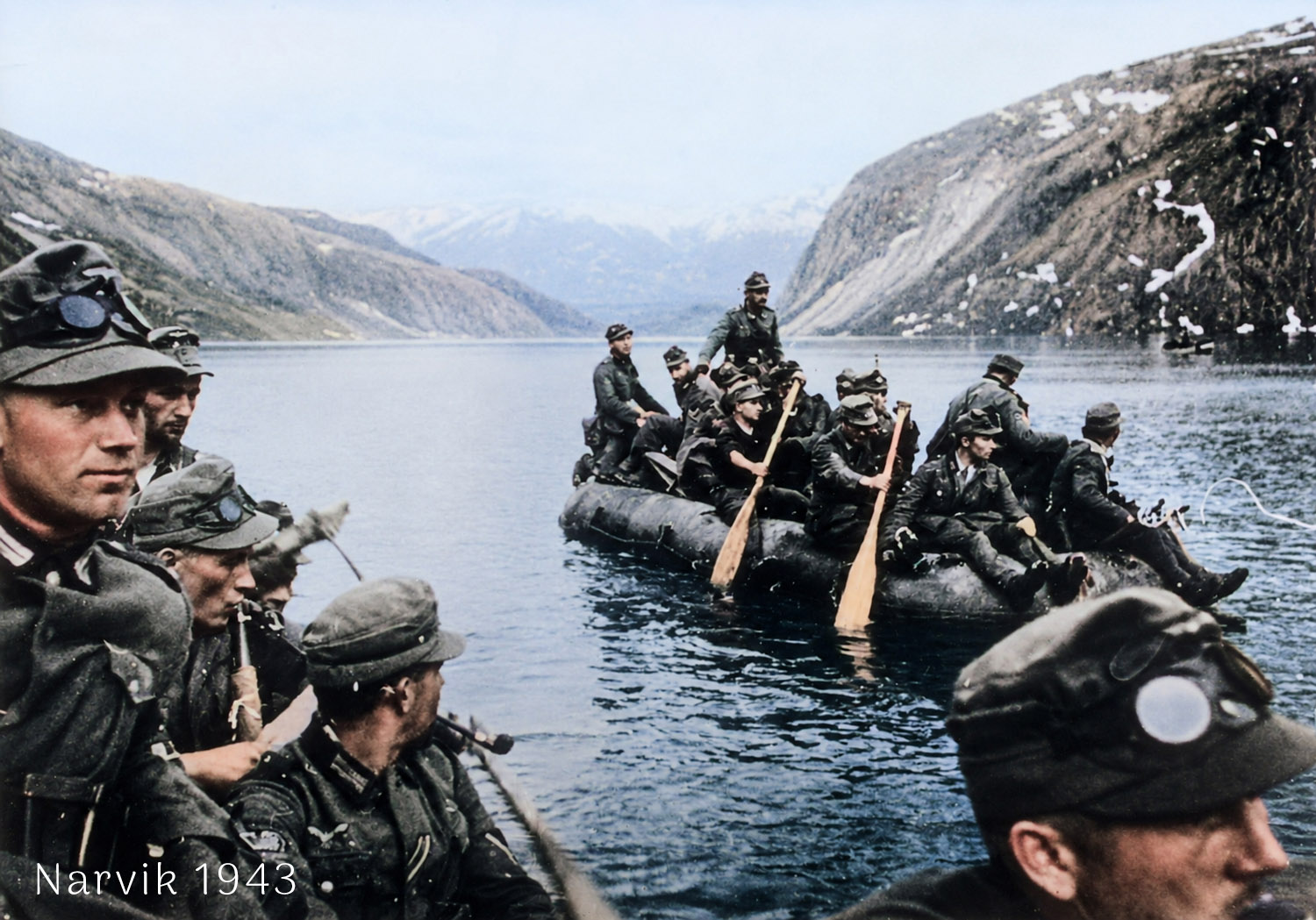
Germany's assault on the town formed part of Operation Weserübung, the invasion of Norway and Denmark. Before dawn on 9 April 1940, ten German destroyers silently entered Ofotfjord carrying approximately 2,000 elite Gebirgsjäger, or mountain troops, commanded by General Eduard Dietl. As the ships approached Narvik, the Norwegian coastal defense ships Eidsvold and Norge attempted to resist. Both aging warships were quickly sunk after refusing German demands to surrender, marking the beginning of one of the most dramatic naval campaigns of the war.
Within hours, German forces occupied Narvik, securing the harbor, railway, and surrounding military installations. Yet the victory proved short-lived. The Royal Navy responded almost immediately, launching two fierce attacks into the fjord. During the First Naval Battle of Narvik on 10 April and the Second Naval Battle on 13 April, British destroyers and the battleship HMS Warspite systematically destroyed all ten German destroyers trapped within the narrow fjords. Although the German fleet was annihilated, Dietl's soldiers remained ashore, isolated but determined to hold their ground.
Over the following weeks, British, French, Polish, and Norwegian forces mounted an aggressive counteroffensive through the snow-covered mountains surrounding Narvik. Fighting occurred under brutal Arctic conditions, with deep snow, freezing temperatures, and rugged terrain making every advance difficult. On 28 May 1940, Allied forces succeeded in recapturing Narvik, marking one of Hitler's first significant battlefield defeats. For a brief moment, it appeared Germany had lost one of its most valuable strategic prizes.
Events unfolding farther south soon changed the course of the campaign. Germany's invasion of France and the Low Countries demanded the immediate attention of Britain and France. Allied leaders reluctantly decided to withdraw their forces from Norway to reinforce the rapidly collapsing Western Front. During Operation Alphabet, Allied troops evacuated Narvik between 4 and 8 June 1940. Once they departed, General Dietl's surviving mountain troops reoccupied the town without opposition, beginning nearly five years of German control.
With Narvik firmly in German hands, the occupation shifted from conquest to consolidation. The town became one of the most heavily fortified locations in northern Norway. Thousands of German soldiers were stationed throughout the region to defend the vital iron ore railway connecting Narvik with Sweden and to protect the strategically important Ofotfjord. Coastal artillery batteries were installed along the fjords, anti-aircraft guns guarded the harbor, and an extensive network of bunkers, observation posts, tunnels, and defensive positions spread across the surrounding mountains.
German engineers transformed the landscape. Massive concrete fortifications appeared overlooking the sea, while roads, ammunition depots, and military barracks expanded around the town. The occupation relied heavily on prisoners of war and forced laborers from across occupied Europe, many of whom endured harsh conditions while constructing military infrastructure. These laborers built roads, fortifications, and defensive positions that can still be found scattered throughout the region today.
Although Narvik remained under firm military control, resistance never disappeared. Norwegian civilians secretly gathered intelligence for the Allies, monitored German naval movements, and helped refugees escape across the nearby Swedish border. Information flowing out of Narvik became increasingly valuable as German naval operations expanded across the North Atlantic. Acts of sabotage and quiet defiance reminded the occupiers that, despite their overwhelming military presence, they never fully controlled the spirit of the local population.
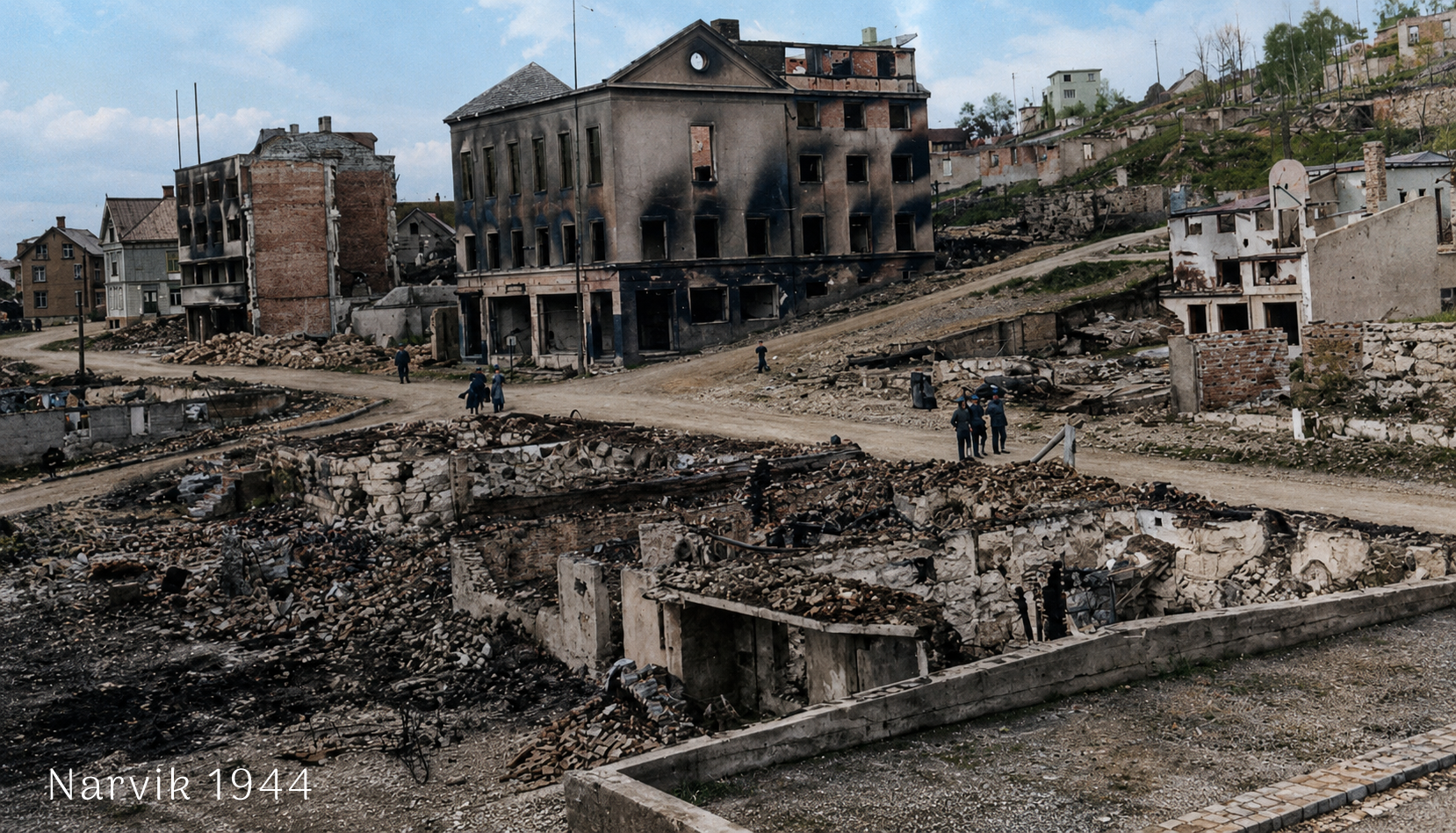
Throughout the occupation, Narvik also served as an important logistical center for German naval activity in northern waters. Warships, supply vessels, and merchant ships regularly anchored within the sheltered fjords, while convoys transported iron ore and military supplies essential to Germany's war effort. Constant vigilance against Allied air raids and naval attacks remained a daily reality, although the town avoided the widespread destruction experienced by many European cities later in the war.
As Germany's fortunes declined after 1943, Narvik's strategic importance remained unchanged. The defenses were strengthened further in anticipation of an Allied invasion that never came. Despite growing shortages of fuel, equipment, and experienced personnel, German forces continued to occupy the region until Germany's unconditional surrender on 8 May 1945. Unlike many cities across Europe, Narvik was liberated without large-scale urban combat during the final days of the war.
Today, the waters surrounding Narvik preserve one of the world's most remarkable underwater battlefields. The destroyers sunk during the naval battles of April 1940 remain largely intact beneath the cold Arctic waters, attracting divers from around the globe. Above the surface, abandoned bunkers, gun emplacements, and military tunnels still overlook the fjords, silent reminders of the years when this remote Norwegian town stood at the center of one of the Second World War's most important strategic struggles. Narvik's history is not only one of occupation and conflict but also of resilience, where the landscape and the sea continue to tell the story of a battle that shaped the course of the war in northern Europe.




 By the spring of 1944, four years had passed since German forces had recaptured Narvik from the Allies and resumed the export of Swedish iron ore. Nearly every ton shipped through the port was now destined for Germany's wartime steel mills and weapons factories.