 |
|
|
|
|
 |
|
| 4 Hands 2 Brains |
|
by: Curt Bowen |
|
|
| Let's face it, often dives that begin with a buddy become a solo dive before they are over. Accidental separation due to low visibility, miscommunication of the dive plan or just not paying attention to each other may force buddies to end their dive alone. |
|
|
 |
|
| Artifact Preservation - Bones |
|
by: Curt Bowen |
|
|
| Not all desired artifacts are man made. Prehistoric remains of mammals, reptiles and fishes are often found in silt mounds, rock layers, caves and ocean floor sediments. These fossils can either be rock hard or, if trapped in the soft clay layers, extremely fragile. |
|
|
 |
|
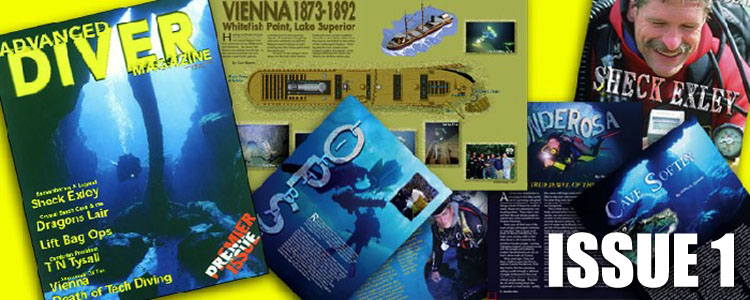
| Cave Softly |
|
by: Shelly Orlowski |
|
|
| As divers, we have all seen the beauty of the under-water world. It is this beauty that draws most divers to go under water in the first place. Jacques-Yves Cousteau and National Geographic specials brought the underwater world of coral reef and colorful fishes into our homes and beckoned us to come and see for ourselves. Some divers become bored with all of the 'pretty fishes.' They search for other underwater mysteries - caverns, caves and wrecks - that offer new challenges. I was bored with the 'pretty fishes' to start with. It was the first video I saw of cave diving that drew me in, with its pristine limestone formations and tunnels eroded bit by bit over millions of years. |
|
|
 |
|
| The Death of Technical Diving |
|
by: Jarrod Jablonski |
|
|
| Change can come so quickly that sometimes it goes unnoticed. Many divers can remember that, in the not too distant past, groups like PADI marshaled to ban technical diving from the scuba industry's largest annual trade show. And diving leaders were outspoken against it, like SkinDiver editor Bill Gleason who led the charge, claiming that Enriched Air Nitrox was Snake Oil. Well, times are changing. Even PADI, a true bastion of recreational training, has an enriched air program. And agencies like NAUI are tugging hard on the purse strings of technical diving. NAUI is going full speed ahead with rebreather, deep air, and trimix training. It does not take a soothsayer to imagine a time when most recreational organizations will cross the technical frontier. This recent change of heart by recreational organizations leads one to ponder these rapidly changing times. |
|
|
 |
|
| Dragons Lair - Crystal Beach Cave |
|
by: Michael & Sherry Garman |
|
|
| There it sat, just over 2,000 feet from the entrance. A virgin tunnel waiting to be explored. The original explorers of the cave system, Brett Hemphill and Rudy Sturm, had taken a quick peek into the tunnel. They had seen a white layer in the water that resembled the hydrogen sulfide-rich waters commonly encountered in many stagnant, water-filled sinkholes. Therefore, they considered this side tunnel a dead end and continued their exploration forward along the main line. |
|
|
 |
|
| Liftbag Ops |
|
by: Curt Bowen |
|
|
| Lifting objects off the bottom may seem simple, but there are always risks involved. A heavy artifact can be sent plummeting back to the bottom if a line should break or come loose. At the same time the lift bag will shoot to the surface clearing a path of divers or equipment that may be in the way. Divers should never position themselves anywhere in the water column, above or below an object being lifted! Lines and clips can easily entangle a careless diver causing serious injury or death. And controlling the buoyancy of the bag during ascent is imperative. If air is not vented, it will expand as it is brought to the surface and can get out of control. If too much air is vented, the object can be sent back down. |
|
|
 |
|
| One Hand Numbering |
|
by: Curt Bowen |
|
|
| Decompression time, depth, cylinder pressure are all examples of underwater communications that require numbers. Many times a diver has only one hand available because his other hand is busy with extra equipment, cameras, jon line etc. A system was needed that allowed quick number communications between divers using only one hand. Below is the one hand number communication system use by many cave and wreck explorers. |
|
|
 |
|
| Ponderosa |
|
by: Nancy DeRosa |
|
|
| A unique new destination is emerging in the dive world, and it is growing with great excitement and passion. Instead of taking a boat off shore to a wall or wreck, these new adventurers are traveling inland. They ride in cars and hike through dense jungle to explore the cavern systems of the Yucatan Peninsula. |
|
|
 |
|
| Remembering Sheck Exley |
|
by: Jim Bowden |
|
|
| Mexico, April 6, 1994. Sheck Exley, my mentor and friend, and I were prepared to dive deeper than anyone has ever dived independent of submarines or commercial habitats. Sheck never returned. |
|
|
 |
|
| Submarine Coast |
|
by: Stephen Brady |
|
|
| Newport Rhode Island is well known for its white sandy beaches, yacht races, jazz festivals and enormous homes. Countless novels have captured its extraordinary past, from a small resort town to the booming prosperity of the Gilded Age. Famous local boy, Oliver Hazard Perry commanded his US troops at the Battle of Lake Erie and left us with the now famous quote, 'We have met the enemy and they are ours.' Jackie and John F. Kennedy were married in Newport and he used Hammersmith Farm as his summer White House. The history and magic of this town is well known, but its hidden secret is the history and intrigue which lies beneath the surface of its waters. These are the stories of the wrecks and their dives. |
|
|
 |
|
|
|
|
| Terrence is a true leader with the drive and ability to get the job done. Always full of energy and enthusiasm, he is continuously gathering divers, boat captains and broadcast companies for research explorations around the globe. Working side by side with government officials, he is a ready guardian for our ocean environment. |
|
|
 |
|
| Vienna - Lake Superior |
|
by: Curt Bowen |
|
|
| Heading northwest towards Whitefish Point, the 191-foot vessel Nipigon had two schooners in tow, Melbourne and Delaware. Up ahead, the Vienna was sailing towards her. As the distance between the two vessels closed both captains sounded port-to-port passing signals. All seemed to be going well when suddenly the 626-ton Nipigon veered sharply to port crashing into the Vienna just behind the pilothouse. |
|
|
|
|
